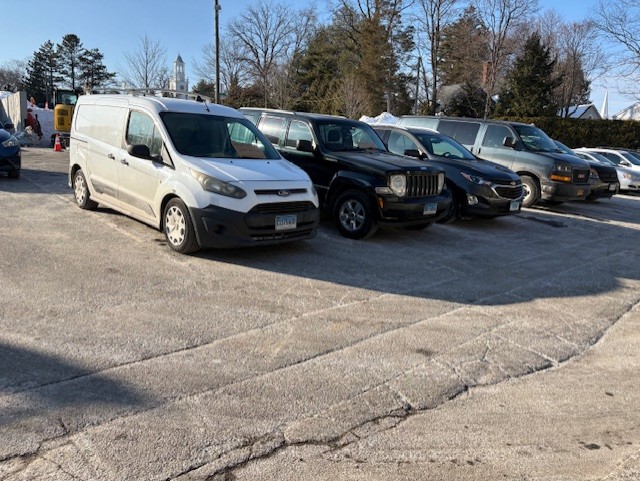
The Parking Commission at its most recent meeting upheld a $30 ticket issued to a woman who claimed that she was actually doing a good deed when she failed to pay for parking in downtown New Canaan.
Anne Nesbitt told members of the appointed body during her Oct. 7 appeal hearing that didn’t understand the free three-hour “upper lot” behind Elm Street was the one at the highest grade, known locally as the “Park Street Lot.”
Instead, Nesbitt—a Weston resident—parked in the Playhouse Lot (facing a payment kiosk) thinking it was free.
What’s more, according to Nesbitt, she only parked there because she could see someone with a cane—described at other points during her hearing as multiple people with canes—walking in the Park Street Lot, and believed that she would be doing a good deed by leaving those spaces to people with mobility challenges, because there was a stairway there down to Elm Street. (Note: There’s also a stairway and ADA-compliant ramp for disabled people next to the Playhouse Lot.)
“I saw people with a cane walking down those stairs and so I really just thought you know, I’m a senior but I have really good mobility and what the heck it’s a nice day, I’ll park in the one that’s farthest from the stops because then that will make it easier for somebody else,” Nesbitt said during the Commission’s meeting, held at Town Hall and via videoconference.
She continued: “Because I saw that there were spaces there, and I just was feeling that I could just do my part to make somebody’s day a little easier. So that’s why when I got back into my car and I saw that there was a sticker, I was like ‘What?’ I was really surprised and I thought, oh gosh, here I was trying to do something good and then I ended up getting a ticket and I am always very careful about where I park, almost obsessive about it.”
Nesbitt went on to say that she’d parked in the free Town Hall Lot while visiting the Town Hall Annex building, and wanted to move her car in order to visit Elm Street. She consulted with someone from the Department of Human Services, who directed her to the free “upper” lot.
Asked about how clear she was on those instructions, Nesbitt said the woman from Human Services who helped her “wouldn’t have bad intentions to tell me a place to park that wasn’t a place to park.”
Nesbitt continued: “She actually thought, like, that’s very nice, you are going to move your car because now you are not doing town business, you are going to be doing on Elm Street. And so that’s why I figured, OK and then she was helpful to me and I kind of felt I was in a helpful mood, and that’s why I thought I would park in the lot. There were two lots and I thought that I would park in the lot that was farther rather than nearer. I will tell you I had to carry a bunch of bags. I would have preferred parking in that upper space, because I saw there was parking near the stairs.”
Nesbitt noted in her written appeal that she’d been in town volunteering that day (Sept. 10, a Thursday).
The practice of paying to park in a lot goes back about 100 years in the United States.
During the hearing, members of the Commission noted that there are six signs near where Nesbitt parked clarifying that it was a paid lot, and that her vehicle was in plain sight of the kiosk.
Commissioner John Clarke said, “I appreciate Ms. Nesbitt’s concern and her motivation for the choice of where she parked. I think it’s too bad that she made a mistake.”
Chair Nancy Bemis said, “It sounds to me that she didn’t realize there’s the allée with the ramp and the stairwell goes down to the mid part of Elm Street … which is unfortunate.”
Clarke, Bemis, Secretary Kevin Karl and member Marley Thackray voted to uphold the $30 ticket. Commissioner Katie O’Neill abstained.