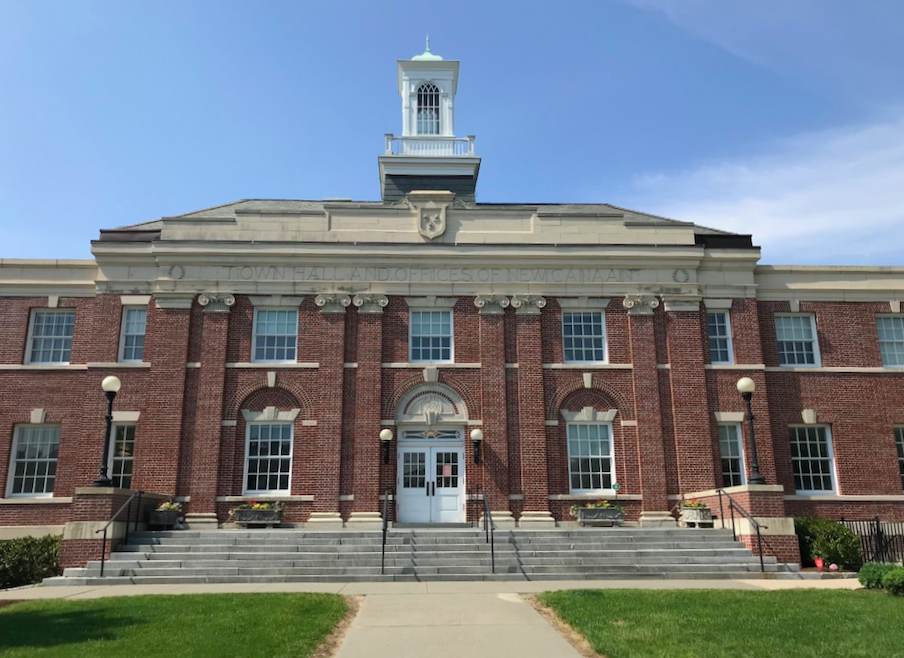
Town officials on Tuesday approved a maintenance contract for the town’s four Combined Heat and Power (CHP) units.
A reason for the approval is that “when the units are running, they save [the town] money,” according to Department of Public Works Senior Engineer Joe Zagarenski.
“They also take power off the grid. They’re greener and work towards the town’s clean energy goals,” Zagarenski told the Board of Selectmen at their regular meeting, held at Town Hall and via videoconference.
CHP systems generate electricity and capture the heat that would otherwise be wasted to provide useful thermal energy, such as steam or hot water, according to the CHP Alliance.
The town has units at the Highway Department, the Wastewater Treatment Facility, the Town Hall, and the Lapham Community Center.
First Selectman Dionna Carlson and Selectmen Steve Karl and Amy Murphy Carroll voted 3-0 in favor of the $36,000 contract ($9,000 for each unit) with New Jersey-based OHA Power LLC. The funds are available under the DPW’s CHP budget, officials said.
The previous company that handled the CHP systems, Massachusetts-based Dalkia Aegis, dissolved its maintenance branch in June and recommended OHA Power, according to Zagarenski.
The units have had an abundance of operational issues in the past, as Carlson said they’ve been running less than 50% of the time, so Carlson clarified that when a unit is not running, the town should not be paying for the service.
Carlson also asked whether all four units are currently working (no), who would pay to fix them (Dalkia Aegis), and when OHA would have them up and running again (once their contract is finalized).
Murphy Carroll asked whether the new price point is what the town was previously paying.
“It started at about 86 cents a year back in 2020,” Zagarenski said. “It’s gone up every year. This contract will go up 10 cents a year, which is in line with what we were paying before.”
Karl asked whether, knowing what they know now, the town would still have installed the units back in 2020.
Zagarenski replied: “We had problems with the maintenance contractor to keep them running, but we’re changing horses now. If they are running, they do save money. They cost about $2.86 to run per hour, and they create 32 kilowatts per hour. We’re getting cheap, clean energy.”