‘New Canaan There & Then’ is sponsored by Brown Harris Stevens Realtors Bettina Hegel, Joanne Santulli and Dawn Sterner.
Philip Cortelyou Johnson had a mischievous, even wicked sense of humor. He once referred to Frank Lloyd Wright, his sometimes friend and forever rival, as “the greatest architect of the 19th century.”
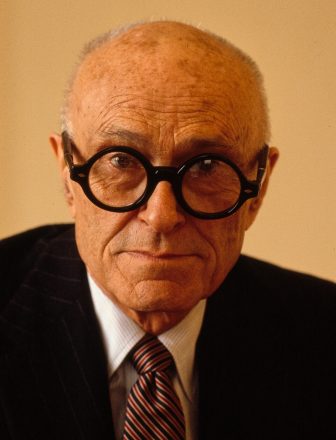
Philip Johnson, 1977. Gotfryd, Bernard, photographer, Public domain, via Wikimedia Commons
Ordinary civilians were also fair game for Johnson. On one memorable occasion he encountered a tour group visiting his Glass House (from “who-knows-where”), a member of which told Johnson she was impressed but in no uncertain terms “would she ever want to live there.” Johnson responded by saying, “Madam . . . I haven’t invited you to do so.”
At times he could even be self-deprecating, as when he joked that he didn’t know how to build a comfortable residence, remarking, “Don’t build a glass house if you’re worried about saving money on heating.”
That Glass House was, of course, Johnson’s opus, built in 1949 as the first building constructed on what would become a 49-acre architectural and fine arts campus on Ponus Ridge, and featuring 14 separate structures designed by Johnson. A young Paul Goldberger, the author and long-time architectural critic for the New York Times, celebrated the Glass House’s 25th anniversary in 1974:
“The Glass House is the building which architects and non-architects alike associate with Johnson most quickly, and it remains not only an extraordinary building in and of itself but as effective a key to his way of thinking about and making architecture at it was when it was built.”
Like all of the great houses architects have designed for themselves, Johnson’s building in New Canaan had a function far more subtle than that of a proving ground for new ideas. Instead of trying to produce something altogether new (which it was), Johnson took the Miesian approach [referring to modernist pioneer Ludwig Mies van der Rohe] and continually refined it, not broadcasting but narrowing the scope until he had what could consider a perfect object.
The result was a glass box, 56 feet long, with furniture groupings defining the use areas. There are no partitions; only a round brick cylinder containing a bathroom rises to the ceiling.
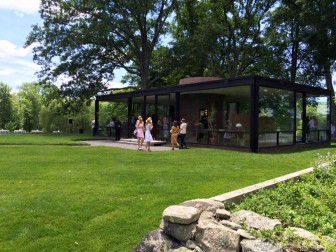
From the Glass House Summer Party on June 13, 2015. Credit: Michael Dinan
From inside, the carefully manicured landscape visible through the glass functions as an enclosure, and the ironic illusion is superb. The vistas tell the occupant he is open to the whole world, while in truth there is no world outside at all – just an elegantly arranged landscape that is as much a part of the house as the furniture. The ‘real world’ toward which the walls of glass beckon is far away and invisible.”
Goldberger’s focus on landscape was appropriate. In a wide-ranging interview with Hilary Lewis, the former Chief Curator and Creative Director of The Glass House, she confirmed Johnson’s profound interest in the outdoor artform. “Landscape is architecture,” Johnson would say simply, and regularly.
Johnson loved the white oak shade and pine trees, the tall grass, the open fields, and the rambling stone walls. Properly curated of course. Indeed, by the time Johnson and his long-time partner David Whitney were done with the campus, there were 11 separate carefully planned vistas (Johnson referred to these architectural experiments as “follies”) amongst the perfect pond, woodland and fields.
***
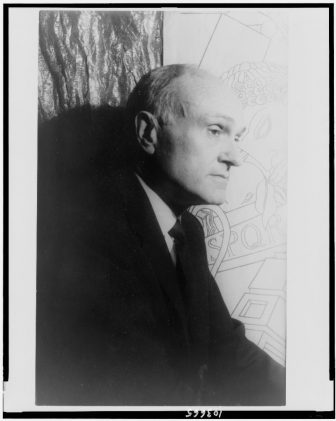
Philip Johnson. Carl Van Vechten, Public domain, via Wikimedia Commons
On Wednesday, Nov. 21, 1945, the day before Thanksgiving, Johnson, his beloved sister Theodate, and Pamela Gores, the wife of his young Harvard protégé Landis Gores, set out for a drive. After stopping in Bedford Hills, New York to view a weekend house that Johnson was building for a client (known today as the Booth House) and lunch at a diner in Mount Kisco, the three travelers crossed the border into Connecticut.
According to biographer Mark Lamster, they stopped at “an unlikely point along a broken stone wall in New Canaan. They climbed through it, then wandered down a long grassy slope to a flat meadow with large boulders fronting a precipitous drop. The view to the west stretched out over the woods.” It was at this point that Johnson shared with his companions the fact that he had recently gone under contract to purchase the first five acres of what became The Glass House.
Why New Canaan? An earlier biographer, Franz Schulze, offered that:
“Having long since sold his [first home] bandbox in Cambridge, Massachusetts, he decided that his next abode should be designed at an appropriately more ambitious level. Hence his interest in New Canaan, a handsome Connecticut town suburban to New York, dominated by well-heeled Establishment types, socially of his own kind though culturally far more conservative. Two architects of his acquaintance, Marcel Breuer and Eliot Noyes [together with Johnson, Gores and John Johansen the so-called “Harvard Five], had recently moved there, and they were both fellow professionals, fundamentally modernist in their tastes.”
The fact that New Canaan was in Connecticut rather than the state of New York certainly did not go unnoticed by Johnson; in late 1945 he had sat for the latter’s license examinations and had “flunked them cold.” Connecticut had no such licensing requirements for an architect.
***
Johnson loved his Glass House, and he loved New Canaan. To Johnson, New Canaan was “country living” and he expected his guests to conform to that standard. Lewis – who prior to her official position at the Glass House served as Johnson’s last de facto chief of staff – described her first visit to Ponus Ridge. “I was wearing a suit and a Hermes scarf and he asked me why I was all dressed up,” she said. “You’re in the country!” exclaimed her boss.
Despite what Johnson might have planned in 1945, The Glass House became his primary residence and not simply a weekend retreat. He lived there for 56 years. This didn’t preclude regular trips to New York City (via Hoyt Limousine), including lunch at the legendary Four Seasons restaurant (table 32 in the exclusive Grill Room) which he designed. Lunches in New Canaan were simpler. “He and David loved to eat at the Blue Water Grill in town [today the restaurant Uncorked],” Lewis recalled. “He invariably had tuna salad.”
Philip Johnson was as controversial a figure as he was influential, often exhibiting internal inconsistencies in his life and profession that stressed both his admirers and critics, sometimes to no end. Through his self-described International Style he was hugely pivotal in introducing modernist architecture to America, but he later broke away from its strict principles to champion postmodernism, most notably seen in his AT&T building with its “Chippendale” roof. And while he pursued questionable politics in his early years (we could have done without his 1933 essay “Architecture in the Third Reich”), he was one of the first gay icons of the 20th century.
Regardless . . .
Picture yourself as a guest in The Glass House on a frigid Friday evening in January, 1964. The house is ablaze with light, befitting the party atmosphere. You’re lucky enough to have secured one of the west-facing Miesian Barcelona chairs that Johnson moved from his Turtle Bay apartment in the city, along with most of his other furniture. Besides Johnson and David Whitney, Andy Warhol is there, as well as Blanchette Rockefeller, for whom Johnson designed a guest house in the city a decade earlier. Composer John Cage and his partner choreographer Merce Cunnigham are expected shortly.
Whitney asks if anyone is “ready to slip into a dry martini” and receives several enthusiastic thumbs up save for Warhol, who begs off for his usual Jack Daniels on the rocks. You are in the majority; you’d been warned earlier that The Glass House could be a bit drafty, despite the brick fireplace and radiant hot water heat system in the floor, and the thought is that the stiff drink might warm you up.
For kicks, Whitney has nabbed one of the new Singer portable transistorized phonographs from a friend, and he chooses several jazz favorites to play quietly as background music, including Stan Getz’s “Big Bear” and Billie Holiday’s “Fine and Mellow.” The conversation is everything you thought it would be: sophisticated, intriguing and entirely entertaining.
And then the snow starts, barely discernable at first. As the flakes softly intensify Whitney gets up to turn off the music and lights and you are . . . transported. Amidst the deep peaceful hush you are thoroughly immersed in the winter landscape that Johnson’s “very expensive wallpaper” of glass has provided for himself and his guests.
Country living at its finest.
Great story Nick! Informative, historical, evocative and unique to New Canaan. Always enjoying Friday’s There & Then – thanks.
Nick, for an M&A lawyer you’re a pretty darned good writer. Thanks for this addition to your fine string of stories.
Wonderful article and photos! New Canaan is so lucky to have the Glass House campus! Both Philip Johnson and Marcel Breuer were enthusiastic Democrats….. Johnson always provided an original piece of art from his collection to our annual White Elephant Sale, Marcel Breuer invited us in for coffee when we were collecting door to door for local Democrats. We are fortunate to have living memories of them both, as well as so many other special architects who lived in Town and contributed to the wealth of ‘moderns’ in our community.
Fantastic writing! A paint a beautiful picture of mood and atmosphere.