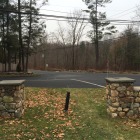
Weed Street Neighbor on Final Piece of Proposed Public Footpath: Keep It on Land Trust Property

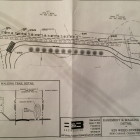
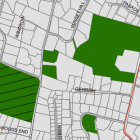
New Canaan homeowners whose properties abut a proposed public footpath off of Weed Street are calling for town officials to condition approval of a subdivision connected to the would-be walkway on making sure it’s inconspicuous and appropriately maintained. It isn’t clear just how the New Canaan Land Trust intends to get hikers out of the woods and across a wetlands-laden parcel that the nonprofit organization owns just north of a driveway at 929 Weed St. As part of a proposed subdivision of that 9-acre lot now before the Planning & Zoning Commission, a strip of land has been set aside that ultimately would connect the Land Trust’s property, which fronts Weed Street, through the woods and back to the New Canaan Nature Center. The grand vision is for a public “greenway” that embraces some principles of the recently updated Plan of Conservation and Development. Specifically, under this vision, pedestrians would be able to complete a loop from downtown New Canaan—say, up Oenoke and through the Nature Center, then out by way of the Land Trust property on Weed and then to Irwin Park and by way of a future sidewalk to the top of Elm Street, back downtown again.

Boy Scout Project Improves Access to Land Trust Parcel

By Mark Peiser

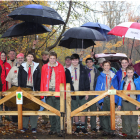
A Boy Scout Eagle Project, completed in October, now provides improved access to the New Canaan Land Trust’s Colhoun Parcel. The project includes a safer entrance gate and a designated parking area, making it easier for members of the community to access the parcel. Gifted in 1974 by Dick and Didi Colhoun, the parcel is located on Davenport Ridge Road, just west of Skyview Lane, and is the New Canaan Land Trust’s third largest with 21 acres of undisturbed woodlands and meadows. Chris Schipper, president of the Land Trust, said, “The Colhoun Parcel is a key part of the Land Trust’s ‘Gateways of New Canaan’ Stewardship Program. At the crossroads of New Canaan and Stamford, Colhoun is a lead parcel for our Gateways program.

Officials to Neighbors Concerned about Proposed ‘Greenway’: ‘There Is No Back Door to Crossing the Wetlands’

Concerned that a proposed 3-lot subdivision on Weed Street—and, separately but related, a planned public footpath that’s part of what open space advocates envision for the site—could negatively impact wetlands and aesthetics in the area, neighbors on Monday night urged officials at a public hearing to proceed carefully with approvals. Strictly speaking, the only proposal before the Inland Wetlands Commission now is for a moderately expanded driveway into the 9-acre lot just north of the intersection at Wahackme (and on the east side of Weed), beneath which new utility lines would be installed, for the two additional lots. That said, the overall site plan—which will require its own applications and hearings—calls for subdivision of the lot , as well as a conservation easement for a strip of land that open space advocates including the New Canaan Land Trust would like to use in order to create a new walk-able trail from the Nature Center to Weed Street in the area of Irwin Park. One neighbor on Weed Street, Dan Radman, told the commission during Monday’s hearing that he wanted “to be sure that if there is an approval to make, it is not the domino effect that it is already the first stepping stone into ‘understood subdivision’ and ‘understood pathway,’ which it should not be.”

Commission Secretary George Blauvelt assured him: “There is no back door into crossing the wetlands.”

“When they [members of the Land Trust] get to a point where they are actually ready to begin the approval process, they will have to come back to this commission and they will have to submit plans,” Blauvelt said at the public hearing, held in the Sturgess Room at the New Canaan Nature Center. “And the public will be invited to hear them and they will have to make their case as to why, if in fact their plans require crossing wetlands, why it would be a good thing, and it would be another opportunity for everyone to take a look.”

Ultimately, the commission decided not to take action on the driveway application, for two main reasons.

On Ponus, a Family’s Barn Restoration Project That’s Benefitting the Larger New Canaan Community

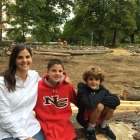
From the start, the antique barn out back drew the Larsons to the 2-acre Ponus Ridge property and Colonial home they moved into 18 months ago. In plain view at the bottom of a hill that runs toward the rear property line, the red, cupola-topped ca. 1910 structure not only graced the tree-lined view but also had potential for practical use for the active family which includes three boys and is headed by a Midwest native dad who grew up on a sheep ranch and mom from Dallas. When last winter’s snowfall took a massive toll on the structurally deteriorating barn—the roof began to sag, on the verge of collapse—the Larsons conceived of one way they might pull together the wood to restore it, namely, by seeing whether any of the dead or dying trees already surrounding their new home could be used. “It’s been fascinating for all of us and exciting for all of us,” Kristina Larson said on a recent afternoon as she stood about halfway down the hill, near five piles of wood that had been salvaged from the carefully dismantled barn.

Open Space Advocates, Preservationists Eye 4.43-Acre Property with ca. 1750 Home That May Soon Hit the Market

The owner of a ca. 1750 home on 4.43 acres on upper Valley Road says that the structure may soon go on the market—a noteworthy prospect for historic preservationists as well as the New Canaan Land Trust, which owns and maintains walking trails on an abutting property that also fronts the Grupes Reservoir. The first taxing district of Norwalk purchased 1124 Valley Road in February 2006 for $2.25 million, with the idea that it may move to that site an inconspicuous treatment plant now located near Silver Hill Hospital, according to James Fulton, the district’s attorney and owner of the parcel, as trustee. “We bought it and over the years, the more we considered it, we decided it probably wouldn’t be cost-effective to use it as part of the utility operation, which is why for years we’ve rented it out to residential tenants,” Fulton said. Though the district hasn’t made any firm decisions, “we are considering marketing the property for sale,” he added.