
Last week it emerged that, after his four-year crusade for affordable housing at Weed and Elm streets, developer Arnold Karp has cooked up an alternative set of plans to build a 62-condo building that will contain precisely zero affordable units. Three neighbors currently serve as holdouts, refusing to greenlight this version of the project. If these neighbors capitulate, the 62-unit, market-rate building will move forward. If they don’t, the 30% affordable, 102-unit rental structure whose grimly generic renderings we first laid eyes on in 2022 will be built.
To add to the intimidation tactic of Karp’s op-ed, bulldozers and land-clearing machinery have been active on the lot all week.
I think we’ve all known for some time that this wouldn’t end without an eye-gougingly inappropriate building doing its best to blot out the sun at Weed and Elm streets. The law under which his initial proposal was made, commonly referred to as ‘8-30g,’ is notably pro-developer and anti-civic planning. What we didn’t know, however, was that once Karp submitted the initial 8-30g application in 2022, he opened a set of legal mechanisms that would allow him to build whatever he wanted, affordability be damned, if he’d just manage the legal appeals process doggedly enough, which he has very nearly done.
You know who knew what we didn’t? Arnold Karp. That’s because Tim Hollister, his land-use attorney, helped write 8-30g in the first place, back in 1989.
Coincidence? Ha.
A refresher timeline
In 2017, the big yellow house on a 3.1-acre lot at the corner of Weed and Elm streets sold for $3,975,000 to an LLC headed by Arnold Karp. It sat quiet for a few years—maybe there were renters? I forget. Karp said he wanted to build senior housing there, but that plan never materialized. During the time between Karp’s purchase of the site and the initial affordable housing proposal, the town’s eligibility for a moratorium from 8-30g, a temporary four-year period during which a town can reject development proposals that don’t fit local zoning laws, lapsed.
Karp is a former New Canaan resident and the owner of several New Canaan properties; this was not his first rodeo. Before this time, he’d jammed several irons into New Canaan’s fire, including providing construction services to the YMCA, restoration of a Greek Revival house on God’s Acre in partnership with This Old House, and construction of a 99-unit, looming gray clapboard structure at Park and Mead streets called ‘The Vue.’
Fast forward, pandemically, to 2022, and fly with the crow back to Weed and Elm. Karp submits an application for a building so laughably wrong for this residential corner that you can hear, I swear, the sound of lower mandibles hitting various flooring surfaces throughout town: 102 units, five stories. A least-common-denominator architectural style favored by shiny-suited hucksters the land over, from Framingham to Fresno. I like to call it ‘Hampton Inn Vernacular’ because it’s a style so nondescript, you genuinely can’t tell whether the spaces therein sell for $4.5 million or go for $219 a night with your AAA discount.
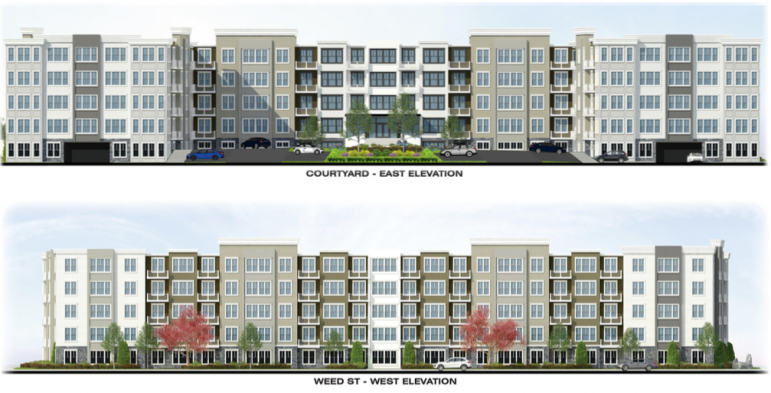
Unclear if there’s a waffle iron at the breakfast buffet. Proposed development at Weed and Elm. Specs by The Eisen Group
Filling nearly every inch of the 3.1-acre parcel with either structure or paving, this was the kind of proposal that Planning & Zoning Commissions were designed to bat out of the air like a cat with a moth. But Karp and his team had the golden ticket: 30% of the building’s units were designated as affordable, at least for the next 40 years. Thus, because of a 30-year-old law, P&Z couldn’t meaningfully touch it.
A brief detour into the law
To those unfamiliar (although at this point, who is?), 8-30g is a Connecticut state law that effectively strips suburban towns of their normal zoning authority if less than 10% of their housing stock is deed-restricted as “affordable.” When a developer proposes a project with as few as 30% affordable units, the town, essentially, can’t say no. The burden flips entirely onto the municipality to prove a specific health or safety threat, not just that the project is too big, too dense, or wrong for the neighborhood. In practice, this means that a developer can carpetbag straight into a town like New Canaan with a monstrosity of a complex that obliterates setbacks, ignores density limits, and overwhelms local infrastructure. P&Z is utterly powerless to stop it unless it can clear an impossibly high legal bar.
Context is helpful here. Against that 10% benchmark, among comparable Fairfield County towns, New Canaan is in the middle of the pack, with 3.93% of our housing stock deeded as affordable. The Housing Authority’s 2024 purchase of The Avalon apartments was, in my opinion, an excellent solution, using existing buildings to create a town-owned equitable housing option in New Canaan.
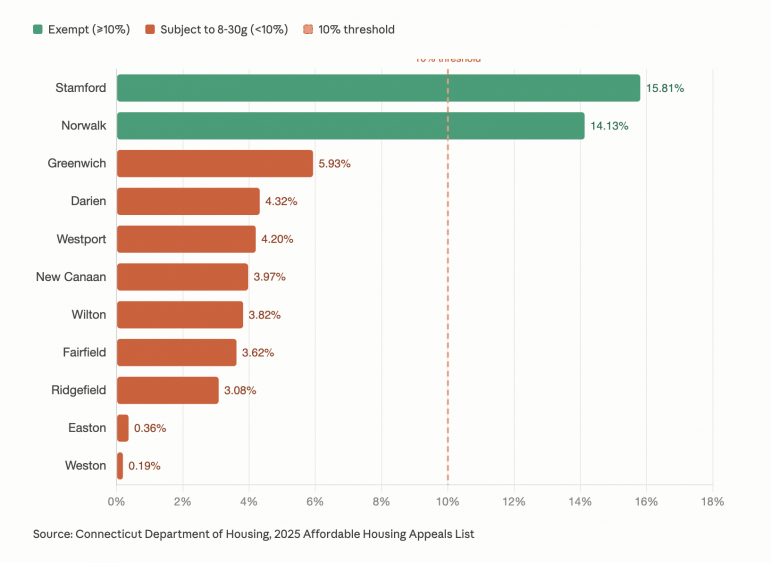
The intentions behind a law like 8-30g are honorable enough. The housing market in lower Fairfield County has been bonkers forever, and it’s both self-defeating and cruel to intentionally plan a town where people can work but can’t afford to live. There’s an emotional component to affordable housing in a town with stellar education like New Canaan, too–to deny someone the chance to live here is to gatekeep a great educational experience from their kids. Should education be more equitable from town to town throughout the state? In a word, duh. But I’ll save THAT inexplicably sizzling-hot political potato for another day.
It should be noted that the qualification rubric for affordable housing is narrow. To rent a one-bedroom unit, your income must fall below $50,670. For a two-bedroom, $55,566. So, while it’s nice to think that we’d be able to house New Canaan’s teachers, police, and firefighters, many of them earn too much money to qualify. Still, though, many private-sector employees in town surely don’t, and could live here.
The rusty knife of my rage at 8-30g sharpens thusly: because it circumvents the expertise of town bodies that exist to manage town infrastructure, the environment, the citizenry, and the long-term interests of the community, the execution of this law winds up being miserably anti-community and pro-developer. This is the part we’ve seen play out in real time. For example, if the town engineer finds that the project lacks sufficient stormwater management plans, as in this case, it doesn’t matter. It can be built, and if the area floods, it floods. If the building’s size requires the town to hire additional police and fire personnel, it’s incumbent upon the town to do so. If it results in an additional 200 vehicles exiting and entering a corner where traffic is already noticeably congested, well, just wake up 20 minutes earlier to get to the train station, loser.

An early site rendering.
I’m going to head off the comment section cowboys here and advise that any state-level political candidate who wants a shot at winning New Canaan in 2026 should think VERY carefully about a commitment to replace 8-30g with something that doesn’t annihilate towns to the outrageous benefit of developers.
The deceptively simple narrative of NIMBYism
In 2022, New Canaan was featured in a New York Times article that, predictably, characterized us as affluent crybabies for resisting the Weed Street project. When I read any coverage of this case from outside, I have the disorienting feeling of playing for the away team. I can hear the licking of chops, the jeers against us, a well-resourced town with an admittedly country clubbish reputation. The nerve of these well-heeled haves, they say, to hoot and holler about this beleaguered hero of a developer who just wants to build a little something for the have-nots. Shucks, all he wanted to do was help some folks out. They leave out the part where the developer walks away with a potential nine-figure payday from the sheer mathematical scale of his project, while the rest of us watch property values take an ice bath.
If this story were an eighties movie, Ted Knight would be in it, and we’d all look like bumbling, entitled goons. But after 12 years in New Canaan, I understand what a mistake it is to collapse us into such caricatures. For every bumbling, entitled goon I know, I know 20 others who are deeply generous, committed, civically minded volunteers. People here are emotionally entrenched in the direction of this town, and to have it wrested from us with the full blessing of the law is a slap to our pretty, pretty face. For many of us, the offensive part of the 751 Weed St. project was never the 31 affordable units. It was the 71 market-rate ones, the White Plainsesque density of it all. Here’s where I’ll sound like Judge Smails’s pill-popping wife in Caddyshack, and I don’t care: If I wanted to spend my precious time on God’s green earth in a place without concern for aesthetics or character when I moved out of Manhattan, I’d have moved to Paramus.
Throughout this back-and-forth with the press, the comment sections, and various Facebook groups, there was an illusion of duress at play, one that Karp himself fed into frequently, with an edge of threat. “If I don’t build it”, he repeatedly intoned, and I paraphrase, “someone else will. And you won’t like it.”
Why is it always the boogeyman who warns us of boogeymen?
Back to the timeline
In 2022, rightfully horrified neighbors were quick to act. Concerns about a five-story building’s oppressive loom over abutting properties were voiced, as were observations about the building’s visual incongruity, density, and what it would mean for day-to-day life in the neighborhood. Through proper channels, neighbors launched a legal campaign. Save Weed Street lawn signs were made, and promptly stolen by teenagers because they said ‘weed.’ Ever quick with a stunt, Karp made counter-lawn-signs. Between 2022 and 2023, P&Z denied Karp’s proposal three times, citing legitimate concerns like fire safety, stormwater management, and pedestrian safety at Weed and Elm streets. Karp filed a legal appeal, and in July, 2025, Judge Edward O’Hanlan in Hartford Superior Court issued a 98-page decision overturning P&Z’s final denial. The court ordered P&Z to approve the project, and things on the west side of town started looking pretty morose.

good one. Karp’s lawn signs in response to the Save Weed Street campaign.
Throughout this process, with each action from P&Z and each court decision, and as the town racked up substantial legal bills trying to defend us from his predations, Karp and his firm’s COO, Paul Stone, insisted that this was purely about a dire need for affordable housing in New Canaan. Comment sections got heated, and it was repeatedly implied that we were snobs, NIMBYs, and racists for resisting it. It was exhausting in its predictability; tropes are tropes. At no point, in my opinion, did Karp or Stone EVER make a coherent case for the building’s need to exist at this scale.
As you likely know, Karp has two other active large-scale proposals elsewhere in town, each specced out to include 30% affordable units. The trouble with these mixed-designation buildings is that they don’t move the needle the way you’d expect. The 70% market-rate units are added to the town’s total housing stock, which expands the denominator, so 10% now represents a larger number than before. Add a building, especially a huge one, and the finish line moves. The other trouble is that the deed restriction expires after 40 years, so come 2066, if that ghastly law still exists, we’ll have a new set of problems on our hands.
But, of course, this is moot for the Weed Street of May 2026, because Karp, although he failed to point it out in his Op-Ed directed at the three neighbors, has walked back from affordable housing and rentals entirely and now wants to build 62 market-rate units for sale. Oh, and he’s adding in an adorable little bonus of $3.2 million, or as I see it, The World’s Saddest Consolation Prize, for the town. Per Stone, “the town would use the $3.2m[illion] payment to help fund the creation of affordable units where it sees fit. The town wants local control, we are paying $3.2 Million that would give them local control.”
That $3.2 million might sound like a lot of money on The Price Is Right, but overflow our town’s affordable housing coffers with the means of local control, it does not.
Contacted for comment about this apparent change of heart, Karp and Stone said, “Our position is that New Canaan needs housing, all types of housing – affordable and market rate, and at various price levels for both. So, our approach was that if there were a compromise to be made at Weed St., then we would entertain that. We came to an understanding with the town and all intervenor neighbors except for these three holdouts. If they can’t come to accept a smaller, less dense building then so be it. We’ll build what was approved.”
(They couldn’t quite make it to the end of a paragraph without a threat.)
The question of “need” is interesting, and on one point, I agree with Karp and Stone. Entry-level single-family home construction has steadily lost market share across the U.S. over the past 50 years. Real estate development is nothing if not a math game, and big houses make developers more money. Anecdotally, it has appeared that most new construction in New Canaan is in the 6,000-to-9,000-square-foot range, which puts our standalone housing stock out of reach for most downsizers, young families, and single folks. Our town has quite a few elegant townhouse mews, which are popular, but I don’t see modestly sized houses going up on their own lots the way they did in the 1940s, ‘50s, and ‘60s.
Also noteworthy is the enormous gulf between the $1,100-per-month rent on a deeded affordable unit and a $13,000 mortgage payment, a back-of-the-envelope calculation I just did based on the median sale price for a home in New Canaan in 2025.
What gets my hackles up is the idea of an interloping developer telling us what our town needs. How seriously can we take such a claim from any developer, not just Karp, who has an entirely profit-driven relationship with real estate? What about the environment, the infrastructure, the character of a quiet little town that we all chose on purpose? A developer exists to extract his own profit from the very facets that make a small town desirable. I believe my duty as a citizen is to resist such profiteering.
Legitimate advocates for affordable housing exist at the national and local levels. Their points of view would be genuinely helpful to inform New Canaan’s approach to creating housing equity. By masquerading as a crusader for affordability and then dropping the cause altogether at Weed and Elm, Karp has undermined their work.
That’s what’s (literally very) rich: after years of wrapping himself in the flag of affordable housing and positioning himself as New Canaan’s reluctant savior, Arnold Karp suddenly dropped the costume. The 30% affordable designation was never the point at Weed and Elm Streets, in my view. It was always the meal ticket, the legal smokescreen that neutered P&Z, ran the clock, racked up enormous legal fees for the town, and got him to the finish line. The affordable units were a means to an end, and the end seems to be an outrageous payday on 3.1 acres he bought for under $4 million.
I find myself quite angry on behalf of 31 hypothetical lower-income tenants who might have been looking forward to a move here.
An Aesop’s fable, The Farmer and the Viper, tells of a farmer who chances upon a frozen snake in the winter, feels bad for it, and warms it up in his coat. Upon thawing, the viper delivers a deadly bite to the farmer, because viper. The moral: don’t expect an animal to change its nature just because you thought you had an understanding. The lesson is so needed, so resonant, that it appears in several other animal forms across folkloric origin points. The Frog and the Scorpion. The Wolf and the Lamb. It’s a story of thinking you can outwit your own predation, and, spoiler alert, you can’t.
We should have known that a developer, one of the most reviled types of apex predators in modern times, would show his true colors at some point. What we failed to guess was just how dirty he’d be willing to play in order to do it.
Here’s what I’d like Arnold Karp to understand: We see you. We saw the P&Z back-and-forth, the counter-lawn-signs, the comments sections, the repeated invocations of equity and inclusion, and the urgent housing needs of working families, and the threatening tone of this last Op-Ed. We always understood it for what it was. It was leverage. It was theater. It was the viper thawing out in the farmer’s coat. And now that the bite has been delivered, he wants credit for only biting us halfway.
No.
Say Karp and Stone, who have clearly gamed this out since the get-go, “the three holdouts will eventually sell their houses (they actually asked us to buy them out) and leave a legacy of a larger building for the town.” This deflection is wild to me–the large building being presented as an inevitability, as if it were simply nature just taking its course. Karp controls what happens here, not people who, once upon a time, just thought they were buying a nice house in a quiet residential neighborhood with good schools.
The three neighbors holding out are not the villains of this story, however much pressure is brought to bear on them. They are, at this moment, the last barrier standing between New Canaan and the whims of a developer. In an email response to me, Karp and Stone said, “We are under no obligation to offer any compromise, but thought this might be a way to heal some wounds and build better projects.”
It’s a neat trick, to wound someone and proclaim yourself a doctor.
The lumber yard is what Arnold wants.
His plan was to trade it for Weed Street
The Town leaders refused to make the trade.
Not sure why? Now it’s part of the Town
leaders ( who seems not able to lead ) plan
to build there own affordable housing
project there. Guess Weed St residents to
be sacrificed. Negotiations in secret on
the new plan. Back and forth on the
Number of units. The holdouts still want
Less to their credit. Who will blink first?
And what has motivated them to give
Up their 102 units and tell the whole town
That these 3 residents are standing in the
way of this noble compromise on their
part. It’s to put pressure on them.
Cause again maybe they don’t hold
all the cards they could have downsize
this project at any time on their own.
But make you think it’s someone else
is keeping them from doing it.
I don’t like the fact that Karp is now acting as if the 102 unit development is some sort of threat, rather than a positive project that would deliver sorely needed housing. However, the smaller development was negotiated with the town. Clearly town officials think it is preferable to have a smaller development with no affordable housing than a larger one that is 30% affordable. Should Karp have refused to negotiate with the town?
Rather than bellyache about how much we all don’t like Karp, or how unfair it is that we are subject to a law that has been on the books for 36 years (and could have been avoided easily by building more affordable housing), the important question is really which development is better for the town.
The smaller project is forgoing a 31 subsidized units, and is 40 units smaller overall. There is a 3.2 million donation for affordable housing in the smaller proposal. In round numbers, if the town takes Avalon units and were to subsidize rents 1k a month for 40 years, each unit would cost the town a half million in foregone revenue, so the donation would cover about six units. Thus, the smaller project would be a net loss of 25 affordable units, and would be a 10% affordable project vs a 30% for the larger. For the 40 extra units in the larger proposal, effectively 63% of them would be subsidized housing. For the cost of one additional story of height, the town gets $12-14 million worth of subsidized housing.
I think the larger proposal is a better deal for the town.
Bravo, Laura!
Shame on us for not protecting the town against irresponsible development. Shame on Mr. Karp for proposing a gargantuan eyesore of a building in the worst possible location and using it as a cudgel to get what he wants. This is indeed theater but with with painful consequences.
Completely agree.
Even “The Vue” was initially promoted as “affordable housing.”
Until, inexplicitly, it wasn’t.
Go back to 2016 and take a look. The project was then Merritt Apartments and the builder was M2 Partners.
The NYT even wrote about it (“A Wall Divides a Connecticut Town”).
It’s always all been a land grab.
Laura,
Thank you for your thoroughly researched timeline of the 102-unit development and how a new plan is for 62 luxury condos with no affordable housing units.
Please send your article to Judge Edward O’Hanlan in Hartford Superior Court and to the Hartford Courant. Yes, the Weed Elm development was never about affordable housing. Neither was Merritt Village that was later changed to The Vue.
Towns grow and expand, welcome to the real world, this is how developers operate, and in 25 years Weed Street across from Irwin Park may look very different, as will the lumberyard parking lot which encompasses probably 20% of the downtown area but I believe is warehoused from development because of the impact such would have on the character of the town. Meanwhile we look at a big parking lot on prime real estate. I guess just be thankful Karp isn’t running for President!
Hear, hear Laura!
This point you make is key “The trouble with these mixed-designation buildings is that they don’t move the needle the way you’d expect. The 70% market-rate units are added to the town’s total housing stock, which expands the denominator, so 10% now represents a larger number than before. Add a building, especially a huge one, and the finish line moves.” New Canaan needs to build or convert its own affordable housing.
If Arnold’s true motivation is to see affordable housing in New Canaan, then perhaps his firm sell (perhaps at a loss) or donate that land to the Garden Homes nonprofit that is also looking to build in New Canaan. I would hope that as a nonprofit, the Freedmans would be able to build a lower density unit on that land given that they do not need to make a profit. The Freedman family, in my mind, has a proven civic-minded approach with its real estate, having owned and run the Garden (Norwalk) and State (Stamford) Cinemas for so many years, and now using the nonprofit model for affordable housing.
A number of years ago, I served on the Senior Health and Housing Policy Team and saw firsthand the challenges of finding and using land for the public good – whether it’s NIMBY, the lack of sufficient space to provide the required scale or the economics of building housing either as a government or commercial entity.
As a developer, Arnold certainly has a right and an obligation to make money — to my mind however, it’s the mix of private real estate ownership and social enterprise that is the challenge in a town where land is at a premium, and architectural character and small-town feel is of such value to its residents.
Spoiler: he doesn’t care about affordable housing. Mr. Karp-are you fighting for affordable housing in watch hill? For more beach access in front of your home for the public? Take up that fight! Stop publicly shaming New Canaan residents for not wanting to agree to your supposed benevolence.
It just occurred to me last night he probably wants to buy the house at end of south Avenue and the yellow corner house on gerdes and build 4 million “affordable”😂😂 condos. Both for sale.
Thanks for writing this meaningful op-ed.
I’d like to point out that the figures generally assigned to the actual cost of affordable housing rents in New Canaan are understated. The standard two room (referring to a one bedroom essentially a studio) costs the tenant $1500 a month not $1000. That’s $20,000 annually with utilities. Not affordable on $50G income. Ask Scott Hobbs for the actuals on larger units. Rents are based on the median New Canaan income and go up every year. Attracting renters without Section 8 subsidy is difficult considering the low amenity, high likelihood of zero privacy and constant management interference which requires a yearly disclosure of all assets and activities on a CIA level. Affordable housing is not a final goal for all of its residents. For some it should operate as a jump start to the next level of property owning independence. As noted by Ms. Ault, who brilliantly described the history of this debacle, the gap between housing options is so vast in New Canaan that permanence is impossible. This isn’t community building, it’s creating instability for a rotating group of residents who will be treated as “other” from the day the lease is signed. Ask those residents, especially the children in this community what their life is like. Revisit the goals here and figure out what is actually being provided. We know Karp is not the benevolent savior he pretends to be, but are the groaning majority of “I guess we have to” really making a positive difference?
Bravo, Laura!!!
While I am partial to the original project, which includes more units and affordable housing, everyone in New Canaan needs to take a deep breath about this project (and others). No matter what is built, it will not negatively affect your life at all. You don’t like how it looks? You are welcome to your opinion and to look away. Worried about schools? We are bleeding enrollment? Traffic? You are not an urban planner; they hire those to study the feasibility of these projects and get their sign-off.
However, more housing (of all types) allows more people (especially those who cannot afford a McMansion) to our opportunity-rich town (which has TWO stops on the country’s busiest commuter rail line), grows our grand list, grows our workforce, and provides more customers for our small businesses. We cannot hoard our world-class amenities and gatekeep opportunities that we and our kids had. If we do that, within a decade or so, NC will be reduced to a senior living community of millionaires.
Our state and our region are barely growing because of NIMBY attitudes everywhere. We have the resources and the space to grow. Just let people live here. I promise you, you will survive. The only difference will be that others will be allowed to as well!
I have no clue what makes you think you have the right to use the word “we” when you very clearly don’t live here, Anthony.
Your take is wild to me. Just curious, do you currently live in NC & pay NC town taxes as a resident? I can’t imagine living adjacent (or in close proximity) to this proposed development & what it would do to both my day-to-day logistics & the overall valuation of my property. I would be apoplectic. It’s one thing to deal with a difficult neighbor—it’s an entirely different scenario living & co-existing next to an apartment complex that completely upends the look & feel of your sense of home & environment. I feel awful for the homeowners on Weed & Elm.
He never answers the question. He is a Karp cheerleader and likely has a vested interest in the project. Before he was touting affordability in New Canaan now he doesn’t care. Go away. We can all see through you.
Very telling that any pro-housing opinion is attacked as not ‘one of us.’ My grandparents lived in New Canaan, my mom, grew up in New Canaan, I went to NCHS and I still live in town and plan on raising a family here.
Well, Anthony, it strikes most people as odd that the sole record of your existence in New Canaan is as a comment section troll, where you repeatedly malign this community and stump for Karp. I’d be happy to spend my afternoon in the Town Clerk’s office to confirm that you’re a voting, taxpaying resident, and proud graduate of NCHS, but I think we can agree that that would be a waste of my time.
Why did you change your response to the project? First you were excited about the project being affordable housing? Karp makes a change, eliminating the affordability aspect and you shrug and say no big deal. You should be attacking him for not providing the affordable housing that you feel that New Canaan needs. Explain.
And I am calling BS on you living in New Canaan. I see no evidence of your presence in New Canaan. I think you are making it all up (unless you are a kid living with your parents here).
Thanks for the good article. I would have hoped that the Connecticut “affordable housing” law would have written into it provisions to prevent the type of vexacious and predatory actions by greedy developers as we are seeing here. New Canaan has been blessed by some of the best architects in the world who left lasting and positive works that inspire gracing the landscapes of this and so many other towns. There are others who build reasonable houses making adequate profits without upsetting neighborhoods by out of place developments. I imagine it could be worse, rather than maximizing profits they could be putting up pre-fab, utterly tasteless construction with spam colors and polka dot vinylume using lighting like strobe lights to further assault the senses.
Legal teams need to make equal or better arguments than Karp’s. There are many other Connecticut towns trying to fight fraudulent and abusive tactics that make a mockery of the “affordable housing” laws. One way hopefully to effectively fight greedy and unneighborly development would be for a number of towns to pool their legal resources, appealing to the highest court if necessary. It’s shocking that some of the developers have gotten as far as they have due to having the most shrewd and determined lawyers to exploit loopholes and the original intent of the laws.
Thank you Laura!
This article should be printed and added to the menu at every restaurant in town, along with their nightly specials, and spoken from the pulpits on Gods Acre on Sunday. These plans, and the perfectly described Holiday Inn designed buildings, will provide no beneficial value to anyone but the developer.
Greed, greed, greed. The degree to which people are willing to destroy every good thing left in the world for a dollar. Or a million of them. Is enough never enough ??
I was a supporter of the 102-unit development but I certainly don’t support the scaled down 62-unit version as all it does is increase the denominator without any change to the numerator. What a farce from Karp and the town officials.
Okay so this guy is a bullying intimidating devil of a developer who cooked up an evil scheme – c’mon there must a whole lot of New Canaan boaters out there to pull your own Tony Soprano – park a few boats outside his Old Greenwich manse and play some Dean Martin tunes LOUD
Laura, go ahead, look me up! I rent on Carter, not that it’s anyone’s business.
Jeff, as I said, I want the original project to move forward, and I hope it will. But even if the legally affordable housing is taken out (which I hope it doesn’t), the market-rate apartments that do get built will still be more affordable compared to the average McMansion in town. And today’s market-rate housing becomes tomorrow’s affordable housing as it ages and filters down.
I just think fighting growth, as history bears out, is a losing battle 100% of the time. This country was great when we built things, and declined as we stopped. And building housing of all types during a housing crisis is a no-brainer for anyone who cares about the greater good.
Karp is simply saying f-you to the town of New Canaan. Greed at it’s highest level.
Alrighty this thread is closed