‘New Canaan There & Then’ is sponsored by Brown Harris Stevens Realtors Bettina Hegel, Joanne Santulli and Dawn Sterner.
The upcoming Independence Day is, of course, the sesquicentennial of our country. For history lovers this Fourth of July will also be remembered as the 200th anniversary of the deaths of both Thomas Jefferson and John Adams in 1826 (in that order, despite Adams’ plaintive last words, “Jefferson lives”), in what surely is the most extraordinary coincidence in American history.
But the year 1826 is also the bicentennial of the birth of Thomas Peterson, who spent much of his early life in New Canaan living in what is now the historic 1764 Hanford-Silliman House, a featured attraction on the five-acre campus of the New Canaan Museum & Historical Society. And it is also possible that Tom Peterson, who died in 1901 in Milford, was the last former slave to live in Connecticut.
***
The history of the beginnings of slavery in Connecticut is scant. There is a 1638 account where several Native American prisoners taken during the Pequot War (1636-1638) were exchanged in the West Indies for enslaved Africans; historians believe this is probably how the first enslaved Africans ended up in the colony. Unfortunately, they wouldn’t be the last.
By 1790, most prosperous merchants in Connecticut owned at least one slave, as did half of all ministers. Unquestionably, the state’s economic links to slavery were entwined with the colony’s religious, political, and educational institutions, making the sordid institution a part of the social contract in Connecticut. According to U.S. census data there were 2,764 slaves in Connecticut as of 1790. This declined during the early part of the 19th century, with the census indicating number reported as slaves in the state of 951 in 1800, 97 in 1820, and 25 by 1830.
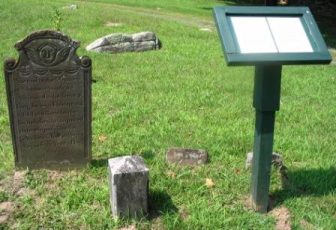
Gravestone of Venture Smith. Find-a-grave
Perhaps the most enlightening account of 18th century slavery in Connecticut is the narrative autobiography of Venture Smith, A Narrative of the Life and Adventures of Venture, a Native of Africa: But Resident above Sixty Years in the United States of America, Related by Himself. The story highlights an individual who has been heralded as one of the country’s first black entrepreneurs.
What’s particularly poignant about the narrative is how his enslaved experience could become seemingly run-of-the-mill, even where life was focused not on the active “pursuit of happiness,” as Thomas Jefferson posited, but daily survival, where human beings and their families were bought, sold and traded like a cow, a piece of furniture, or a collection of farm utensils.
Born Broteer Furro in West Africa, he was kidnapped as a six-year-old and taken to the Gold Coast (modern-day Ghana) to be sold. The young boy was renamed “Venture” by his first enslaver, Robinson Mumford, who lived on Fisher’s Island, New York. Mumford decided to call him “Venture” because he considered his purchase to be solely a business venture. Mumford bought Venture with four gallons of rum and a piece of calico.
Following an unsuccessful escape attempt in1754, Venture married an enslaved woman named Meg, and the couple soon had a daughter, Hannah. Less than a month later, Venture’s enslaver forcefully separated him from his family, selling Venture to a “mean” man named Thomas Stanton, who lived in Stonington, Connecticut. They were reunited the following year when Stanton bought Meg and Hannah.
After Venture intervened in a heated dispute between Meg and Stanton’s wife, where the wife was beating Meg with a switch, leading to Stanton assaulting Venture with an oar, Venture understandably became focused on liberating himself and his family from the Stantons. Venture got his wish, but not his freedom.
He was sold twice more and in 1760 ended up enslaved by Col. Oliver Smith, who agreed to let him buy his freedom. Smith permitted Venture to work for money when his labor was not required at home, as well sell crops from the garden Venture kept. Finally, in the spring of 1765, Venture Smith purchased his freedom for 71 pounds and two shillings. He soon moved to Long Island and over time was able to purchase his wife, daughter and two enslaved sons, Cuff and Solomon, who had also been ripped away from him.
The story of his older son is particularly heartbreaking. Upon turning seventeen “my smiling” Cuff was let out for a year to a man named Charles Church. Unbeknownst to Venture, Church had outfitted a whaling boat and convinced Cuff to join; he would be compensated with his normal wages, as well as a bonus of a pair of silver buckles. When Venture caught word of the expedition, he immediately set off to stop his son from going on the voyage. But when he arrived at Church’s house on the coast, all he could see was the whaling boat on the horizon. Smith would never see Cuff again; while on the expedition he caught scurvy and died.
Despite the unimaginable years of slavery – working 18-hour days, at first to maintain his own sustenance, and later, to rescue and to save his family – he kept good cheer. He also kept working. He returned to Connecticut in 1775, when he bought a farm at Haddam Neck, on the Connecticut River. Resourceful as any other human being in the colony, by 1778 he had expanded his initial ten acres to a farm of 134 acres, with three houses and two dozen sailboats and canoes. Beyond his farming, he ran two fishing businesses and a commercial orchard, and dabbled in lumberjacking, carpentry, and various “trafficking” with Long Island. All this success was accomplished without the ability to either read or write.
In 1798, Venture Smith dictated his life experiences to his family, which were printed by The Bee in New London. Venture died in 1806, and his grave in East Haddam, surrounded by Meg and his son Solomon, is one of the original sites on the Connecticut Freedom Trail.
***
Thankfully, Tom Peterson had an easier go of life than Venture Smith.
In 1833, 26-year-old Martha Mitchell of New Canaan met Tom Peterson in New York City when he was seven years old. An orphan, Tom lived with his aunts who, as he described, “did not care for me and wanted to get rid of me the first chance they got.” Thus, from an early age it was obvious that Tom Peterson didn’t mince words.
After “negotiating” with his aunts for Tom to go “live where the birds live,” Martha and Tom took a boat to Norwalk and then a stagecoach to “the happy land of New Canaan.” Martha then presented him to her mother, Mrs. Hannah Mitchell. Tom’s status when he entered the Mitchell household is unclear – i.e., was he a slave purchased by Martha in New York? We don’t know, and probably never will.
A brief mention about the legality of slavery in each of the-then five New England states – abolition was first achieved: by constitution (Vermont, 1777, abolishing it outright, and New Hampshire, 1783, abolishing it by implication); by judicial decision (Massachusetts, 1783, the state Supreme Court ruling it unconstitutional due to the “all men are free and equal” clause in its 1780 constitution); and (the ultimate political cop-out) by “gradual emancipation” (Connecticut and Rhode Island, 1784).
In Connecticut, its’ so-called “freeing the womb” act provided that all babies born after March 1, 1784, would become free upon attaining the age of 25 (for men) and 21 (for women). The act did not free the parents, nor any other adult slaves. In fact, Connecticut would not completely abolish slavery until 1848, only a dozen years prior to the commencement of the Civil War. In contrast, New York abolished slavery in 1837.
The disparity between the two states is why, in 1839, U.S. Navy Lieutenant Thomas R. Gedney steered the slave ship Amistad that he had seized off of Montauk Point to Connecticut, instead of a New York port; he realized that his chances of participating in “salvage proceeds” were greatly enhanced by Connecticut’s absence of a full abolition law.
The Connecticut case of the Amistad, immortalized in Steven Spielberg’s 1997 historical drama of the same name, led to an 1841 U.S. Supreme Court decision that the captives on the ship were illegally enslaved, had the right to self-defense, and were free individuals. Ironically, given Connecticut’s sluggishness in not abolishing slavery until 1848, the case galvanized the American abolitionist movement, highlighting the hypocrisy of human trafficking in a nation founded on liberty.
All of these events help explain why Tom Peterson’s legal status was unclear when he arrived in New Canaan. Regardless, when Martha married Joseph Silliman in 1834, Tom moved into their home – the Hanford-Silliman House. He later moved to Milford, married a woman named Emmeline Starr, and worked as a carriage painter.
Tom continued his friendship with the Sillimans, including Martha and Joseph’s son, Joseph Fitch Silliman, and his wife, Caroline, who attended his funeral in 1901. As a gift to the couple, he painted a lovely robin on a tilt top table for them. Tom was remembered as a good man, “being strictly moral and honest in every respect. Many people here will miss the old man’s genial smile.”
Before he died Tom Peterson sent a letter to Joseph’s brother Nelson Silliman. The amusing story he told recalls the bluntness that he first exhibited some 68 years earlier:
“I never made such poor-work writing in my life.
I don’t know as you can make it out.
Milford. AD 2.18.1901
Mr. Nelson Silliman
Dear Sir I have forgotten my box paints please send them to me by Addams Express. I will pay for it myself. You will find the box in the back room up on a shelf over the oil can in a box of glass. Please send it to me and I will settle for it myself.
Mr. Nelson, I want to tell you about the chicken thief in Milford.
A man living a mile from us raises a great many chickens so he put an Alarm on his chicken house. Last Tuesday the alarm wake him up. He jumped and grabbed his gun and ran to the chicken house.
He call for help one was his boy about 13 years old the other a neighbor with his gun, my neighbor though he would not shoot the thief as the thief had no gun. So, he told him to come out. The thief came out he see he had no gun so he laide his gun on the ground. He took hold of the thief but the thief threw him so he got up yanked and threw the thief so they had it back and forth.
Pretty soon the boy came with a club and hit the thief on his head three times. That made him come to time then the wife came with rope. They tied him then they went for the other one with a wagon but he see a man coming towards him so he stopped his horse and jumped out the wagon and ran way and left the horse. The man he saw coming towards him was another party and knew nothing of what was going on but the man see thief jump from the wagon and run away.
So the colored man took the horse and wagon to the stable where he was working. It was 5 o’clock in the morning. He put the horse up then looked in the wagon and found 2 big hams and a big lot of fresh beef and 50 chickens they took. The took thief and gave them his trial sent him to New Haven to await his trial to the superior court.
Please excuse my blunders.
I thought I must let you know what was going on over here.
My love to your folk, and to everybody in New Canaan that I know.
Thomas Peterson, Milford Conn.”
Another great story. You are becoming our town historian. One note, sesquicentennial is 150 years, while semi quintessential is 250 years. What can I say, it’s the Jesuit in me.