‘New Canaan There & Then’ is sponsored by Brown Harris Stevens Realtors Bettina Hegel, Joanne Santulli and Dawn Sterner.
“The town where I grew up has a ZIP code of E-I-E-I-O.”
“Show business is just like high school, except you get paid.”
There are celebrities who have sought fame since childhood, and others that have had it thrust upon them later in life. And then there are those rare individuals who seem to have wandered into celebrity-dom by mistake.
Martin Mull belonged in the last category. He was an actor who preferred to be known as a painter, a musician who made a career out of songs that were funny for reasons that sometimes took a moment to appreciate, and a comedian-satirist whose greatest gift was making the ordinary American look just a tad ridiculous.
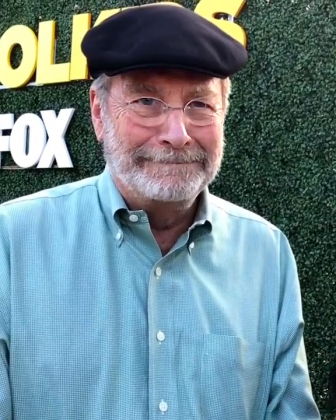
Actor/comedian Martin Mull. By Life, Love, and Pop-Culture, CC BY 3.0, https://commons.wikimedia.org/w/index.php?curid=75559780
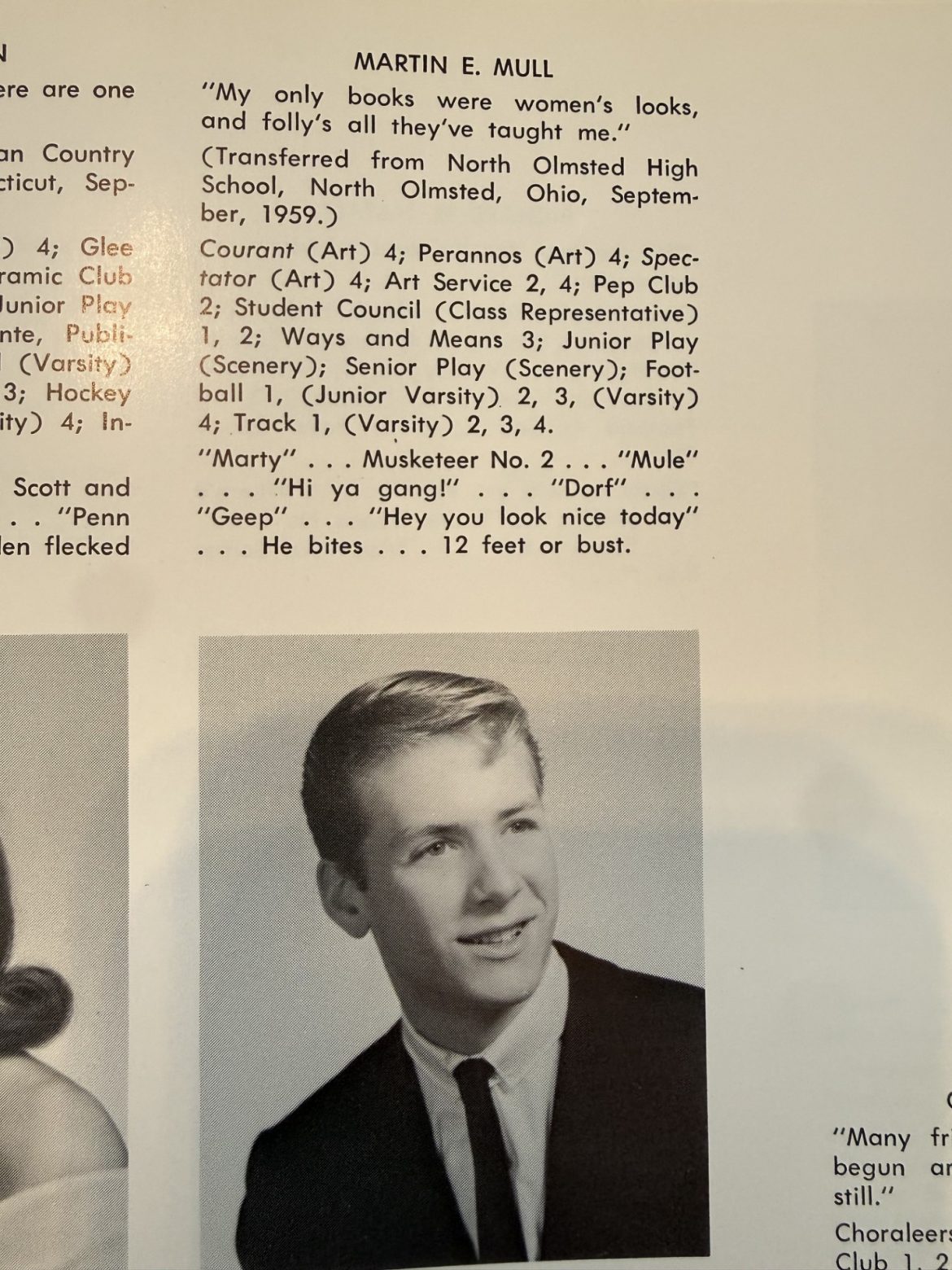
He was also a New Canaan resident and a graduate of New Canaan High School.
Mull became familiar to millions of television viewers through roles in hit shows like Roseanne, Sabrina the Teenage Witch, Arrested Development, Two and a Half Men, and the cult movie comedy Clue. His was a face that seemed to turn up everywhere, usually wearing an expression that suggested he knew something that we didn’t.
Martin Eugene Mull was born in Chicago on Aug. 18, 1943. His family moved to Ohio when he was a toddler, and later, when Martin was 15, relocated to New Canaan.
After graduating from New Canaan High School in 1961, he headed north to the Rhode Island School of Design (RISD), where he studied painting and earned both a bachelor’s degree in fine arts in 1965 and a master’s degree in 1967.
“I was involved in the Great Folk Music scare back in the sixties, when it almost caught on.”
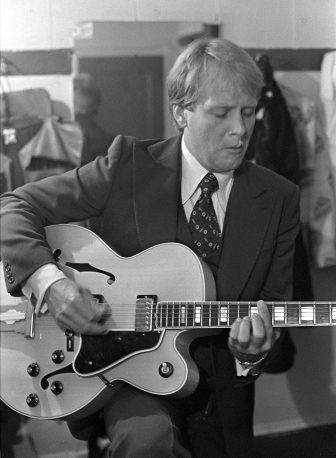
Martin Mull backstage at the Boarding House in San Francisco, May 1976. By David Gans – originally posted to Flickr as Martin Mull, CC BY-SA 2.0, https://commons.wikimedia.org/w/index.php?curid=6974201
After graduating from RISD, Mull pursued music and songwriting. His songs occupied an entertaining place in the busy four-way intersection of country, rock, social commentary and parody. He would perform with a straight face while delivering lyrics that dismantled the conventions of the genre he was performing.
In 1970, singer Jane Morgan recorded Mull’s song “A Girl Named Johnny Cash,” a playful reversal of Johnny Cash’s hit “A Boy Named Sue.” The single reached the Billboard country chart, giving Mull an early taste of commercial success.
He subsequently released several albums, including Martin Mull (1972), Martin Mull and His Fabulous Furniture in Your Living Room! (1973) and Days of Wine and Neuroses (1975). His musical performances combined songs with extended comic monologues – invariably done deadpan – and he developed a following among audiences who appreciated humor that was less about punchlines than about the absurdity of everyday life.
He was an accomplished guitarist, but the instrument was also a means of getting his observations in front of an audience; if the songs were funny, so much the better. If the audience was momentarily uncertain whether it was supposed to laugh, better still.
It was an education in comic timing that would serve him well when television came calling.
“I don’t jog. It makes the ice jump out of my glass.”
Mull’s breakthrough came in 1976, when he joined Norman Lear’s unconventional TV series Mary Hartman, Mary Hartman. The program was a parody of daytime soap operas, specializing in family crises, emotional revelations and seemingly endless complications. In another word, life.
Mull played Garth Gimble, whose death in the first season not only didn’t end Mull’s day job, but opened the door to something even more consequential.
Lear (who was responsible for the ‘70’s blockbuster hits All in the Family, the Jeffersons, and Maude) developed Fernwood 2 Night, a spoof of local television talk shows.
Mull played Barth Gimble, Garth’s twin brother, and the host of a fictional program originating in the equally fictional Ohio town of Fernwood. His “co-host” and sidekick was Jerry Hubbard, played by the late great Fred Willard, whose talent for improvisational comedy made him the perfect partner.
Barth Gimble was a master of self-regard who conducted interviews with the solemnity of a clergyman, while presiding over a production that seemed perpetually on the verge of chaos and collapse.
In Fernwood Mull found his natural habitat: a world in which the people who believed themselves the most important people in the room were unintentionally the funniest.
“A cult following is like saying very few people like you.”
In 1985, Mull appeared as Colonel Mustard in Clue, the film adaptation of the popular board game. The picture assembled an ensemble of accomplished comic actors and sent them racing through a mansion filled with suspicious characters, secret passages, improbable revelations and multiple possible endings.
Mull was perfectly cast. Colonel Mustard possessed the air of a man who might have something to hide even when he was doing nothing more incriminating than standing in a hallway.
The film’s initial reception was mixed (decidedly), but over the years it acquired a devoted following. Its elaborate plotting and broad, self-aware humor made it a cult favorite, and Mull’s performance became one of its most memorable.
He appeared in other films, including Mr. Mom (1983), Mrs. Doubtfire (1993) and Jingle All the Way (1996), playing the pompous authority figure that he became known for. His success was restraint. Mull rarely needed to mug for the camera. A pause, a glance or the faintest adjustment of his expression could suggest an entire lifetime of vanity.
“It’s hard to decide if TV makes morons out of everyone, or if it mirrors Americans who really are morons to begin with.”
For many viewers, Mull became a household presence through Roseanne, the ABC sitcom that debuted in 1988 and portrayed working-class family life with a frankness that set it far removed from the more traditional domestic comedies of the period (e.g., Family Ties and, yes, hmmm, the Cosby Show).
Mull played Leon Carp, Roseanne Conner’s boss and a recurring character in the series. Leon was openly gay, sharp-tongued and professionally capable, with a personality that could be as endearing as it was exasperating.
His presence was culturally significant in a period when gay characters were still relatively uncommon in mainstream American sitcoms. But Mull didn’t play Leon as a lesson or a symbol, let alone a stereotype. He played him as a person: funny, occasionally irritating, and entirely entitled to his place in the story.
Mull also appeared as a recurring character in Arrested Development, a show that appeared on Fox from 2003-2006. It was cancelled in 2005 but was so funny (six Emmy Awards and a Golden Globe) that Netflix re-released the series in 2011 and later commissioned a whole new season more than a decade after its cancellation.
Mull played Gene Parmesan, a private investigator whose disguises were so transparent that their very obviousness became part of the joke.
Mull’s character offered a particularly delicious variation on his then-established persona. Gene could appear in the flimsiest disguise imaginable, yet the series’ hilarious matriarch, Lucille Bluth, would react with delighted astonishment whenever she discovered his true identity.
Mull understood that the joke was not merely that Gene was a bad detective. It was that the people around him were perfectly willing to participate in the absurdity because doing so gave them pleasure.
“Human beings are seventy percent water, and with some the rest is collagen.”
Mull’s last major TV gig ran from 2008 to 2013, where he had a recurring role on the show Two and a Half Men as Russell, a humorous drug-using and drug-selling pharmacist. The perfect culmination of Mull’s absurdist acting career.
He died at his home in Los Angeles on June 27, 2024, at the age of 80, following a long illness. He left behind his beloved wife Maggie and daughter Wendy.
Until the end he kept painting. And why not? The comedy that so favorably influenced his music and his acting also did so for his artwork (his first exhibition, in 1971, was entitled “Flush to the Wall” and held in the men’s room of the Museum of Fine Arts in Boston). Today his work (described as “Norman Rockwell with distortions”) resides in the permanent collections of the Museum of Modern Art in New York and the Los Angeles County Museum of Art.
Martin Mull never became the conventional superstar who dominated every headline, but he achieved something more durable: a reputation among fellow performers and audiences alike as a comic genius.
“Talking about music is like dancing about architecture.”
A genius for sure, but low key and no fuss, please . . .
Worked with Marty while at NCHS at Empire Studios
the art store in New Canaan .
Had more laughs than was legal at the time. Great times.
Bob VanDerheyden
Nice article. One correction: Wendy was his wife and Maggie was his daughter. Marty was my classmate at NCHS
I couldn’t get enough of Fernwood Tonight. It possessed a subtle absurdity that I loved, followed in absurdity by my all time favorite movie, Caddyshack. I had no idea Martin Mull had roots in New Canaan. Thank you, Nick.
I’m a classmate of Marty at NCHS and hiked him the ball for a kick 👏 he was a great guy and teammate, we were HS state champions in Connecticut in our school “Class” 1961.
Rest in peace Marty 🙏