
‘New Canaan There & Then’ is sponsored by Brown Harris Stevens Realtors Bettina Hegel, Joanne Santulli and Dawn Sterner. (Part 1 of 2 in this series can be read here.)
What opportunities come your way after you’ve won an Olympic gold medal and been heralded as The World’s Greatest Athlete? How about starring in a movie wearing a loin cloth?
In anticipation of the 1972 Olympics in Munich (yes, that tragic fortnight), ABC Sports commissioned “Ancient Games,” a film paying tribute to the decathlon. It was filmed in the ancient Stadium of Delphi, and starred Toomey and Rafer Johnson, a fellow American who won the decathlon gold medal in the 1960 Rome Games.
The movie, which remains immortal on YouTube, required a great deal of physicality. “Poor Rafer, he hadn’t done anything like that since he won, and 1968 was a lot closer to 1972 than 1960,” recalled Toomey. “In some of the running scenes I had to hold up a little to make sure I didn’t get too far ahead of him.” Regardless, “Rafer and I became great friends. And of all the athletes I ever knew, Rafer and Bob Mathias [1952 and 1956 Olympic decathlon gold medalist for the U.S.] had the most amazing personalities and stature. They were Gods of the track.”
Apart from the loin cloths and glistening bodies (it gives Bridgerton a run for its money), the movie was also notable in that it was produced by the legendary Roone Arledge (ABC News head, Monday Night Football creator, and father of the late Patty Arledge, a long-time New Canaan resident) and Saturday Night Live co-creator Dick Ebersol. It was written by Erich Segal, the author and screenwriter of the supernova 1970 Love Story novel and movie. The creative team worked – “the show became the highest-rated half hour during the whole Olympics,” Toomey remembered.
Bill Toomey’s path to Olympic greatness, and fame, took 28 years. Beyond his time at New Canaan High School, Toomey became an All-American for the Colorado Buffaloes track & field team. In 1964 he finished fourth in the decathlon at the finals of the U.S. Olympic track & field trials, held at the Los Angeles Memorial Coliseum. Overcoming his disappointment (only the top U.S. three decathletes were invited to the 1964 Olympics in Tokyo), Toomey recommitted his time, efforts and life in pursuit of the 1968 Games.
That determination came in large part to the person who he says was “most responsible for my going to Mexico City”: New Canaan High School coach, and later long-time athletic director, Joe Sikorski. “He taught me discipline and he taught me motivation. He was a natural leader. There was something about him – his aura, his personality . . . his being.” Toomey played football for Sikorski his junior at year at NCHS (he described the coach’s late summer pre-season practices thusly: “if you came out alive you made the team).
He would have played his sophomore year along with his twin brother Dick, but he was having surgery; a childhood accident severed a nerve in his right hand and it took seven surgeries for him to regain 75% mobility, which still plagues him today at age 87. Toomey’s disability wasn’t known publicly until years later. “I never told anyone I had a paralyzed right hand. To tell someone would have simply provided me an excuse to fail.”
As New Canaan’s track & field coach (double- and even triple-timing high school sports coaches were commonplace in the 1950s), it was Sikorski who saw the potential in Toomey and was the one to suggest that he pursue the decathlon.
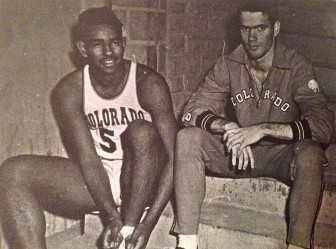
Wilky Gilmore with fellow New Canaanite and future Olympic gold medalist decathlete Bill Toomey, who provided some hometown flavor for Gilmore as he was already at Colorado when Gilmore arrived.
“Now remember we didn’t even have a track in New Canaan back then. We went to Mead Park, and what we ran on was mostly sand, with some dirt, worn grass and sometimes tree roots. Running a quarter mile at Mead Park could be tortuous.”
“My home was one of the only houses in our neighborhood; it was an old farm with about 20 acres and before I could drive, I could never get into town – I was stuck out there. That’s when I started throwing a bamboo chain over our house – that was my javelin. I got a broken discus from the high school that they were throwing out. And that’s where I started training for the decathlon. On Cheese Spring Road.”
Reflecting on his life beyond the decathlon, Toomey says that travel was always something of great importance. “I always wanted to travel,” he stated, noting that “I’ve been to 50 countries and pretty much every state in in America. I was always mesmerized by different cultures and peoples.”
But even his travels could come with an athletic twist. In 1995 Toomey flew to Ethiopia as a representative of the President of the International Olympic Committee, Juan Antonio Samaranch, carrying a check for $25,000 to assist the family of Mamo Wolde, an Ethiopian who won the gold medal in the 1968 Olympic marathon.
Wolde had made the mistake of being on the wrong side of a national tribal dispute and was being held in prison. Toomey and his friend, the iconic Ethiopian two-time Olympic gold medalist Kip Keino, met with the special prosecutor and secured Wolde’s release. When Wolde first saw Toomey and Keino, he said “Thank You Jesus for sending my Olympic brothers.” Toomey said simply, “I cried too.”
One other opportunity that came to Toomey after his Olympic success involved being fully clothed. On Wednesday evening November 13, 1968, Toomey was Johnny Carson’s guest on the Tonight Show. Other guests (per Wikipedia; no judgments please) were Dan Rowan, Dick Martin, Robert Wagner, Dinah Shore and Carol Lynley.
Although Toomey was the last to sit down on the famous Burbank set, he had already forged a special relationship with the then (and still) King of Late Night Television. “Johnny wanted to do a decathlon with me before the show. So we went out to Mt. San Antonio College [Walnut, CA] and I took him through every event. He actually pole-vaulted nine feet, which is what I did when I was getting started. He was a really good athlete. We hung out the whole day and he was incredibly kind to me then, and later on the show. Just another way that my life has been blessed.”
My friends and I used to admire Bill Toomey’s unique decathlon cleats that were on display in the trophy case at NCHS (they may still be). The shoes had seen better days, and didn’t smell very good, but they were an important part of New Canaan and Olympic athletic history.