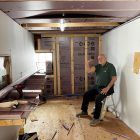
Retired New Canaan Lawyer Turns To Fungi Farming

Pondering what to do after 50 years of practicing law, fourth-generation New Canaan native Richard Stewart turned to YouTube. 

It was 2019, and on the global video-sharing platform, he stumbled upon an unexpected hobby: growing culinary mushrooms.

“I knew I was ready to step away from law, and I needed something new to dive into,” Stewart told NewCanaanite.com on a recent morning. “I found a YouTube video that said you could gut your basement, grow mushrooms for 15 hours, and make $500 a week. That sounded like the perfect retirement plan.”

Stewart continued with a laugh: “Five years later, I’m working 50 hours and losing $500 a week.”

A member of the New Canaan High School class of ’61, Stewart has spent nearly 50 years living in New Canaan and now operates a small mushroom farm in North Salem, N.Y., called Stewart-Watson Farm. A graduate of Beloit College in Wisconsin, Stewart served as a First Lieutenant in the U.S. Army during the Vietnam era before earning his law degree from the University of Connecticut School of Law in 1972. After 11 years practicing in the courtrooms of West Hartford and Stamford, he returned to New Canaan to open his own firm, where he worked until his recent retirement.
Police Commission: Don’t Remove Any Main Street Crosswalks Yet

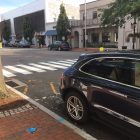
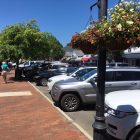
New Canaan shouldn’t remove any crosswalks on Main Street until a traffic study is in hand and the town attorney reviews a legal opinion that could preempt the need, officials said last week. The Police Commission, New Canaan’s local traffic authority, during its Sept. 18 meeting voted unanimously to request that the town attorney look at a legal opinion challenging the notion that a state law required the municipality to lost 13 parking spaces on Elm Street irretrievably last summer. That same legal opinion—which finds, in part, that the town could preserve some parking through local ordinance—also bears “tangentially” on a more recent finding that New Canaan must lose 10 to 12 spaces on Main Street because they’re located within 25 feet of a crosswalk, according to Commission Chair Sperry DeCew. “If we had some municipal parking regulations, which are indicated… that could possibly help us with the Main Street issue,” DeCew said during the Commission’s regular meeting, held in the training room at the New Canaan Police Department.

Police Commission: Let’s Take a Second Look at Parking Changes That Cost Elm Street 13 Spaces

Members of the Police Commission said Wednesday night that they’re willing to take a second look at a decision they made last summer to comply with a seldom-observed state law, leading to the elimination of 13 parking spaces on Elm Street. 

Prompted by a local attorney’s assertion that there appears to be a relevant 1950 opinion letter from the state attorney general and an appellate court case that could empower the town to find relief from the statute, commissioners said during their regular meeting that they would ask for a formal opinion from municipal counsel. New Canaan lost 13 spaces on Elm Street after a resident put town officials on formal notice about the town’s lack of compliance with a state law requiring a 25-foot buffer between crosswalks and parking spaces. Though local officials at the time asked transportation consultants and the state about what New Canaan might to do find a way out from under the restriction, no path to exemption materialized, and the Police Commission—the town’s on-street parking authority—voted 3-0 at its July 18 meeting to change Elm Street’s parking configuration. 

Merchants in the heart of New Canaan bemoaned the loss of parking. 

A guest at this week’s Commission meeting, Richard Stewart, said the change has upset him. Saying he’s seen a high number of vacant storefronts on Elm, Stewart told the Commission, “I know they are all under attack from Amazon and the Internet but in New Canaan that is such a vital thing for our town—we don’t have like Darien has a waterfront, we have the 100-acre cent er of town with the retail space and everybody comes in and it becomes a friendlier town.”

According to Stewart, an opinion issued by the Connecticut attorney general in 1950, one year after the statute in question took effect, could give municipalities the ability to pass an ordinance that allows them to get out from under the 25-foot rule. Stewart said he would investigate the option which while it “doesn’t have the power of law, still has power.”

He added that he found an appellate court case where a man fighting a $90 parking ticket was told by the court that he would have the ability to be exempted from the parking rule but that his city didn’t have an exemption on its own books, “so let’s make sure our town does that.”

Stewart said he would return at the Commission’s April 17 meeting with the information.