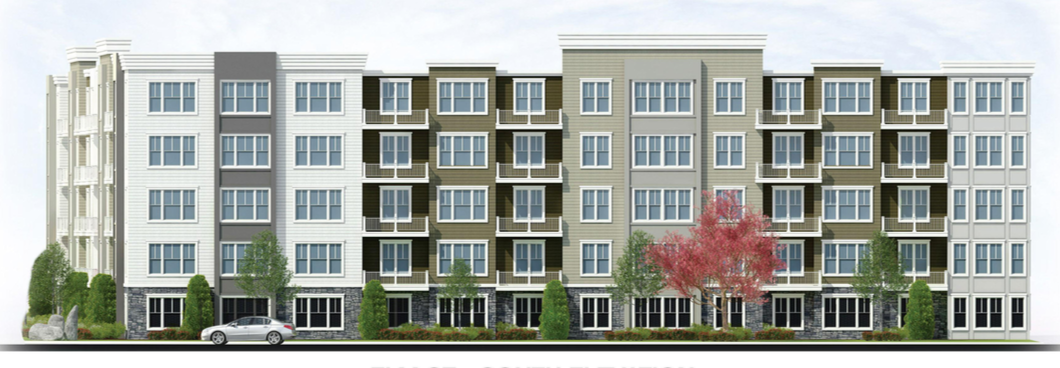
A state Superior Court judge last week ordered the New Canaan Planning & Zoning Commission to approve a widely discussed application to build a large housing complex at Weed and Elm Streets.
P&Z in 2023 denied the application, filed on behalf of local developer Arnold Karp under a state affordable housing law known by its statute number, 8-30g.
In denying the application for a 102-unit complex at 751 Weed St., the town cited “public interests in fire safety, pedestrian safety and a stormwater management plan,” Judge Edward “Ted” O’Hanlan wrote in a 98-page decision issued July 1.
He continued: “It further asserts that these interests outweigh the need for affordable housing and that either plaintiff was unwilling to make reasonable changes or that such changes could not be made to protect the identified public interests. This court disagrees.”
According to O’Hanlan, P&Z “has not met its burden to prove that its denial was necessary to protect these public interests, or that these public interests as identified outweighed the need for affordable housing and could not be protected by reasonable changes to the site plan. To the contrary, the record demonstrates that (1) plaintiff’s site plan and building design meet applicable fire codes and legitimate fire protection concerns; (2) plaintiff s site plan improves pedestrian safety and all other non-speculative concerns along Elm Street and at its intersection with Weed Street; and (3) the stormwater management plan, as designed by plaintiff’s engineer and revised with input of the town engineer and a peer review engineer, meets both sound civil engineering practices and applicable guidance of the town and Department of Energy and Environmental Protection (DEEP); the critique of an engineer not willing to demonstrate the same level of detail or analysis to justify his conclusions cannot be credited.”
O’Hanlan called for P&Z to grant a text change to the New Canaan Zoning Regulations, as well as zoning map amendments, and to approve a site plan that includes the following revisions:
- Remove a proposed sidewalk between 751 Weed St. and Kimberly Place; and
- Revise the stormwater management plan and/or site plan to remove a proposed septic lateral to Weed Street and to include placement of the level spreaders in consultation with the town engineer.
It isn’t clear whether the town will appeal the decision. Town officials could not immediately be reached for comment on the holiday weekend.
The plaintiff in the case, property owner and local developer Arnold Karp, told NewCanaanite.com when asked about the case that the judge “made it very clear in his 98-page ruling that New Canaan could use 102 units of housing, of which 31 will be affordable.”
Karp continued: “This will be a good thing for the town of New Canaan despite the anti-housing beliefs of past and current selectmen. We regret that rather than working collaboratively to develop housing, the town refuses any dialogue, opposed five earlier proposals ranging from senior housing to townhouses, and continues to spend taxpayers’ money on unproductive litigation and continues to fight our other two housing applications. As a local developer we had offered to work with the town towards a community solution but were continuously rebuffed.”
Referring to the town’s purchase of the “Avalon” housing complex on Lakeview Avenue—a lynchpin of the town’s strategy to find relief from 8-30g—Karp added: “If New Canaan town officials worked with us, they wouldn’t have spent $70 million plus renovation costs—expected to be $15 to 20 million—to buy a 30-year-old project in New Canaan that means the town and the Housing Authority are going to take on a large future burden.”
Under 8-30g, in towns where less than 10% of all housing stock qualifies as affordable, developers who propose projects where a certain number of units are set aside to rent at affordable rates may appeal to the state after a local P&Z Commission denies their applications. New Canaan three such applications when its moratorium lapsed in July 2021, at Weed and Elm, Main Street (20 units) and Hill Street (93 units). P&Z denied all of them and the applicant appealed in each case.
In the case just decided, Karp was represented by attorney Tim Hollister of Hartford-based Hinckley Allen, the town by Berchem Moses PC of Westport.
O’Hanlan earlier this year denied the developer’s appeal of P&Z’s denial in the Main Street case. The Hill Street case, which is no longer under O’Hanlan, is headed toward a trial, according to Connecticut Judicial Branch records.
O’Hanlan’s decision marks a major milestone in a housing application that has drawn criticism from many corners of New Canaan, including town government and neighbors. In issuing his decision, O’Hanlan noted that the site at 751 Weed St. is located “within 2,000 feet of the New Canaan train station and two grocery stores.”
The judge added: “The property is surrounded by residential uses, including market-rate, multi-family uses; and is screened on its east and northeast sides by large trees with a six foot high stone wall along the property’s boundary with Weed and Elm Streets. The property contains no wetlands or watercourses; and is connected to public sewer through an easement on private property. The easement contains both the sanitary sewer connection lateral and a stormwater sewer line, which ultimately connect to corresponding mains in Weed Street.”
Citing communications with the prior first selectman’s administration, O’Hanlan wrote in his decision: “Prior to filing this application, plaintiff proposed several development concepts for the site, not involving affordable housing, including an age-restricted development, an assisted living facility, and workforce housing. The town’s staff determined that each proposal was not acceptable. The applicants then proposed a development of market-rate townhouses, which was rejected as ‘not in keeping with the character of the town’ ”—reasoning that runs afoul of state law.
The bulk of O’Hanlan’s decision is a review of updated applications at Weed and Elm filed in March and December 2022, and P&Z’s 10 subsequent public hearings and meetings which ultimately concluded with the appointed body’s denial for reasons of pedestrian safety, fire safety and stormwater management.
The judge went through each point in detail, and found on the side of the applicant.
For example, with respect to fire safety, P&Z argued that “the lack of apparatus access due to the height and bulk of the building and the lack of sufficient fire department personnel and timely mutual aid were proper bases for its decision that the substantial interest of fire safety outweighed the need for affordable housing,” O’Hanlan wrote.
He continued: “The commission cites [consultant Andrew] Kingsbury’s testimony about staffing and mutual aid, asserting that ‘the staffing deficiencies cannot be addressed as long as the building remains essentially unchanged.’ The commission also cites [Fire Chief Albe] Bassett’s ‘significant concerns’ about ladders not reaching the upper floors. In addition, the intervenors cite to Kingsbury’s opinion that emergency vehicles on the driveway would be obstructed by other vehicles and his recommendation that the stairwells be moved or that a center stairwell be added. As previously stated, our courts have recognized fire safety as a substantial public interest in the context of affordable housing appeals.”
Yet “the record here demonstrates that the proposed development met the state fire codes,” according to O’Hanlan. The judge notes that Kingsbury himself made recommendations either not required by fire code or already addressed by Karp.
“Specifically, in the application materials in March 2022 application, Bruce Spiewak, a code compliance expert, confirmed that the proposed building complied with the Connecticut Building Code, Fire Safety Code and Fire Prevention Code,” he continued. “Later during the public hearing on the resubmitted application, [Code consultant Joseph] Versteeg testified as to code compliance, stating that ‘this project will be compliant with the building safety, fire safety code, the Building Code and the Fire Prevention Code’ and that this code compliance addressed ‘proper access to the building site, maneuverability within the site and access to the interior of the building for responding emergency personnel.’ ”
It’s one thing that our tax dollars go to Hartford to help other towns in CT, but it’s quite another to know that our tax dollars are being spent by people who intend to irreparably damage our own town, largely due to envy and malevolence. It truly boggles the mind that that building can be built in THAT location, particularly when you consider that 90% (I’m guessing) of the town’s residents are opposed to it. Sad times.
I hope the town continues to fight this. It is SO wrong to change zoning to put such a large building in a residential zone.
so spend millions more taxpayer dollars to try and deprive families the opportunity to live in our amazing town? Raise their kids in a safe area with amazing schools and resources? You are right, no one else is allowed to live here ever again! Just me and mine!
The town has been absolutely right to spend our taxpayer money fighting a looming, inappropriate building designed in apparent tribute to the 3rd-least successful Hampton Inn on the I-95 corridor. Frankly, I hope we keep at it until the end of time. It’s predatory development masquerading as some kind of Robinhood crusade for affordability, and I don’t know of a soul who wants it.
I’m glad the court saw through the charade by our town’s P&Z. It’s time to get affordable housing units moving towards the 10% mark. If anyone has a better solution instead of pointing out problems, please reply.
That is completely false. 8-30g actually takes NC further away from the 10 percent due to the only 30 percent affordable that goes in the numerator and the 100 percent of ALL units that go in the denominator that includes the 70% market value. It is virtually impossible to get to 10% through 8-30g for towns like NC that 1) have very few CHFA loans due to high income and property values and 2) zero usda Loans per the Fed govt, and 3) we also don’t get vouchers from the state. So our policy for affordable development by building 100% forever affordable makes way more sense and get more affordable built more quickly.
The big lie is that this is for NC’s teachers and police, yet if they are married or have summer jobs they do not qualify for these units under 8-30g.
The other big insult is that the affordable units disappear in 40 years, which means it is just creating generational wealth for the developers that end run the existing zoning under which they knowingly purchased the property in the first place and after 40 years all the units are market value, once again taking NC away from the 10% affordable.
It’s high time we all walk away from the developer advocates and their false narratives and focus on making CT more affordable for all residents: reduce energy costs and unfunded mandates on municipalities that raises property taxes. Stop the state’s anti-business policies that make CT businesses leave our state or make it uneconomical for businesses to start up here in CT. We need such strategic holistic solutions – good jobs and higher salaries is truly the only sustainable way to get to better affordability. Vigilfying zoning was always just a false narrative and a handout to developers.
These are reasons why 8-30g remains a complete failure statewide. The increase in 8-30g units from 2023-2024 was only 144 units statewide! Meanwhile 5k units of affordable are expiring in the next 5 years.
Check out the written analysis:
https://docs.google.com/document/d/1j_Hvl0uLRQ0TuzvpWsKo0SKVcZmwPZst/edit?usp=sharing&ouid=118061102363959473282&rtpof=true&sd=true
And here’s the spreadsheet analysis by municipality. https://docs.google.com/spreadsheets/d/12QXlweDeasCkm5NYA8l-gUoLHL6wAKHz/edit?usp=sharing&ouid=118061102363959473282&rtpof=true&sd=true
This is the type of review that DOH and CHFA should be doing annually instead of just reporting the raw data. But likely that won’t serve the narratives being thrown about…this region is severely under allocated vouchers and should get a lot more since housing costs are higher in Fairfield County due to proximity to metro NYC. You can visit CT169Strong.org for bills that did not move forward but should have and we have also made suggestions for equalizing HUE points for moratoriums for HOME OWNERSHIP and for Senior housing with other types of housing. That can also help the housing mismatch of elderly not downsizing and families needing housing for home ownership.
8-30g lets developers build outsized projects overriding height, density and setbacks. CT’s 8-30g policy is also a complete outlier in the entire U.S. giving outsized rights to developers over local residents rights.
Your numerator/denominator math does not add up. 30% in NEW affordable housing WILL increase the percentage from its current 4% value.
Hence I cannot find the rest of your comments credible. But feel free to correct me with the math.
I cannot give your comments credibility as you are not a player in this scene. Or, perhaps you might want to take a small role in this play? That would be fun. All you need for this role is to sell one of your acres (that is also zoned residential) to a developer so an enticing sewage connection, water line, heavy LX wattage, a cell tower, oh, and a parking lot, can peacefully exist next your lovely abode. Oh, and you’ll need a traffic light and some nice additional light pollution, a parking lot, excessive noise of 250 people to make the scene realistic. Most important you’ll love the views and you’ll be the star! Phone a realtor and we’ll send the set designer right away.
Perhaps you’ll learn through your new character that #s are only a small piece of a larger script.
I know there are many protagonist lead players that would love to exit this failing play as they know the theme of this production will never win a Tony Award or simply sell tickets. It will never please all. Unfortunately, closing night will not feel so good to the cast, company, crew and production and the theatre it took place.
Her math may be off slightly, but the point is well taken. We will need to add more than 2,000 units of housing with a 70/30 split to get to 10% affordable overall. That’s a lot of housing units for a small town to absorb and it will transform the community.
With approximately 8000+ units in NC, 10% is about 800 units. So I’m not sure where 2000 comes from.
But my point really is that inaction is not a solution. Perhaps 10% is not achievable. That does not mean we can’t get to 8% or 6%.
We have to stop with the NIMBY attitude and move towards a society that does not try to exclude people.
Current stock:
255 affordable, 7500 total
3.4% affordable
Adding the proposed building:
285 affordable, 7600 total
3.75%
An additional 24 of these projects would need to be completed to get the town to 10%. This math is bad and folks are not wrong to balk at it.
That said, energy prices and taxes are not the limiting factor for people to enjoy living here. A lack of supply is and the Town should do what it can to increase housing stock. The calls to change “anti-business” policies could just as easily be calls for changes to “anti-building” policies.
Thanks for showing the correct math.
I am assuming developers require 70 market-rate units for every 30 affordable units, as is the case with the proposed Weed and Elm development. If this is the case, it will take 2000 total units (1400 market-rate plus 600 affordable) to get to 10%.
Our current housing units per the 8-30g report is 7,502 (so 10% is 751 units) and that housing stock number will only hold until the next Census when the threshold will increase once again. Per the 2025 Fair Share Study, the current existing housing stock number for NC is 7,668, so that “10% threshold” will keep going up and up. And 8-30gs are by nature outsized because they require 30% affordable so they end up being out of place developments.
The NC strategy of focusing on 100% affordable projects serves 2 purposes: 1) to get NC to moratoriums more quickly to get temporary 4 years of relief from 8-30g projects 2) the 100% affordable projects limits the increase in total housing stock without a significant impact to our town services (schools, police, fire, human services, etc.).
Another lower cost option was mentioned by Andrew Ault in this thread, and makes a lot of sense given current housing market conditions right now. It in the WestCOG affordable housing financing study: https://westcog.org/wp-content/uploads/2024/07/WestCOG-Affordable-Housing-Finance-Study-1.pdf
It’s time to walk away from the developer funded advocates and end their false narratives, like NC being “NIMBY” when in reality NC should be an example of a town that gets it right and has been doing so with our seed funding for affordable and projects that have gotten us to our 2nd moratorium, and we have enough HUE points already to apply for our 3rd moratorium in 2028. NC’s AH committee is working on plans for getting to a 4th moratorium in 2032. There are other towns now looking to incorporate NC’s strategy even when while we are wrongly vilified by some legislators in Hartford who know little about our community and what has been accomplished here. Time to end that narrative.
Another fallacy, development isn’t happening because of zoning. Wrong. There is market value development happening in New Canaan (with a 15% inclusionary policy btw) and P&Zs statewide approve projects all the time under existing zoning regs. Projects are getting approved but permits are not always pulled because the costs of development are high right now – high interest rates, and lumber and labor costs. The mixed use development of apartments and townhomes on Burtis & Cherry Street is well underway and other projects especially on Forest Street and elsewhere in town as well.
Another misconception from DesegregateCT and their zoning atlas, is that 92% of land is zoned single family in CT. Everyone pictures 92% homes with lawns, but NC has a large amount of “single family attached” in town – town houses – which cost less to build because building code requirements are less stringent on townhomes, it provides off-street parking which doesn’t clog NC streets and is form of gentle density that makes a lot of sense in towns like New Canaan with narrow roads & limited on street parking availability. NC was not built out the same way as other towns and cities that have wider streets with available on street parking – like Fairfield and Hartford. Even the city of Bridgeport has narrow streets and lacks adequate on-street parking in many areas to support the density they are facing from their local zoning which removed any parking requirements on developments in 2021. That is now causing serious congestion and quality of life issues for their residents in Bridgeport.
Parking was part of bill HB5002 that the Governor just vetoed – P&Zs couldn’t require any parking on developments under 24 units statewide if it had passed! That is completely unworkable for NC. HB5002 is nothing but a developer handout and has quite a few unworkable policies with conflicting mandates and everyone should be paying close attention to what happens during the special session. State legislators need to hear from ALL of us, especially those that voted in FAVOR of the bill like New Canaan’s State Senator Ceci Maher and State Rep Lucy Dathan.
Another fallacy is assuming that Housing Cost Burdened per the developer advocates of 120K units is a proper surrogate for the amount on housing stock needed in CT. False again. Population has been stagnant (only increased slightly because we are a sanctuary state = the amount non-US residents coming to CT has increased, otherwise there was net outmigration from CT.) Homeless is approx. 4,500. The real housing need is much less – by some estimates 30-40K at most. It should be noted that CT is already the 4th most densely populated state and the 3rd smallest. Density can only happen when infrastructure is adequately addressed. Fairfield County in particular already has serious density issues – I-95 Southbound from Westport to Greenwich has the #1 most congested highway in the U.S. per the Inrix annual study.
Another fallacy is that we are the most cost burdened, but in reality this is a regional issue and we are the most affordable relative to other New England states. The nearest state with better affordability is PA! https://licensing.visualcapitalist.com/product/mapped-u-s-housing-affordability-by-state/
Another fallacy is that we are the most constrained real estate market. That is only partly true. We are 16th most constrained state in the U.S. for RENTALS, but we are #1 most constrained for HOME OWNERSHIP. Yet the developer advocates keep pushing for rentals development, not home ownership, not encouraging home ownership and the creation of generational wealth.
Great job, Maria! Now get some sleep 🙂
800 Units times (at lets say) a family of 4 could be 3,200 more cars on the roads and highways. Do these people in Hartford not understand that our local roads and highways are over capacity in Fairfield county already? We don’t have the road infrastructure for any more high dense buildings being built all of Fairfield county as is. This Is Not Manhattan. STOP OVERDELOPMENT AND GREEDIE DEVELOPERS. Period.
Traffic concerns are why we build developments like these. Because they are near… train stations! New Canaan is blessed enough to have TWO stops on one of the nation’s busiest commuter rail networks. Building housing near transit is the only way to reduce sprawl/overdevelopment and actually ease traffic!
And the people who would most benefit from building housing are… people who will live there! Families who will be able to live in our amazing, high-opportunity suburb. Our state cannot grow unless people can live here. And cramming every single person into Stamford and Bridgeport is not an option. The only constant in life is change, brother. Get with it or be left in the dust.
Where is it written that to create more affordable housing in New Canaan we have to create more physical housing? Is there not a scenario where we find creative ways to make existing housing more affordable? If the town is buying the Avalon outright, is there not the possibility they/we could subsidize other apartments or homes in town to get the numbers we need?
This whole debate has been a bit misleading in that some (aka developers and a few commenters) want to make this about people either wanting affordable housing or not, which easily paints those against these various proposals as evil, selfish, uncaring, “nimby” bad people.
What a joke.
What this is actually about is a majority of people in town not wanting hideous apartment buildings built in residential neighborhoods (or crammed into downtown spaces that suck the charm and character out of the historic district), and developers thinking the only solution is adding a bunch more of them.
Affordable housing is a good thing (duh). Ugly-ing up the town, and overtaxing our infrastructure isn’t.
The thing that is so mind-blowing is the amount of traffic that would jam up Elm & Weed and all the way down to Exit 36 onto the Merritt, 24/7. Really?
Why in Gods green earth is there no low cost housing in the Vue? The great defender of low cost housing Mr. Karp please, explain that.
Gary,
To answer your question about why there is no low cost housing in The Vue, please read Mike’s detailed article from November of 2016 [and see 18 comments, mostly from residents who attended the P+Z hearings]:
https://newcanaanite.com/pz-approves-110-units-for-proposed-merritt-village-development-45407
Why not ask the same question of the town boards that approved the application and permits with no concessions? Some have been voted out or retired from their roles but others remain in positions of influence. Their shortsightedness and unwillingness to push back has exacerbated the current situation by empowering the developers and removing a prime piece of RE from the market.
Completely agree which is why Planning and Zoning needs to be elected. Be accountable for your vote. Darien, Ridgefield and other towns all elect their P&Z commission. They are accountable to the people and not the selectperson who appoints them.
I moved to New Canaan over thirty years ago. Overdevelopment by criminals has destroyed the town’s charm, and I would never move here today. New Canaan housing and development is to blame for not protecting us from these money grubbing predators. Too bad some of the real estate agents are in on it. Money talk. The idea that these multi million dollar developers give a crap about economically challenged individuals is laughable.
Jane— since you continue to call my office and abuse my staff—/ maybe it is time for you to relocate And Merry Christmas and a Happy New Year