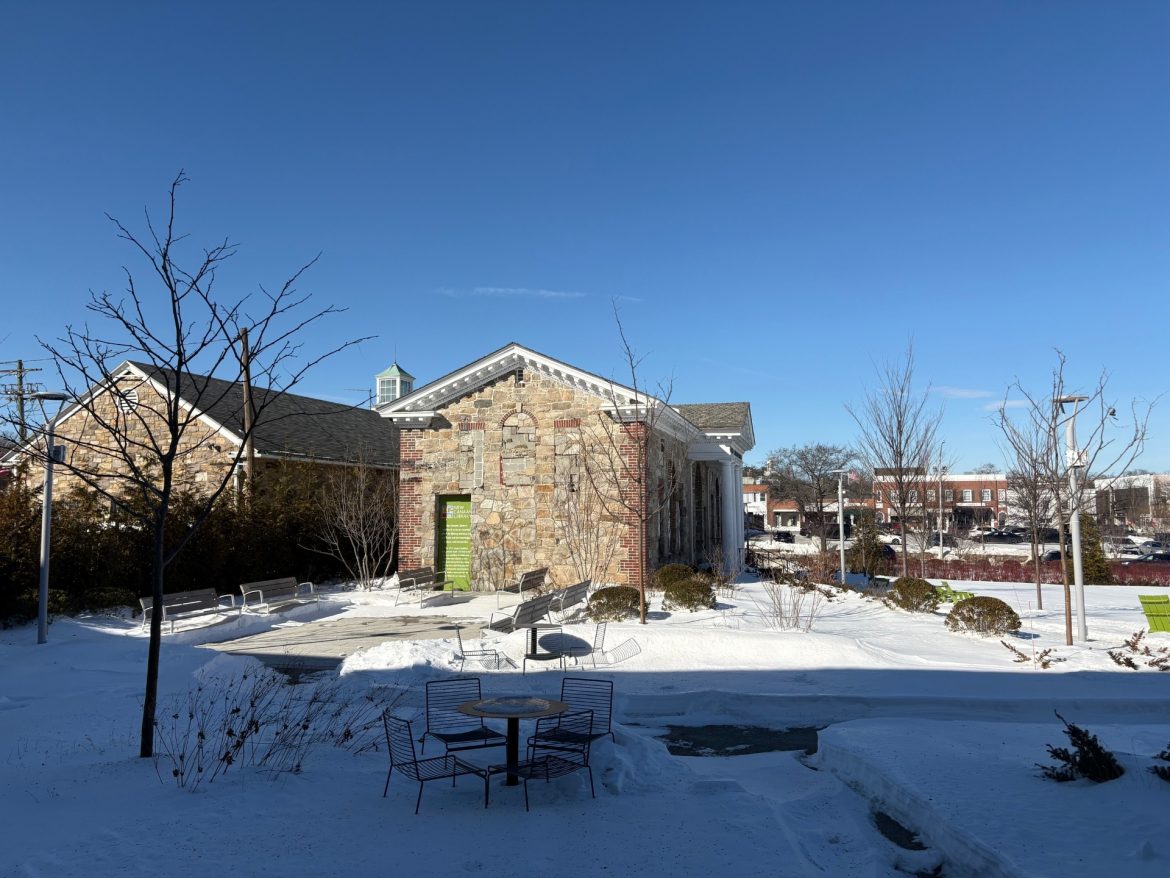
New Canaan Library officials are seeking a $1 million grant from the town to help redevelop its legacy building —about one-half of the cost of a project that the organization is planning.
Tasked by the Planning & Zoning Commission with preserving the original 1913 building—which was not part of the library’s rebuilding plans—the library spent $2.4 million, an “additional cost that we undertook with our own cash and our own endowment reserves to preserve, pick up, lift and move that building,” according to library CEO Ellen Sullivan Crovatto.
“This has left us with a very big hole to fill,” Sullivan Crovatto told members of the Board of Finance at their Feb. 5 meeting, held at Town Hall and via videoconference.
She added: “I think the building’s new position has pleased pretty much everyone. We are going to be working hard now to restore its lustre. So over the summer, we worked with a local architect and builder to come up with a preliminary set of plans that will maximize the flexible use of the space. And I think it’s important to understand we’ve had three years to understand how our current building works and where we need to grow and where we need to create new opportunities to enhance service to the community and also create spaces for our staff to work and our nonprofits to meet.”
Sullivan Crovatto’s comments came during a budget presentation to the finance board. The library is seeking an approximately $3.1 million grant from the town for next fiscal year, a 3.5% increase over current support ($105,500 more).
The presentation itself was similar to the one given to the Board of Selectmen last month, though Sullivan Crovatto was able to provide more details about what the organization is envisioning for the 1913 building, as well as how much it would cost. The 1913 building would serve as a flexible meeting space that could be used for special events. Asked by Board of Finance member Michael Chen whether using the legacy building would bring additional operating costs, Sullivan Crovatto said “the rental income opportunity is very large” and any such costs are expected to be offset.
The library has “developed a preliminary design that has a very flexible use case that works for our needs but also I think works very well for the needs of the community,” Sullivan Crovatto said.
She continued: “We’re estimating that a buildout that would cost approximately $2 million. And I think that given the public’s interest in preserving the building—which was not part of our original plan—I think it’s appropriate that we come before the town and ask today for a town grant of about $1 million which would be 50% or the cost of that going forward. I think this would really help us to rebuild and launch the project in the public eye so that we can begin to plan for its future.”
Sullivan Crovatto noted that the town’s support “would be an important factor in securing its redevelopment, and possibly enabling the building to open for our 150th anniversary which is in the year 2027.”
Additionally, “having this support from the town would also make us eligible to apply for possible Connecticut State Library grant funds up to $1 million,” Sullivan Crovatto said.
“Which would mean we don’t have to tap our donor base too terribly for this renovation—obviously, that is of great interest to me,” she said. “Once we are better able to understand how the town might support a project, we’ll be in a better position to talk about what a financial structuring plan and what final designs would look like. We have formed a small committee of community leaders and our board members who will be reaching out to the wider community for input here once we have a better picture of what the financial support might look like. So then we’ll begin in earnest to present our plans to the P&Z and to the community. In this budget we have put in a very modest amount of increase allowing for the hopefully idea that legacy might come online some time during 2027-28.”
Though it didn’t take a formal vote at this midway stage of the budget process, the Board of Finance signaled its support for the $1 million grant, with Chair Todd Lavieri asking whether it would be better to place a $500,000 grant in each of the next two fiscal years rather than a single allocation.
“It’s not the end of the world if we put in $1 million, since you’re not going to go get the money for at least a year,” he said.
The timing of a grant from the town is important.
Sullivan Crovatto said that in order to qualify for the Connecticut Grants, “we need to begin the process with a letter of intent to the state June 1.”
“And in order to be approved and move forward with bonding from the state for a grant, we would need to be able to show the kind of support we can get from the town,” she said.
Sullivan Crovatto added, “We can’t spend money on construction costs. If we’re going to be successful with the grant, we can’t put spades in the ground but there are preapproved expenses—engineering, site studies—those we can spend money for.”
The library has seen high demand for its meeting rooms, especially among nonprofit organizations. A revamped 1913 space could accommodate those organizations, as well as library staff, and could even help the library differentiate its hours so that a nonprofit could hold a meeting there after regular hours without requiring the full new building to remain open longer. The renovated space would include an ADA-compliant bathroom as well as a small kitchenette.
Sullivan Crovatto said, “It’s much harder to keep the whole building open for one person’s meeting, but if you need to have a board meeting, and you need to go past 8 o’clock, we can certainly accommodate that in a space like this.”
Sorry, what? The library coughed up 2.4 mil to move that building? Someone got rich on that one!
Two wrongs do not make a right, the saying goes. The first wrong was the governmental decision that the library preserve the old building, bowing to misguided public pressure in the face of a well-designed new facility. sans the old building. We now have a looming second wrong, partial public funding of the renovation of a building that should not be there in the first place. While there would be an alignment of sorts with such funding, I do not want my tax dollars spent in this way.
I agree that taxpayer dollars should not be spent in this way. The town has far higher priorities.