‘New Canaan There & Then’ is sponsored by Brown Harris Stevens Realtors Bettina Hegel, Joanne Santulli and Dawn Sterner.
In the third summer of the Civil War, Union Army Private Justus Silliman, a 21-year-old native of New Canaan, wrote home about his role in the greatest battle in American history.
Hospital 11th Corps
Public School Gettysburg Pa
Friday, July 3rd 1863
My Dear Mother,
You undoubtedly will have heard of the fight before you will have received this. I am a prisoner, yet the fighting still continues.
We marched from Emmitsburg Md. to this place on the morning of July 1st. The roads were muddy and the march very tiresome as we were pushed forward in great haste. On arriving to within about three miles of the town we heard the cannonade and for the first time it entered our minds that we might soon have some fighting to do.
On our arrival at the town we found the 1st Corps engaged with the enemy and learned that its brave commander Gen. Reynolds had been killed in the first charge. The citizens lined the streets holding cups of water, but we had no time to stop but passed through almost on the double quick and took our position on the right of the town.
After changing our position several times more in as many minutes most of us threw off our knapsacks and in ranks stretched ourselves on the ground to rest ourselves and escape the shells which were continually flying over. My gun would not work so I dropped it and picked up another. This also missed fire (it rained during the morning).
Just then the man next to me was shot dead. I seized his gun and had just fired at some rebs advancing on our left when I experienced a curious sensation in the head. On opening my eyes I found myself in a horizontal position and surrounded by Greybacks, our men having been forced back a short distance. I placed my cartridge box in front of my bruised noodle and lay a short time.
Was then sent to a rebel hospital about three miles to the rear. Here we had every attention shown us, our wounds promptly attended to and received kind treatment. Those who a short time had been hurling death at us, now assisted our wounded bring them water and crackers and such.
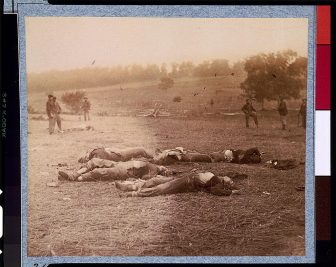
By Civil War Glass Negatives – Library of CongressCatalog: https://lccn.loc.gov/91732541Image download: https://cdn.loc.gov/service/pnp/cph/3g00000/3g01000/3g01800/3g01827v.jpgOriginal url: https://hdl.loc.gov/loc.pnp/cph.3g01827, Public Domain, https://commons.wikimedia.org/w/index.php?curid=65867597
Silliman’s unit, the 17th Connecticut Volunteer Infantry, was part of the grand opening scene of the battle of Gettysburg. Fighting commenced on July 1, 1863, counterintuitively, with the Union Army to the south blocking General Robert E. Lee’s Confederate Army’s attack from the north. The 17th’s entrance took place on the first day of battle, at Barlow’s Knoll, named after the young Union General who recklessly pushed his 11th Corps into an advanced and exposed position that was quickly overrun by the rebels. It was a blunder of disastrous proportions, resulting in a chaotic Union retreat and casualties of upwards of 50% in some regiments.
***
Justus Mitchell Silliman was born in New Canaan in 1842, the younger son of Joseph Silliman, Jr., a Yale graduate and prominent resident who had taught school in town before being admitted to the bar in New York. His great-grandfathers Robert Silliman and Justus Mitchell were also Yale graduates (1737 and 1776) and clergymen, the second and fourth ministers of the Congregational Church.
Facing mounting defeats and extraordinary casualties at the hands of the Confederacy, on July 1, 1862 – exactly one year before the outbreak of Gettysburg – President Lincoln issued a nationwide call for additional troops (in fact a staggering 300,000 men). William Henry Noble, a Bridgeport lawyer, proposed that he raise a regiment entirely from Fairfield County, and Silliman’s 17th Connecticut was thus formed.
The regiment’s first stop was at Fort Marshall in Baltimore in September 1862, where the 21-year old’s thoughts turned not to upcoming glory but the fairer sex:
How are all the Newcanaanites, particularly the feminines, as Uncle Joseph calls them? Tell Julia Carter [a cousin] I will write to her the first opportunity. Is Cara [a servant] as lively as usual and does she get to the washtub Monday mornings as early as ever? I suppose Cousin Mary is enjoying herself, my love to her.
By contrast, in early March 1863, in the midst of an otherwise innocuous letter to his brother thanking him for a gift box containing jelly, biscuits and eggs (“six of them held their own”), Silliman dropped a grenade:
We are having a very interesting time in camp. Col. Noble has arrested nearly all of our line officers for their having signed a request to General McClean that the Colonel either be taught how to drill the battalion properly or be dismissed. The officers expect the court martial to come off soon, which will probably terminate in either the Col. or the officers leaving for home. As I have another letter to write I will close for the present.
Talk about burying the lead. For the next two years numerous letters from Silliman sprang forth – to his mother, brother and cousins – about the war, politics, race relations, food and females. But not a whiff of a mention, let alone a considered follow-up, of the incipient mutiny of almost every officer in the 17th Connecticut.
The regiment’s first significant action wasn’t until May 1863 at the battle of Chancellorsville, in Virginia. As was the case at Gettysburg a few months later, it did not end well:
The attack commenced about four oclock Saturday afternoon. Five minutes after the first shot was fired the bullets grape and shell cam whistling and singing over our heads most melodiously. The waiters and others at the house jumped on their horses and were off in a hurry. The signal captain after tearing his signal flags off their supports followed their example.
The Major was some excited, but said he did not know what to do as he had no orders. We had been placed there to support the batteries, but they had left us. The rebels were on our flank, so we could neither change front or return their fire. They had nearly reached the house when he ordered us to make for the woods. As the regiment was divided before the attack, it was impossible to collect again.
The 17th Connecticut at Chancellorsville was a victim of the tactical brilliance of Robert E. Lee (“his perfect battle”) and his finest general, Thomas “Stonewall” Jackson, not to mention the utter incompetence of their Union Army counterparts. The losses were frightful:
Our Lt. Col reported killed and one hundred & one of our regiment killed, wounded & missing, besides several other officers. I have seen no official report of the same number for our brigade but have heard it stated that there were between six and seven hundred out of 2400 engaged. There was certainly a want of generalship somewhere or we could not have been surprised and flanked as we were.
***
Justus Silliman’s captivity after the debacle at Barlow’s Knoll in Gettysburg was mercifully short-lived. Following General George Pickett’s unwise and ill-fated charge on the afternoon of the third day of battle, ensuring an almost mythological victory for the Union, the Confederate Army withdrew south under the cover of night, never to be seen in the north again. As prisoners of war would only have slowed that movement, Silliman was left behind.
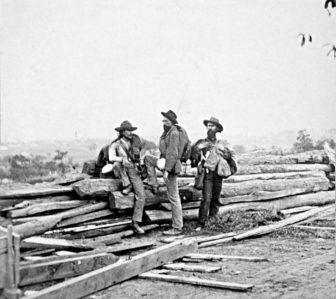
Gettysburg, Pa. Three Confederate prisoners. July 1863. Wikimedia Commons
The 17th Connecticut spent the remainder of the war in more temperate (and safer) climates, South Carolina and Florida. It was in the latter that Silliman recounted his receipt of the news of the extraordinary events taking place northward in April 1865:
We received the sad and startling intelligence of the assassination of President Lincoln last Saturday night while we were rejoicing over the glorious news of the recent victory of our arms, and the prospect of speedy peace and restoration of the union.
So great was our surprise and grief on hearing it we could not utter a word. It seemed as though from the sunshine of our joy we had become suddenly enveloped in a dark and gloomy cloud that was horrible to contemplate.
Being the progeny of clergymen, Silliman divined a possible lesson in the collective grief,
Then we reflected that our cause was still in the hands of the Supreme Ruler who has thus far guided us through our troubles, and that he might have removed from us the Father of our Country that we might be induced to place our whole reliance on the God of our fathers, and not man as perhaps had been done by a large portion of our people.
Justus Silliman was mustered out of the 17th Connecticut on July 19, 1865. He soon entered Renssalaer Polytechnic Institute and graduated in 1870 with a degree in mechanical engineering. He was later appointed to the engineering faculty of Lafayette College and remained a member there until his death in 1896.
Professor Silliman was married in 1876 and had three children. He stayed loyal to New Canaan. In addition to being active in church and YMCA affairs, he was one of the founders of today’s New Canaan Museum and Historical Society.
As a proud Lafayette grad, (though the college may not be particularly proud of me), I can attest to Prof Silliman’s accomplished legacy at the school.
This is a fascinating story. I’m touched that the Rebels cared well for their prisoners. I’m proud of Justus Silliman, and all the Silliman family — I do remember Silliman’s Hardware on the corner of Main Street and East Avenue. –Peter Hanson, Lafayette College ’61
For historical accuracy. a few notes. Francis Barlow wasa brigade commander in the 11th Corp commanded by Oliver Otis Howard. Howard troop placement of the right of the union line was exposed by the lack of any elevated position to defend, Barlow’s Knoll was slightly elevated but not enough and was outflanked and easily over run by numerically superior confederate forces. Picket was a division commander in Longstreet’s First Corp and did not plan the assault that was General’s Lee’s decision. Young Silliman after the battle was allowed to remain in Gettysburg to nurse his good friend Mathew(?) Comstock from New Canaan who was severly wounded and died some 6 week later in one of the field hospitals. Most of the New Canaan men serving in the 17th regiment were in Company H. Justis Silliman is buried in the Silliman plot in section C of Lakeview Cemetery.
Enjoy your articles on New Canaan lore. It is interesting that in 1862, we were already known as newcanaanites. Keep the stories coming.