‘New Canaan There & Then’ is sponsored by Brown Harris Stevens Realtors Bettina Hegel, Joanne Santulli and Dawn Sterner.
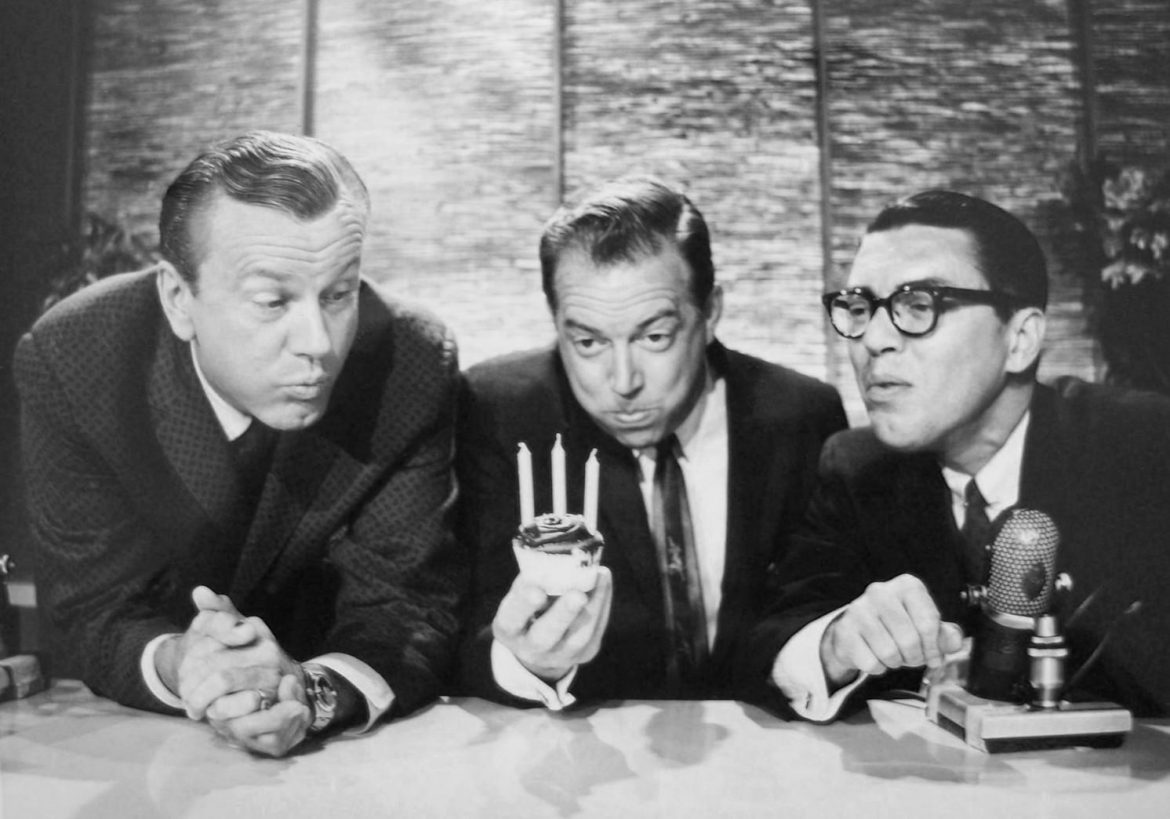
On Feb. 11, 1960, Jack Paar, America’s first late-night television king and the second host of NBC’s Tonight Show, on the cover of both Life and Time magazines and at the height of his fame and power, did the unthinkable: He quit his job. In tears. And in front of a live studio audience in Studio 6B of the NBC Studios at 30 Rockefeller Plaza, New York.
But back to that moment a bit later . . ..
It’s tough to describe Jack Paar in print.
The late-night talk show host Dick Cavett, who was often referred to as the “intellectual Johnny Carson,” started out as a copy boy at Time and became Paar’s booker, and ultimately his favorite writer.
Here’s Cavett’s description of his former boss, as related to the Archive of American Television in an interview a few decades ago:
“It was an exciting job because of his extremely neurotic and quite thrilling personality. I don’t know how to explain Jack. His quicksilver, odd, impetuous, witty, unsettled, suspicious personality and ten more things you could throw in that list. To me it made him the most interesting and compelling face that’s ever been on the television screen.
The great critic Kenneth Tynan put it best when he said “when you watch the Paar show, even with someone else on the screen who is infinitely more famous, or of greater stature, like Cary Grant, you realize you can’t take your eyes off Paar because if you do, you might miss at any moment a live nervous breakdown on television.”
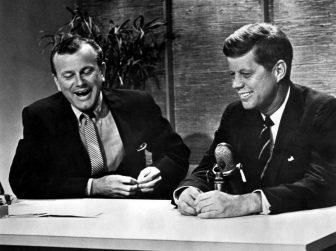
Photo of television host Jack Paar and John F. Kennedy as a Senator and Presidential candidate when he appeared on The Tonight Show in 1959. Jack Paar, who was then the “Tonight Show” host, presented an ABC Special, ABC Stage 67: The Kennedy Wit, in 1966. By ABC Television – eBay itemphoto frontphoto back, Public Domain, https://commons.wikimedia.org/w/index.php?curid=17309060
The progenitor of “must-see-TV,” who called New Canaan home (115 Pequot Lane) for many years, Paar turned late-night television into an American national institution as host of the Tonight Show from 1957 to 1962, interviewing the likes of Fidel Castro, John F. Kennedy, Richard Nixon, Muhammad Ali and Judy Garland, and helping to launch the careers of Carol Burnett, Woody Allen, and Liza Minnelli, besides Cavett himself.
Even though his late-night reign only lasted five years (as compared to Carson’s 30 years), Paar was a seminal figure in television.
“Before Jack Paar, there were various variety shows doing the midnight watch,” the critic John J. O’Connor wrote in The New York Times in 1997. “He simplified the format into a talk show, complete with the sofa-and-desk set that remains a fixture. His secret? Interesting guests, far more so than the celebrity hordes working on product plugs today, and an uncanny ability to listen carefully and engage in clever and often witty conversation.”
***
Jack Harold Paar was born in Ohio on May 1, 1918. His childhood wasn’t easy. As a young boy he overcame a stutter, and at 14 contracted tuberculosis. After dropping out of high school at 16, Paar became a broadcaster and disc jockey for various Midwest radio stations.
Paar was on the air in Cleveland in 1938 when Orson Welles broadcast his famous simulated alien invasion over the CBS radio network and its WGAR affiliate. Attempting to calm panicked listeners, the 20-year-old Paar boldly announced to them, “The world is not coming to an end. Trust me. Have I ever lied to you?”
In 1943 during World War II, Paar was drafted into the U.S. Army and assigned to entertain troops in the South Pacific. Paar was remembered (by himself at least) as a clever, wisecracking master of ceremonies who narrowly escaped being court-martialed for his dead-on impersonations of senior officers. In 1947, Jack Benny, America’s most popular radio comedian, was so impressed by Paar’s U.S.O. performances that he suggested that Paar serve as his summer replacement; Paar parlayed that opportunity into a radio show on ABC.
After the war Paar was also signed as a contract actor for Howard Hughes’s RKO studio, where he appeared in a supporting role in a number of forgettable films. His high point in Hollywood was actually his work for another studio, Twentieth Century Fox, where he played Marilyn Monroe’s boyfriend in the 1951 movie “Love Nest.”
Throughout the early 1950s, Paar made regular television appearances as a comedian, including on Ed Sulivan’s legendary show. He honed his chops by hosting a game show (“Up to Paar”) as well as a morning variety production.
In 1954 Steve Allen became the first host of The Tonight Show (NBC still trumpets it today as “the world’s longest-running talk show” as well as “the longest-running regularly scheduled entertainment program in America”). After the network offered Allen his own prime-time hour in 1956, he decided to leave The Tonight Show the following January, providing an opening for Paar.
***
Paar transformed The Tonight Show from a typical variety format to something completely new. With a rare combination of intelligence, intuition and irreverence, he invented a new genre of programming that would become a mainstay of modern broadcasting.
In a segment on Late Night with David Letterman in 1983, Paar recalled his visit to Havana, Cuba in 1959 to conduct the first interview with Fidel Castro. Paar’s classic stream-of-consciousness style was on full display:
“I was there four days after the revolution. I lived beneath Castro in the same hotel where he was staying in the penthouse suite. He came down at 2 am surrounded by nine guys with machine guns. When I met him, in my nervousness I blurted out to him, ‘You live above me.’ Castro said yes with a grunt. I then said to him, ‘I hope you didn’t come down to borrow sugar.’ He looked at me like I had four eyes.”
Incidentally both Paar and Letterman (a former late-night king in his own right and today a noted Civil War reenactor) lived in New Canaan at the time of the 1983 interview.
On June 16, 1960, Senator John F. Kennedy joined Paar and made history by being the first presidential candidate to appear on late-night television. Kennedy incorporated much of his standard stump speech into the interview (his nomination by the Democratic Party in Los Angeles was only four weeks away), including his comment that in the post-World War II geopolitical scene, the United States was “the only guardian gate against the Communist advance.”
Kennedy’s brother, Robert, made several appearances on Paar’s show, including one memorable interview that led to both Paar and RFK being sued by Jimmy Hoffa for $2 million after Kennedy labeled him “a common thief and crook.” The suit by Hoffa, then President of the Teamsters Union and future Giants Stadium denizen, was later dropped. Walter Winchell, the powerful syndicated gossip columnist also unsuccessfully sued Paar for libel; in his 1983 interview Paar charitably noted about Winchel that “the man is dead and I don’t wish to speak about him again – it’s not fair.”
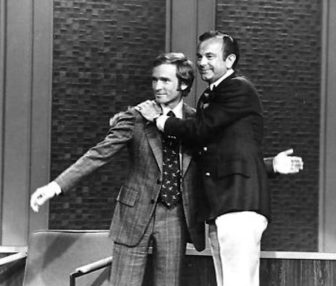
Publicity photo of Jack Paar and Dick Cavett from The Dick Cavett Show. Paar appears to announce that he will host a once monthly television talk program, 1973. By ABC Television – eBay itemphoto frontphoto back, Public Domain, https://commons.wikimedia.org/w/index.php?curid=16522237
Paar found the everyday routine of planning a nearly two-hour program five nights a week to be too difficult to sustain, and his final show aired on March 29, 1962. He later confided to Dick Cavett that leaving the Tonight Show was the greatest mistake of his life.
***
In an effort to keep Paar from jumping to another network, NBC offered him a Friday prime-time, hour-long gig with full control of content and format. That show, entitled The Jack Paar Program, debuted in the fall of 1962 and ran through 1965. It had a global perspective, featuring acts from around the world and exhibiting travel films from exotic locations, including Russia, Africa and Latin America.
The best guest on that show? Surprisingly, in the opinion of Paar’s director Hal Gurnee (who later also directed Letterman) it was none other than Richard Nixon, who had previously appeared on The Tonight Show in both 1960 and 1962. Gurnee recalled that Nixon “came on the show in 1963 after he lost the [1962] governor’s race in California when he had said to the press, ‘You won’t have Nixon to kick around anymore.’ He agreed to play the piano if he could play his own music. He wrote the piece and Jack hired a string section for him and made it into a big deal. The whole thing was great television.”
In a one-upmanship over his now rival, Paar showed film clips of the Beatles performing on November 15, 1963, a full three months before their famous live appearance on The Ed Sullivan Show on February 9, 1964. The fact that at the time Paar was using the clips to make fun of the Beatles escaped him in later years when he bragged about his showing them first.
The final segment of the program, broadcast on June 25, 1965, featured Paar’s favorite guests from past shows, including Richard Burton, Bette Davis, Liberace, Jonathan Winters, and the Rev. Billy Graham. In classic Paar fashion, the show ended with him sitting alone on a stool recounting a discussion that he had with his daughter about his departure, culminating with Paar summoning his dog to come onstage as he left it.
Save for a brief show called Jack Paar Tonite (yes, that’s the spelling) which ran on ABC for one season (1973-1974), and introduced comedians Freddie Prinze and Martin Mull (yet another Newcanaanite – NCHS ’61) to a national audience, Paar’s career was effectively over.
***
Paar’s retirement allowed him to spend more time at 115 Pequot Lane, a post and beam house that was custom built for the talk show host in 1973. In 1986 the house was sold to Spiros “Sid” Segalas, an investment manager. For the next 37 years until his death, Segalas essentially kept 115 Pequot Lane house exactly as it was when it was constructed in 1973.
“It’s like going back in time,” said the listing broker who sold the house on behalf of Segalas’s estate in 2023. “It still had the green shag carpet, the original 1973 kitchen wallpaper and tile and the original signage (e.g., ‘Desert Room,’ ‘Royal Enclosure’) throughout the house.”
Paar “had a lot of great parties in the house,” the broker continued. “He had a buzzer installed under his foot in the dining area so that the martinis would flow freely from the staff without interrupting his hosting duties.”
Finally, back to that extraordinary exit Paar made less than ten minutes into his 105-minute Tonight Show on February 11, 1960. The night before Paar quit in a fit of pique, NBC censors excised the following joke Paar had made to his studio audience earlier that evening before its playback at 11:15 pm:
“An English lady is visiting Switzerland looking to rent a room. After viewing a few options and choosing one to let, she returns to her hotel, where she realizes she forgot to ask about the W.C. [bathroom]. Too bashful to write ‘water closet,” she sends a polite note to the Swiss schoolmaster who owns the house, inquiring about the location of the ‘W.C.’
“Because English is not his first language, the schoolmaster has no idea what ‘W.C.’ means. He consults with the local parish priest for help, and the two men conclude that the initials must stand for ‘Wayside Chapel.’
“The schoolmaster enthusiastically writes back to the English lady to explain that the ‘W.C.’ is located nine miles from her room; is very popular, capable of holding 229 people, with both wooden benches and cushions; and is only open on Sundays and Thursdays.
“In closing, the schoolmaster mentions that his daughter was married in the W.C., and it was also there that she met her husband.”
Jack Paar made a triumphant return to Studio 6B three weeks after he left, with a full apology from NBC in hand, and told the W.C. joke to an audience whose attention was probably more rapt than the joke deserved. He truly got the last laugh.
Jack Paar died Jan. 27, 2004, age 85, in Greenwich, Conn. In classic form Time magazine’s obituary of him reported wryly, “His fans would remember him as the fellow who split talk show history into two eras: ‘Before Paar and Below Paar.’”
[I will be on hiatus from contributing to “There & Then” for the upcoming summer; my sincere thanks and eternal gratitude for all your kind support over the past eight months. — Nick Williams]
Nick,
Your excellent contributions to our knowledge of New Canaan’s history are greatly appreciated. Enjoy your summer off. We look forward to more “There & Then.”
Great article Nick! I had the pleasure of helping Susan Goodman, the best caterer in town back in the day, work a party at Mr. Paar’s house. A legend!
Nick, I wish you would do a podcast. I have limited time and energy to read long articles, but would love to listen while I walk!
Nick will be presenting a Lunch and Learn at the Museum on Tuesday from 12-1 on the movie, 1776, Fact or Fiction. I think you would enjoy that if you can come. You bring your own lunch or snack and we provide the entertainment. All are welcome!
Register here: https://www.zeffy.com/en-US/ticketing/lunch-and-learn-with-nick-williams-declaration-of-independence-through-the-prism-of-the-movie–1776
There was this feature on the Jack Paar house a few years ago: https://www.ctinsider.com/realestate/article/nbc-tonight-show-jack-paar-new-canaan-ct-house-18578599.php
In the late 1990’s, I was at the High Ridge Shopping Center in Stamford, where the Barnes and Noble is now.
An older man, quite frail-looking, was walking towards me.
I thought… that guy looks like an old Jack Paar.
He made his way to his car, a classic brown Rolls Royce.
As he pulled away, I saw the license plate: JP.
So, I was right. It was Paar.
I thought it strange that nobody seemed to notice him.
But things got stranger.
About two weeks later, I was shopping at the now defunct Turn Of River Hardware on High Ridge Road.
There, at the checkout counter, was again Jack Paar.
He was buying a bucket of driveway sealer.
He apparently had a charge account there, and the teenage girl behind the counter asked “What was your name again?”
He answered very slowly, “Paar… P-A-A-R.”
I remember thinking– 40 years ago, one of the most famous people in America. He picked up his driveway sealer and left.
Later that day, I felt badly that I hadn’t offered to carry the bucket to his car.
Nick – you are not only entertaining and interesting but prolific as well. Jack Paar was a neighbor of my Bronxville NY classmate when Paar had some tiger cubs as pets. The tigers generated a lot of publicity – mostly good but eventually animal control authorities got involved and the tigers were moved to a zoo.
This article is fantastic! I toured Jack Parr’s house a few years ago when it was on the market. I immediately fell in love with the architecture, and the fact that it was so charming with the green shag carpet, dining room foot buzzer for pronto staff service, sign by the garage, warning “Don’t even think of parking here”, as well as sports options galore – a tennis court with a “royal viewing gallery”, pool with a rustic outdoor bar, and paths snaking to a paddle tennis court too. I loved it so much that I called a client and had him tour it the same day- unfortunately, it wasn’t for him. It traded very quickly and the buyer was lucky, indeed.