New Canaan Now & Then: The Congregational Church

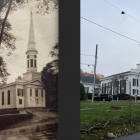
The history of New Canaan is tightly entwined with the history of the Congregational Church. By 1731 enough members in the New Canaan area were tired of traveling to either Norwalk or Stamford to attend services on Sunday, and they petitioned the colonial government to form their own parish in the area. Their request was approved and the Society of Canaan Parish was established, which covered just about the same area that New Canaan does today. The entire membership of the church was only twenty-seven people. With the church established, it began to collect taxes from both members and nonmembers living in the parish.

New Canaan Now & Then: The Playhouse

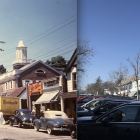
In 1922, when the New Canaan Playhouse was built, current day Elm Street (then Railroad Avenue) was vacant land, except for one resident on the south side.  A group of local men, The Village Improvement Company, recognized the need for a playhouse.  Their proposal included the opportunity for each and every resident to become a stockholder. 

The cupolaed building was designed by local resident, Calvin E. Kiessling. Kiessling’s design, the red brick and white trim, suggesting a  modified colonial structure, established the style for the future buildings that eventually filled in both sides of Elm Street. The building had a frontage of 58 feet on Railroad Avenue (Elm) and extended back 100 feet with flanking passageways on each side used in conjunction with the fourteen exits in addition to the exits off the main lobby. The original plans also called for two stores at street level. The auditorium itself was originally 56 feet wide and 76 feet deep, with a seating capacity of 400.

New Canaan Now & Then: Grace House in the Field

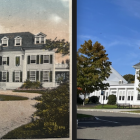
The New Canaan Country School campus has a long history of serving the needs of children and the majestic main campus building, Grace House in the Fields, has been an integral part of this legacy. Grace House was completed in April 1899. The columned portico was fronted by a dirt driveway lined with sugar maples. If you happen to drive up Frogtown Road, be sure to take notice of the size of these trees today. 

The NCCS acquired the property from the Grace Episcopal Church of New York in May 1936 as a new campus, having outgrown its prior location on Seminary Street. At the time of the acquisition, the St.

New Canaan Now & Then: The Thrift Shop

The next time you are waiting at the light on Locust Avenue take a minute to consider the interesting history of the building that currently houses the New Canaan Thrift Shop. This clapboard Greek revival home was built in 1840 by Joseph Scofield. Scofield purchased the property, “75 feet from the highway,” from Seymour Comstock for $150. Scofield, a prohibitionist, leased the two-story house to the Young Men’s Total Abstinence Society (later known as the Friendship Division of the Sons of Temperance). Unfortunately, Scofield had limited success with prohibition.  The upper floor of 2 Locust Avenue was used as a dance floor and boasted a vaulted ceiling that was painted to resemble the night sky.

New Canaan Now & Then: Ponus Ridge Chapel

The history of the Ponus Ridge Chapel begins in 1902 when a group from the Ponus Ridge area began to hold church services and a Sunday school in a butcher shop on Davenport Ridge.  

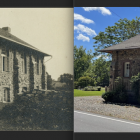
In 1907, the group formally organized as the Ponus Street Union Chapel, a non-denominational Christian group.  In their first meeting, a building committee was created to find land and build a dedicated meeting space.  Both Levi S. Weed and Charles E. Hubbell sold a part of their land to the committee for $1.  In total the parcel was 25′ by 100′.  The chapel itself was designed by Charles E. Hubbell and Charles A. Luckhurst both Ponus Ridge residents and architects.  The stone came from local farms, predominantly from the Thurton farm across the street.  

Two hundred people attended the chapel dedication on September 10, 1911.  It quickly became the center of the community for the area. Six weddings and a funeral were held in the chapel in its first forty years. Many local fairs were hosted from the chapel.  One such fair was centered around the dedication of a bell for the chapel.   Edward Lawerence married Fanny Davenport and so to replace the “belle” that he was taking from the ridge, he gave the chapel a bell in return.  During WWI, the chapel was used by the Ladies’ Aid Society for what is described as “Red Cross work.”  This group of women is most likely the group depicted in the picture above. By the 1930s, activities in the chapel had slowed down.