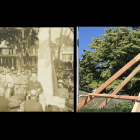
New Canaan Now & Then: Time Capsule

Earlier this week, Tucker Murphy, the Town’s Chief Administrative Officer, asked where the time capsule buried near the Wayside Cross was located. Searching through the New Canaan Museum & Historical Society’s records, we discovered that a time capsule was buried during the Town’s 200th anniversary held on September 29th, 2001. Because the Museum still had the VHS of this celebration, and a TV with a built-in VHS player, too, we could watch the events from 2001.  The ceremonies were held just weeks after 9/11, and many of the patriotic speeches reflected the town’s sense of loss and grieving.  The burial of the time capsule at God’s Acre received a relatively short mention, and the location remained unclear. 

However, with some sleuthing and additional research, we were able to identify that this time capsule was buried a few feet behind Wayside Cross in a carefully constructed hole lined with plywood and gravel.  The capsule, which is meant to be unearthed in 2051 for the Town’s 250th anniversary, holds fifty items including dance tickets to the New Canaan High School, a map of the Town and its parking lots, a telephone book, and newspaper clippings about the World Trade Center disaster.  

The real mystery, and what it turned out Tucker wanted, was a 1923 time capsule.  A few weeks before the 200th anniversary celebrations, work began to find this time capsule.  Its burial had been recorded in the May 31, 1923 edition of the Advertiser.  The ground around the Wayside Cross was thoroughly turned over, but eventually it was given up for lost. Thanks to this article, and some current day research, we now know the location of this 1923 time capsule.  The April 12, 1923 edition of the Advertiser states “the coffer will be lowered into the concrete foundation….”  (Rereading the May 31 edition, it does mention that the coffer was lowered into the foundation during Memorial Day celebrations.)  Unfortunately, there is no information on how the coffer was sealed in the foundation.  There is no mention of pouring concrete, lowering it into the wet concrete, or how it was sealed.  Therefore, it seems likely that the coffer is in its own chamber as there was originally a plan to drape the bronze coffer with an American flag.  

It is also of note that General John Thompson, the inventor of the Thompson submachine gun, gave a speech during the 1923 Memorial Day celebration.  Thompson and his wife first lived on Bank Street and later Brinkerhoff Avenue beginning in 1919.  Also at this 1923 celebration was the dedication of the cannon that stands outside Town Hall.  The cannon, most likely a Blakely rifle, was originally located on Governor’s Island in New York City and protected the city during the Civil War. When we wrote about the Wayside Cross in an earlier Then & Now article, we didn’t realize there had been two dedication ceremonies – the first on May 30, 1923, and the second on September 9 of the same year when the cross was finished.  The first ceremony took place on Memorial Day because the Town needed funds for the completion of the project.  Work on the base was about to begin and workers were well on their way on carving the cross.  A decision was made to generate interest – and possible donations – by filling a “bronze coffer” with items for future generations to find.  The contents are as follows:

Letter from President Harding*
Letter from General Pershing*
Letter from Connecticut Governor Templeton*
Autographed copy of President Wilson’s address to Congress declaring war with Germany
List of the soldiers from all wars
Engraved charter of the Veterans of Foreign Wars
List of members of the local branch of the Red Cross
Resolution from the Women’s Relief Corps donating $500 to the Wayside Cross project and listing charter members
List of sixty-three soldiers from St.
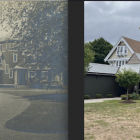
New Canaan Now & Then: The Lindenfield Estate

Taking a step away from “downtown” New Canaan for a week, the subject of this article is more hidden than our usual Then & Now buildings. But for those who attend the First Presbyterian Church, or those who explore the Nature Center with keen eyes, the main house of the Lindenfield Estate is probably familiar. The history of Lindenfield, or the Bliss Estate, begins in 1875 when Osborn E. Bright, an attorney from Brooklyn, bought eight acres of land on Oenoke Ridge from Joseph Fitch Silliman and built his summer residence.  When finished, the new house stood very close to the neighbor’s cow barn, so close in fact that Bright’s wife, Maria, offered to build the neighbors a new barn if they would tear down the existing one.  A new barn could also not be built within 100 feet of the Brights’ land.  At the same time, the Brights also bought a piece of land from the same neighbor for $200.  Probably a deal too good to pass up on, the old barn was torn down and a new one built out of smelling distance. In 1899, the property was sold to Miss Catherine A. Bliss from New York City for $22,500.  Over the next thirteen years, Miss Bliss expanded the house and improved the grounds. A full wing was added along with a large living room and a porch.  The living room was so large that it was able to fit a thirty six foot rug, which was said to have been the second largest rug ever woven in America at the time.  The house built by the Brights would eventually become a hall and a dining room with bedrooms on the second floor.  A farmer’s cottage was built along with a cow barn, a laundry, a grapery, a heated greenhouse, and a potting shed.  To compliment all of this new construction, the property was lavishly landscaped with various rare trees and shrubs.  Wetlands behind the house were drained so that flowerbeds could be installed as well.  The stone wall along Oenoke was repaired and an entrance was installed.  Because the driveway was lined with linden trees, the estate was named  “Lindenfield.”  Miss Bliss had an active social life in New Canaan and New York City.  She was a member of Grace Church and helped it purchase 140 acres on Ponus Ridge.  The house and the property became Grace-in-the-Fields, a retreat for underprivileged mothers and children to vacation, and is now the New Canaan Country School. When Miss Bliss passed away in 1916, the property was inherited by her niece, Susan Dwight Bliss.  Susan, like her aunt, was also a summer resident, but still managed to be a great benefit to the town.  During WWI she had a large vegetable garden  planted on her property to help the war effort.  When the Great Depression swept through New Canaan, she employed over 200 workers on various jobs around her estate.  Bliss was also an avid collector of rocks from her frequent trips and had a special octagonal building constructed to hold her collection.

New Canaan Now & Then: Wayside Cross

A. L. Benedict first proposed what would become the Wayside Cross in a letter to the editor of the Advertiser in 1915  He proposed that the 18 acres donated to the town be made into the Soldiers’ and Sailors’ Memorial Park.  His idea was rejected, and the land later became Mead Memorial Park.  However, the Town recognized the need for some sort of war memorial, and residents proceeded to fight over the specifics for the next eight years.  By 1919, it seems that sufficient funds had been raised, but there was no clear direction to the project.  The idea for the memorial to take the shape of a cross and to be at the base of God’s Acre seems to have come from local artist Daniel Putnam Brinley, a prominent member of the Silvermine Guild of Artists.  The cross itself was designed by both Francis Adams Kent and W. Frank Purdy, who was the director of the American School of Sculpture and a local resident. Francis Adams Kent was a student of Gutzman Borglum, the artist who carved Mount Rushmore, and the brother of Solon Borglum, who started the artist colony in Silvermine in 1908. The Wayside Cross was dedicated at 3 pm September 9, 1923.  1,500 people attended to honor the fallen soldiers from New Canaan.   Major General John F. O’Ryan and Admiral Robert P. Forshew were both invited to address the crowd.  Lieutenant Commander F. L. Humpreys, pictured above, read “the Roll of Honor of New Canaan who made the Great Sacrifice.” The ceremony was recorded in meticulous detail by the Advertiser and featured seven photographs, which was very unusual for the time, as well as a transcription of the opening remarks and the general’s.   Even fifteen years later, the ceremony was described as one of the greatest things to happen here in New Canaan. The Celtic cross is carved from travertine limestone imported from Rome.  The cross alone weighs 10 tons and stands sixteen feet five inches tall.  There are five carved panels on the front of the cross representing the Revolution, the War of 1812, the Civil War, the Spanish American War, and finally World War I. Columbia, the personification of the United States, is depicted in each of the panels – freeing an enslaved person, holding a ship, and rushing off to Europe armed with a sword and shield.   The pedestal on which it sits is inscribed with “Dedicated to the glory of Almighty God in memory of the New Canaan men and women who, by their unselfish patriotism, have advanced the American ideals of liberty and the brotherhood of man.”  The other three sides are inscribed with “service,” “sacrifice,” and “loyalty.”  These inscriptions were finished three weeks after the cross was installed so that they could be adjusted for the natural light.

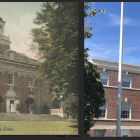
New Canaan Now & Then: Town Hall

New Canaan has had several town halls since it was founded 221 years ago.  The current Town Hall is actually the fourth, but only the second one built especially for that purpose.  

Although New Canaan was incorporated as a town in 1801, the first town hall was not built until 1825.  Until that time, town meetings were held in the Congregational Church, and the clerk’s office and treasury were housed in a business run by Samuel St. John.  When St. John passed away in January of 1825, town officials finally felt that they needed a dedicated building out of which to run town business.  In the next few months, officials decided to build just north of the Congregational Church on land purchased from Joseph Silliman Jr., the third owner of what is now the Hanford-Silliman House.  To fund the purchase of the land and to cover the construction costs, an extra tax of 2.5 cents on the dollar was authorized (on what we assume was property taxes) and four other town owned buildings were sold.  The building seemed to serve its purpose very well as it was the seat of government here for the next forty years until the town sold it in 1865.  Strangely, upon its sale,  the building was moved a few feet from the road and a few feet to the west. The Town House, as it is now called, is located at 13 Oenoke Ridge and it became the home of the New Canaan Museum & Historical Society in 1960.    

New Canaan’s second Town Hall was built in 1834 as the first Methodist Church.  This small structure was originally located on the north corner of Main Street and Church Street.   In 1854, the Methodists sold the building to a group of their parishioners, who had the structure moved up the hill by a team of oxen to its present location of 132-138 Main Street, the current home of Spiga.  The new owners then expanded the building  into a two story structure so that it could seat 500 people and opened the venue as the Concert Hall, even though lectures were much more common than any musical acts.  By 1865, the Concert Hall had gone out of business and the town bought the building for $1,125 despite being in financial trouble due to the Civil War.  The first town meeting was held in this building on October 3.  (The meeting actually started in the Town House, adjourned, and then reconvened and finished in the second Town Hall.) Even though the building has undergone many changes, it is still the second church structure in New Canaan, after St.

New Canaan Now & Then: First Baptist Church of New Canaan

Most may be familiar with this building today, but it is almost unrecognizable in this c 1910 photo.  

This the first Baptist Church in New Canaan, which now stands at 62 Main Street. This church was built in 1872 by the local New Canaan Baptist congregation.  Like every religious congregation in town, the local Baptists had grown tired of spending their Sundays traveling from New Canaan to either Stamford or Norwalk for their services.  The project was spearheaded by Watts Comstock.   Comstock’s involvement would not have been a surprise to residents at the time as his parents, Enoch and Anna, were the first Baptists in New Canaan.  The first service in the church was held on February 6, 1873, and the parishioners included the Tuttle, Weed, Selleck, and Benedict families.  The baptism immersion pool was located under the pulpit, but most converts preferred to head down the hill to be baptized in Mill Pond.  However by the turn of the century, attendance started to wane, and there were no longer the funds to keep the building. In 1908, the building was sold to Dr. James W. McLane, who immediately started to expand the building.  The back of the church was expanded.  He did bump out the front of the building by a few feet so the exterior walls were flush with the front entrance.  Once work was done, Dr. McLane, along with a group of summer residents, financed the “Young Men’s Club” or the “Boys Club.”  With space for a reading/club room along with a gymnasium, it was essentially a precursor to the YMCA.  However, despite the improvements, interest in the club was so low by 1913 that the building was given to the library for its building fund.  The library stayed in its Elm Street location and  62 Main  was rented out to future Selectman George T. Smith and his business partner Segbert S. Brinckeroff.  The pair converted the building into the Suburban Theater, a movie theater and playhouse.  Tickets were a dime and show times were often listed on the front page of the Advertiser.  Acts such as Harry L. Bill, a blind banjo player, drew standing room only crowds.  Other acts were not so lucky.  One act from Springdale was booed off stage after only five minutes and the Advertiser reported they “beat it before the grocer could fetch some eggs to throw at them.”  When the Suburban Theater folded it was replaced by the Pleasant Hour Theater, which seems to have almost immediately closed.  The property was then sold to Francis E. Green, who started his real estate firm in the building.  Green later became a major developer of much of the downtown area of New Canaan.  In 1917, Green sold the building to the local chapter of the Masonic Order, Harmony Lodge No. 67.