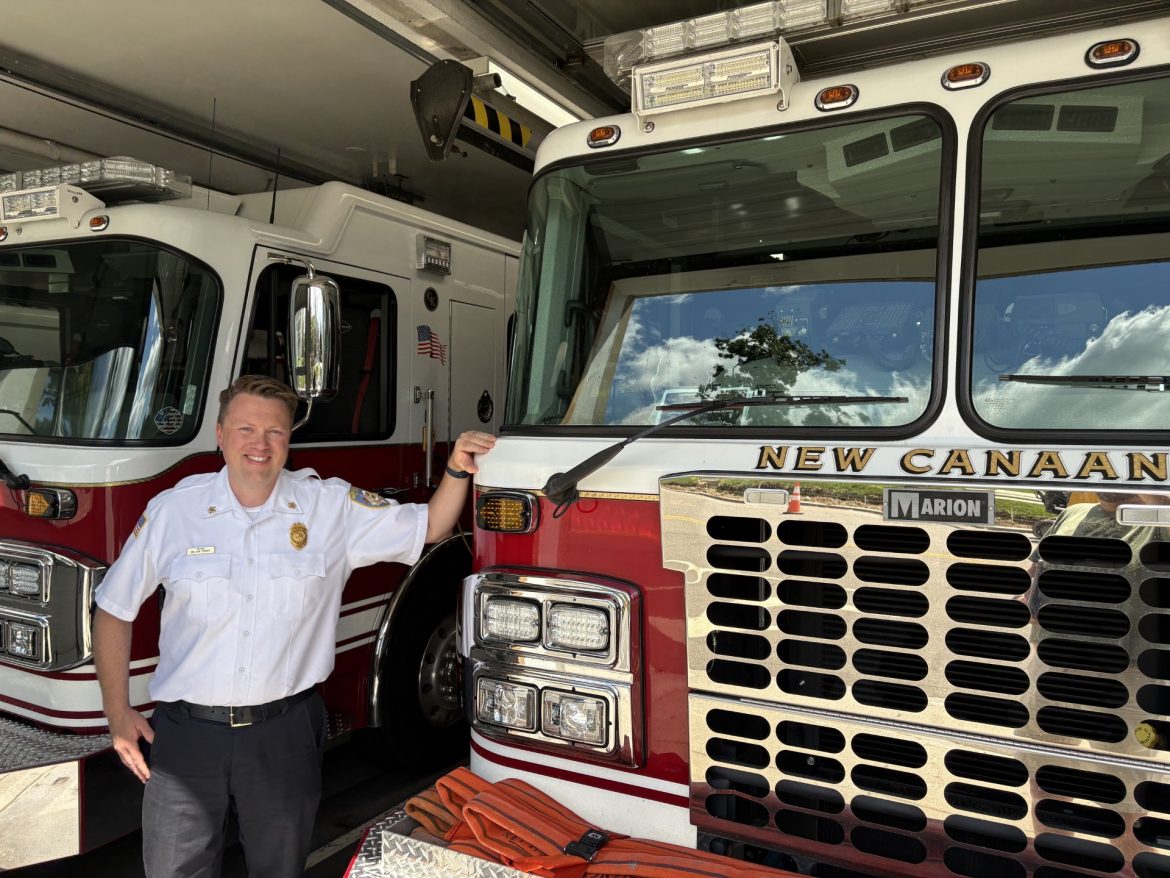
The Board of Selectmen last week voted 3-0 in favor of promoting William Perritt to chief of the New Canaan Fire Department. Perritt has served as an assistant chief and in an interim chief capacity since last May. He succeeds Albe Bassett in the chief position.
We sat down with Perritt on Wednesday afternoon at his office in the Main Street firehouse.
Here’s a transcription of our conversation.
***
New Canaanite: Give some of your background. When did you join the fire service, where are you from, all of that.
William Perritt: I was born and raised in the Bronx. I grew up around the corner from a firehouse, saw them in the community. You’d see them at the supermarket, see them in the neighborhood. Always something I wanted to do. I lived on a main road, the Grand Concourse, big street, so I’d see the rigs go by, and I always liked it. When I moved from the Bronx to Pleasantville my senior year in high school, I joined the volunteer fire department immediately. And once I started getting into that, at 18, I became a full volunteer firefighter. I decided I really liked it. Over the summers I did it when I was back from college, had an internship with the Scarsdale Fire Department. Graduated Holy Cross in 2002.
What was your degree in?
European literature. Not exactly fire service. I was fortunate enough to get hired almost immediately by the Scarsdale Fire Department as a career firefighter. So I started the academy in September of 2002, worked in Scarsdale for about two years. Great group of guys. Transferred over to Hartsdale, which is next door. Hartsdale was a little bit busier with mutual aid fires, bigger buildings, apartment houses, stuff like that. So it was a little more interesting to me. I was there for 21 years. Worked my way up from firefighter to captain to deputy chief. We have municipal training officers— every career department has their own training officer. So I was the president of the Westchester MTO Association. I was pretty heavily involved with training. I am still currently a Westchester County fire instructor and a New York State fire instructor. Did a lot of programs for them, ran the FDNY Westchester County mutual aid drills, where we would practice moving our resources into New York City if there was ever an event, God forbid. So I got to meet a lot of people from a lot of different departments. And I had 23 years when I retired.
Tell me about your interest in the New Canaan position.
New Canaan, funny enough, years ago on this first date my wife, we drove through New Canaan. Went for a drive and I’m like, ‘Wow, what a nice town.’ And saw the firehouse and a real nice New England town. And it was always in the back of my mind, ‘Wow, that’s a pretty cool place.’ And then I had enough time for retirement—I’d always worked on shift, and I have young children, I have a, a nine-year-old and a 12-year-old, and you miss a lot. A lot of nights, weekends, holidays, birthdays. So when I saw this I was like, ‘Wow, this would be an opportunity to work a straight day schedule—be home nights, be home a lot of weekends and holidays, and that’d be really great.’ I knew some people that had interactions with New Canaan. They’re like, ‘Yeah, it’s a great department, it’s a great place.’ So I thought, ‘You know what? Let me see.’ So I put in for it and it was a pretty long process, and ultimately they offered me the job. So then I retired and came here.
What did you come here as?
I came on as assistant chief.
What year was that?
That was May of 2025,
So you’ve had more than a year around the department now. What is your assessment of this department? And also just given some of the challenges the department has faced in recent years, how is morale among the firefighters?
I think it’s a great department. We’re a combination department, so we have 24 career and about 24, maybe 26 volunteer. And they augment each other very well. The career members, there’s always six on duty, rapid response. We have a very large response area, 21 square miles, so getting there quickly is a big deal. A fire doubles in size every 30 seconds. So they get out quick, they train, they’re out the door in 60 seconds, and we have a very dedicated core of volunteers that come in and augment. So I’m very impressed with the operation. I always think there’s areas for growth but I’m very impressed with how they operate, how they work together, how they support each other. My assessment of the morale, I think the morale’s pretty good right now. We have a lot of motivated people. They’re very dedicated. We drill every day for a couple hours in the morning. Since I got in as interim chief, I gave all the officers administrative responsibilities to divide up and put people where they’re passionate, hopefully. And they have gone over and above, with firefighters jumping in and helping, so it’s been great.
You got this impression of New Canaan driving through that day. What’s it been like? You’re now interacting with residents, you’re interacting with municipal workers, you’re interacting with firefighters and other emergency response agencies. What are your first impressions?
It’s going to sound like ‘too good to be true,’ but it almost is. The civilian population, the residents, have been fantastic. You see them come into the firehouse. We have the doors open. They’re bringing their dogs into the firehouse, it’s kids stopping by. It’s a really community-based firehouse, which I love. In terms of the other town employees, Town Hall, they’ve been super supportive. The first selectman’s always been great. Police, we’ve had a great relationship. EMS, we’ve been responding with them. And since I got here, kind of unusually, we’ve had a lot of incidents of significance. We’ve had a lot of fires, significant accidents, weather events. So I’ve been thrown into it with them. And they’ve been great. Couldn’t be any better.
What is your vision for the department? Are there any priorities or sort of ideas that you have in mind to bring here to to make it even better than it is?
I think the big thing that I look at is: How do we function on the standard operations? Meaning fires, car accidents, elevator rescues, gas leaks. What we respond to every day. And how we can really look at what we’re doing and then do it even better. So examples would be, we’ve changed how we pack our hose, changed how we stretch hose. We’ve added different nozzles that operate at lower pressures, which reduces fatigue and flows more. So just being brilliant in the basics. Looking at each part of the operation, which I’ve been doing since I got here as AC [assistant chief], and now even more so in this role. And looking at: How can we do things better? It sounds basic, but I think we should have a plan to stretch a hose line into every building in the response area. So that’s my starting goal. So when we look at very difficult structures—and we have a lot of those, long driveways, different commercial buildings, assemblies—what’s the best way for us to do that? So with that, we’ve been going out and pre-planning. Lieutenant [Michael] Jackson, who’s actually working today, is in charge of it. We go out every Friday, and we’ve been pre-planning the whole downtown. Any big buildings we can get into, figuring out—where should we park? What’s the shortest distance? So that’s a big thing for me, is just looking at our basic operations. What equipment do we need? What apparatus do we need? And then the biggest thing is the training aspect of it. Getting into the buildings and training.
What was your interest in European literature, and what kind of stays with you, if anything, from your coursework at Holy Cross? How does that affect you today, that course of study?
I went to Fordham Prep in the Bronx, and it was a great school and really exposed us to a lot of different things. And I enjoyed reading, I enjoyed writing. It was something I guess I was pretty good at, and I stayed with it. Holy Cross has really small class sizes, so you would have really good discussions and debates. And I think it taught me how to think critically, how to think analytically, and how to express myself, which I think especially as a fire chief, one of the biggest skills is to be able to communicate, how to talk to people and how to listen to other people’s perspectives.
It’s good news for me to hear you say that you enjoy writing, because then the press releases can turn around even faster and better. They’ve been good, and detailed, too, I’ll tell you that.
I appreciate that.
Anything on your bookshelf at home that reflects your coursework?
Recently I’ve really been reading a lot of other fire departments’ commission minutes and just trying to get ideas.
That doesn’t count.
I know. I’ve been in really deep with the fire department the past few months just because I’ve been a number two in other places, and this is my chance to try to do it the way I envision. So I’m all in on it recently.
Good luck to you.
I appreciate it.