‘New Canaan There & Then’ is sponsored by Brown Harris Stevens Realtors Bettina Hegel, Joanne Santulli and Dawn Sterner.
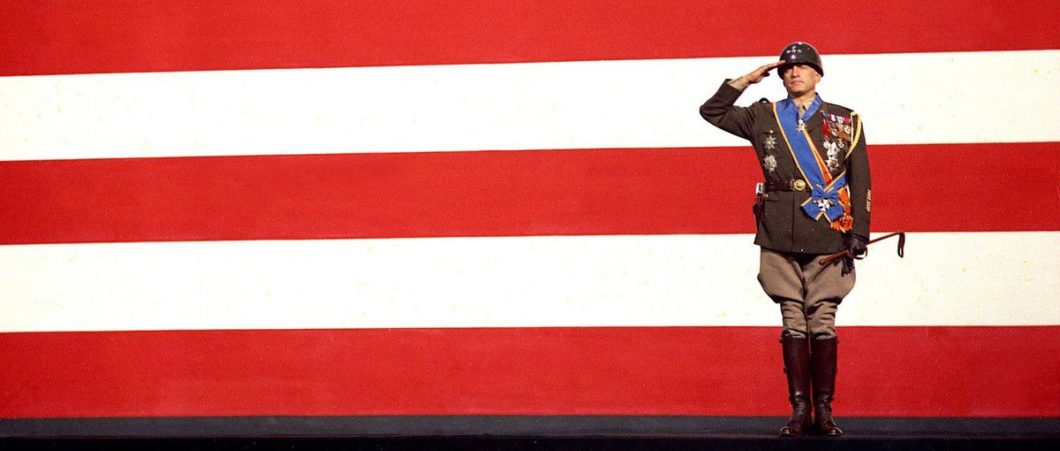
The opening scene of the 1970 Academy Award-winning movie “Patton” is one of the most iconic in cinema history.
Screenwriter Francis Ford Coppola brilliantly cobbled together various statements of U.S. General George S. Patton Jr. into one fiery and profane speech to his beloved troops, with the immortal first lines spoken in front of a giant American flag:
“At ease, men. Now I want you to remember . . . that no bastard ever won a war by dying for his country . . . . He won it by making the other poor dumb bastard die for his country.”
Much of the movie, which captured seven Academy Awards (including Best Picture, Director, Actor and Original Screenplay), is based upon the World War II diary of Chester B. “Chet” Hansen, who later lived in New Canaan for 44 years and spent much of that time volunteering for his community.
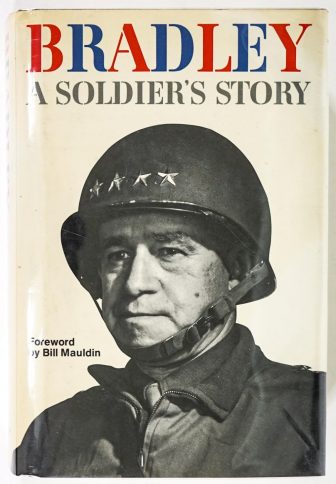 Hansen secured his place in American history as ghostwriter of General Omar Bradley’s 1951 acclaimed autobiography, “A Soldier’s Story”, drawing on that diary that he kept throughout the war.
Omar Nelson Bradley was a career senior officer of the United States Army. He rose to the rank of General of the Army in 1950, becoming the last of only eight individuals promoted to that five-star rank (the others are, by seniority: Ulysses S. Grant, William T. Sherman, Phillip H. Sheridan, George C. Marshall, Douglas McArthur, Dwight D. Eisenhower, and Harold H. “Hap” Arnold).
After the Allies’ breakout from Normandy in 1944, Bradley took command of the Twelfth United States Army Group, which ultimately comprised 43 divisions and some 1.3 million men, the largest body of American soldiers ever to serve under a single field commander in the history of the United States.
Bradley was the first Chairman of the Joint Chief of Staff and was the senior military commander at the start of the Korean War. He supported President Harry S. Truman’s policy of containment yet was instrumental in persuading Truman to dismiss General MacArthur in 1951 after MacArthur resisted administration attempts to scale back the war’s strategic objectives.

Capt. Chester Hansen, left, with Lt. Gen. Omar N. Bradley in Sicily. Credit: Omar N. Bradley Papers
From 1942 to 1951, Chet Hansen was inseparable from Omar Bradley as his aide-de-camp. He was also indispensable to the General, who described Hansen as “my trusted associate and my friend.” Hansen’s 300,000-word diary is renowned for being a primary, and sometimes pivotal, source for historians such as Stephen Ambrose and Rick Atkinson, as well as Hollywood screenwriters, providing anecdotal details that shaped not only the autobiography itself but the history of World War II generally.
***
Chet Hansen was born to Norwegian immigrants on May 17, 1917 in Elizabeth, New Jersey. He graduated from Syracuse University in 1939 with a degree in journalism, and while attending there served as editor of The Daily Orange, the student newspaper.
Hansen was drafted into the U.S. Army in August 1941, shortly before the Japanese attack on Pearl Harbor four months later. With a college degree he was selected for Officer Candidate School (OCS) at Fort Benning, graduated seventh in his class and commissioned as a second lieutenant on April 10, 1942. Upon the recommendation of the OCS Director, Hansen was chosen to serve as an aide to then Major General Bradley, who was conducting army recruit training in Louisiana.
Hansen followed Bradley as they both rose through the ranks, accompanying him in the North Africa campaign and the invasion of Sicily and as he led American ground forces on D-Day at Omaha Beach as commander of the U.S. First Army. He described Bradley on that historic morning of June 6, 1944, when the two were on the Navy’s heavy cruiser U.S.S. Augusta:
“Like others in the Army party, Bradley was up at 3:30. He is on the bridge, a familiar figure in his ODs with Moberly infantry boots and OD shirt, combat jacket, steel helmet. He smiles lightly as though it is good to be nearer the coast of France and get the invasion under way.”
But Hansen’s role was not limited to simply observing events on D-Day. When the landing on Omaha Beach ran into vicious German resistance and Bradley was at a loss for information on the situation, he twice sent Hansen and a gunnery officer ashore to report on the situation.
The first time was shortly after daybreak with fighting at its fiercest, and they returned with alarming news. Omaha Beach was divided into eight sectors of attack. Along one of the sectors, named “Fox”, few channels had been opened through the mines and other obstacles for landing crafts to pass, causing them to divert to “Easy Red”, where more gaps had opened. However, this was leading to congestion as the tide crept in, and an overcrowded beach made for a shooting gallery for the Germans.
This was eventually confirmed at noon when Bradley received a message from the beachhead, “Situation critical at all four exits.” Hansen and the other officer then went back to the beach. However, because the time lag between achievement and reporting had been so abysmally slow, it turned out that that the situation was much better than expected.
By 9:00 am, approximately 500 men had landed safely in every sector of the beach, negotiated their way through minefields, climbed the bluffs, and in small groups finally were moving inland. By the time Hansen returned, that figure had climbed to around 5000 troops safely ashore and forging onwards.
Finally, at 1:09 pm, through Hansen’s prompting, the V Corps headquarters officially informed General Bradley, “Troops formerly pinned down on Easy Red, Easy Green, Fox Red, advancing up heights behind beaches.”
***
Hansen was Bradley’s primary aide, but he also served unofficially as his public relations person, and letter and speech writer throughout their working relationship, including in 1945, when Hansen was assigned with the General at the Veterans Administration; in 1948, when Bradley became Army Chief of Staff and they both moved to the Pentagon; and in 1949, when Bradley became the first Chairman of the Joint Chiefs of Staff.
In 1951, Hansen transferred to the U.S. Air Force and was assigned to the Central Intelligence Agency (CIA), where he worked for director General Walter Bedell “Beedle” Smith in Washington, D.C. In 1955, Hansen left active duty as a colonel and joined the reserves. He served in public relations for Gruen Watch Company, Earl Newsome Advertising and, from 1958-1986, for International Business Machines Corporation.
But it was as a diarist that Hansen particularly excelled and made a lasting impression. Pulitzer Prize winner Rick Atkinson, author of the three-volume history of the role of the U.S. military in the liberation of Europe in World War II, has observed that:
“Chet Hansen’s war diary is surely among the most unusual documents ever written from within the headquarters of a major combat commander. For more than six decades it has put historians inside that command post, and, in some measure, inside the head of his boss, General Omar Bradley. Hansen had a ringside seat, and he made the most of it, with a sure eye for the telling detail and the ironic voice of a thoroughly modern observer of the greatest event of the 20th Century.”
While the diary entries report battles and occasional scenes of carnage, most record the rather mundane details of important lives during extraordinary times.
One entry recounts how General Eisenhower sent Bradley an ice-making machine because Eisenhower was tired of drinking warm whiskey when he went into the field to visit his fellow classmate at West Point (their 1919 class was the legendary “class that stars fell on” since it produced 59 generals out of 164 graduates, the 36% yield being an unsurpassed rate before or since).
Another describes Bradley in his “West Point dressing robe” when he learned that the war in Europe was over. Later that night, Hansen wrote that officers drank cognac in celebration and watched the “starry skies” with joy, thankfulness and some tears in their hearts.
Hansen was not immune from criticism. For one thing, for obvious intelligence reasons the very maintenance of a diary by an American army officer was strictly prohibited by the army in the European Theatre, even though Bradley was well aware of it and didn’t seem to care.
Hansen has also been seen by some observers as being too harsh on the legacy of General Patton. Indeed, much of the premise of “Patton” is based on the clash of disparate personalities between “Old Blood and Guts” George Patton and his former subordinate, the “G.I.’s General” Omar Bradley. Hansen was a historical consultant on the movie, and his own character was portrayed by a man named Stephen Young, whom Hansen wryly described as “a promising young actor who was never heard from again.”
The scenes between the hard-charging Patton (played exquisitely by actor George C. Scott) and the softer, gentler Bradley (Karl Malden) are all viewed through the prism created by Hansen, whether in North Africa, where Patton led American troops to their first victory at the Battle of El Guettar in 1943; Sicily, where the notorious “slapping incidents” that triggered Patton’s removal from the field took place; or in Belgium at the Battle of the Bulge in late 1944 when Patton rushed his Third Army northward in the dead of winter to relieve the besieged town of Bastogne.
Partial or impartial towards Patton, shaded or not towards Bradley, Chet Hansen was there “in the room” – for all of it.
***
After moving to New Canaan in 1957, Chet Hansen became deeply involved in town as a volunteer. A long-time parishioner of St. Mark’s Church, he was a 20-year trustee for the New Canaan Library and held leadership positions in the (former) Senior Men’s Club, Schoolhouse Apartments and the Lake Club.
He was also a proud member of the Democratic Party, serving on both the New Canaan Town Council and the Democratic Town Committee. On one occasion while appearing before a student group in town, Hansen was asked if he had ever done anything brave. “Just once,” he answered, “when we moved to New Canaan and I registered as a Democrat.”
Chris Hussey, a former 29-year member of the Town Council and a close friend, described him as “a man of outstanding character, the most ethical person I ever met.” His humility in particular impressed her. “He never looked for credit for anything,” she said. And “he never talked to hear himself talk, and when he did speak, he had always done all of his homework.”
Another former Town Council member, Sperry DeCew, also considered Hansen a good friend. “He was a very nice man, highly intelligent, and very invested in New Canaan,” he said. “We bonded because we were both veterans,” said DeCew. Their first meeting, at a cocktail party in town, was somewhat inauspicious however: “I mentioned that I was a tank commander in Vietnam and he said ‘well, war can be a wonderful thing.’ I looked at him and wondered where he was coming from. I had no idea that he was Omar Bradley’s adjutant in World War II and that he was making light of the fact that that relationship had led him to success in his life.”
DeCew still marvels at the history that Hansen saw and was a part of. “He met every single major figure in World War II: FDR, Churchill, Montgomery, Patton, Sir Arthur “Bomber” Harris, and on and on. That’s incredible,” he noted.
On Monday, May 28, 2001, Colonel Chester Hansen served as grand marshal of New Canaan’s Memorial Day Parade, a fitting honor for a man that had given so much to both his country and his long-time home.
Chet Hansen moved to Raleigh, North Carolina later that year to be closer to his family, and died there on October 17, 2012 at the age of 95. Appropriately, he is buried in Arlington National Cemetery, not too far from his old friend and mentor General Bradley, in a grave he shares with his wife of 65 years, Marjorie, who predeceased him. He died on her birthday.
“Chet Hanson was an incredible man whose stories and experiences from World War II touched everyone who heard them. It was like listening to living oral history. We were fortunate to have him speak to our Kiwanis Club many times, and we always wished we could listen a little longer. Thank you for honoring such a remarkable man.”
Another well written and fascinating story about a New Canaan resident. I don’t know if it was coincidental but today, May 17th, is Norway’s Independence Day 🇳🇴. I am proud of my Norwegian heritage and will celebrate today with a fellow Norwegian.
Chet Hansen was our public relations person on the New Canaan Adopt-a-Minefield Committee which in 2001 raised $50,100 to remove all the landmines, many of which we’re placed by the U.S., from Phum Thmei, Cambodia. Though he pretended to be a grumpy guy, Chet had a heart of gold. He was always optimistic and energetic.
Chet was an amazing man and close friend of my father’s as they both experienced WWII all the way through Gen. Bradley’s course from Utah Beach, Belgium and The Bulge. and crossing the Rhine. A great sense of humor and thoughtful person. We miss him.
Nick what a wonderful story.
Remember watching Victory at Sea at around 10 yrs old.
Got hooked on WWII history from that moment on. My uncle was in France and got a bullet in his neck, a ticked home. Was waiting to go to the Pacific and then Truman dropped the bomb and the war was over.
Also remember Look Magazine showing the invasion plans of the US .
Japan and Germany would divide the country in half.
This was indeed the greatest generation!!
You know before the war 90% of Americans were against entering the war
That all changed with Pearl Harbor — The brother of one of my HS teachers was killed at pearl harbor. That’s how close the War to us back in the 60″s
PS Don’t believe the story that Alan Turing Killed himself and was cremated
He came to the US to continue his work.
Another great article, Nick. Thank you!
Thank you for the excellent article on Colonel Hansen and his role in New Canaan.
Although I never had the pleasure of meeting him, I know his story from the movie “Patton” and the various interviews he gave after the war.
Also, many of the books on military history in the NC Library have a sticker on the title page showing that they were donated to the library as part of the “Chester Hansen Collection”.
It was by checking out one of those books years ago that I first became aware of Col. Hansen’s ties to New Canaan.
Thanks again for a great article.
P.S.: The West Point Class “that the stars fell on” is the Class of 1915 (not 1919). You can see a reference to that class in the film “The West Point Story”.
Chet served as my Election Moderator during most of my years as Registrar of Voters. He was always detail oriented, and reliable. I loved sitting next to him and just listening.
My fondest memory was, after a mishap at home, he appeared in my office the day after the election, and reported (yes reported), that he was retiring. I stood up and saluted.