
‘New Canaan There & Then’ is sponsored by Brown Harris Stevens Realtors Bettina Hegel, Joanne Santulli and Dawn Sterner.
The site Niche.com recently named New Canaan the 8th-ranked “Best School District for Athletes in America” for 2026, out of 9,934 school districts reviewed.
Given the townspeople’s somewhat obsessive enthusiasm for athletics generally, that ranking is, as the inimitable Captain Quint quipped in the movie Jaws, “Not a bad reputation for this location.”
At least a small part of the ranking is undoubtedly due to the existence of Dunning Stadium, which since 1997 has been the home of the New Canaan Rams in multiple sports, served as the High School’s annual graduation venue, hosted events such as Division 1 NCCA lacrosse games and the NFL’s Northeast Regional Flag Football Tournament, and been acclaimed as “one of the premier high school athletic facilities” in New England.
The genesis of Dunning Stadium was simple: a desire for Friday night lights.
It’s hard to believe, but the New Canaan High School football team wasn’t always the veritable colossus that it is today. Indeed, in 1980 the New York Times wrote about, “New Canaan Football Fans; Hope for Better Times,” reporting on the painful fall of the team from excellence in the late 1960s and early ‘70s to three consecutive years without a single victory in 1978-1980.
In 1981, Vin Iovino, the High School’s new Athletic Director and a football guy through-and-through, hired a fellow coach from Westchester named Lou Marinelli to be the new head football coach. Marinelli pushed the Rams to a 4-5 record that year, the only losing season in Marinelli’s long and storied history (399 wins & 16 state championships – and counting – will do that for your reputation).
As player Paul Devlin (NCHS ’82) recounted, before Marinelli we were a “laughingstock,” but with him we were “always the least talented but best prepared team each time we took the field.” (Another movie reference: Devlin also played baseball for NCHS, and capitalized on that expertise in a memorable scene in “Bull Durham,” where Kevin Costner’s catcher Crash Davis tips off batter Devlin as to the next pitch from Tim Robbins’ spacey fastballer, Ebby Calvin “Nuke” Lalooshe, resulting in a wicked long home run).

1960 opening of Mead Field. Photo courtesy of the New Canaan Museum & Historical Society
From 1960-1996, the football Rams played their home games not at the High School, but at Stanley P. Mead Field at Saxe Middle School. The original home of the Rams, serving that role from 1928-1959, was actually Mead Park, on a football field where the former High School baseball diamond sits today.
Mead Field ran parallel to South Avenue. The south endzone was in the outfield of what is today’s baseball diamond at Saxe fields, and the north endzone laid just south of the primary entrance to the Middle School (If you’ve ever wondered why there is a three-bubbler water fountain standing alone in the vicinity of the entrance, it’s a memorial to a member of the Mead family and the last remaining vestige of Mead Field).
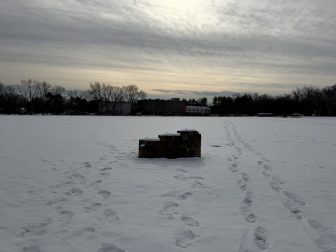
The water fountain at Mead Field today.
Mead Field was cramped. It was also rustic; the original tiny press box was situated on top of a few ex-telephone poles that would vibrate with the slightest breeze. And its location was far from ideal: to get to a game, players would have to clomp in their cleats and uniforms behind the high school, through the Waveny woods, and across a busy South Avenue.
Finally, Mead Field lacked the ingredient peculiar to so many football-fanatic communities in Texas and elsewhere in modern America: powerful light towers that would permit high school football games to be played on Friday nights, the so-called “Friday Night Lights” immortalized in the 1990 non-fiction book of immersive journalism by Pulitizer Prize winner H. G. Bissinger, as well as a follow-up movie (2004) and television series (2006) of the same name.
Adding lights to Mead Field wasn’t in the cards, however. As the New Canaan Advertiser’s long-time sportswriter Dave Stewart reported in his five-year retrospective of Dunning Stadium in 2004: “When the question of the installation of lights at Stanley P. Mead field was first introduced before the Town Planning & Zoning [Commission], the outcry from neighbors of Mead Field was loud and the idea died in its tracks.”
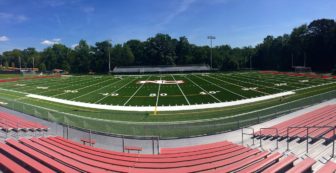
Dunning Field. Credit: Terry Dinan
With all that in play, the decision was made to finally move the Rams’ home turf to a location adjacent to the High School.
The first site that was identified, where the high school running track is currently situated, met with opposition as well, in that case from proponents of Waveny Care Center lying adjacent to the track to the west. However, when an alternative to that first site was proposed – where Dunning Stadium is today – those same Waveny Care supporters put their money where their mouth was to the tune of a $150,000 donation to the newly-formed Stadium Committee.
Even more important were the contributions of New Canaan residents James Dunning and Rodney Hawes, each of whom generously provided $750,000 donations, and who received recognition in the form of the official name of the structure, “Dunning Stadium at Hawes Plaza.”
Besides Athletic Director Iovino, key figures in the Stadium Committee included Al Woodall, a former quarterback for the New York Jets who was Joe Namath’s backup, and the Committee’s spokesperson Armen Keteyian, a television and print sports journalist who nabbed 11 Emmy awards and six New York Times bestsellers in his illustrious career.
Behind the scenes, Coach Marinelli understandably played a large role, as well as two late legends of the Town of New Canaan: assistant football coach Thomas Henry “Bo” Hickey, the longtime NCHS boys hockey coach and a former fullback for the Denver Broncos, and “Mr. New Canaan” himself – Parks and Recreation Director Steve Benko.
Not surprising for New Canaan, the financing of Dunning Stadium was not exempt from political intrigue. While town officials were in theory not opposed to the concept of a new sports venue, they were concerned about potential spending needs that the town might incur in the future, specifically the replacement of the then-cutting edge “AstroTurf 12” playing field.
That problem was ultimately solved, but not before the Chairman of the New Canaan Town Council was left horrified upon driving up to the site of the new venue and finding that excavation had already started, prompting him to storm off in a torrent of well-chosen expletives. This account was confirmed by Vin Iovino, who added, “That just made us work a lot faster.”
But while politics can be a fickle beast, it can also bring fortuitous and sometimes surprising outcomes; when the Stadium Committee tallied up their contributions on the eve of the Stadium opening and found that they were some $60,000 short, it was another politician – First Selectman Richard “Dick” Bond – who personally (and quietly) ponied up the shortfall.
Dunning Stadium opened on Homecoming, October 25, 1997, a sunny day with clear skies, temperatures in the mid 40’s, and a brisk northerly breeze. The boys’ varsity soccer team inaugurated a winning tradition at the new venue with a morning victory over Homecoming opponent Trinity Catholic, followed by wins there by both the girls’ soccer and field hockey teams.
The day capped off with a 24-0 drubbing of the Crusaders by the Rams’ football team, starting an incredible home field advantage that remains in effect today. While Coach Marinelli’s Rams captured two state titles in the 16 seasons they played at Mead Field, the following 28 seasons at Dunning Stadium have seen a staggering 14 state titles come New Canaan’s way – an unheard of .500 championship winning percentage.
Now that’s Friday Night Incandescence.
Nick’s recount is quite accurate but omits the key role of Rodney Hawes in the final hours of the approval process. There was a noon deadline for the group to have commitments to cover the cost of construction. Apparently there had been an arthmetic mistake , resulting in a significant shortfall, jeopardizing the project. Upon hearing that, Rodney Hawes wrote a substantial check to cover the shortfall . I was not in the room but heard soon after that apparently the Chairman of the Town Council was happy at the prospect of the project failing. Nick is being kind to say “in theory” he was for the project. The reality is that he was strongly opposed. I can certainly believe Dick Bond made a significant contribution, as he did
also for Benko Pool a few years later, but Rodney Hawes saved the day
Love the story, Nick. I’d often wondered more about the history of it.
Great story Nick! The Stadium is a tremendous source of town pride. As are our students and their accomplishments!
Thanks for the memories, Nick.