‘New Canaan There & Then’ is sponsored by Brown Harris Stevens Realtors Bettina Hegel, Joanne Santulli, Dawn Sterner and Pam Stutz.
William Maxwell Evarts “Max” Perkins was the preeminent editor, and in many cases discoverer, of the greatest authors of 20th century American literature, including F. Scott Fitzgerald, Ernest Hemingway, Thomas Wolfe, Marjorie Kennan Rawlings, James Jones and Ring Lardner.
And Perkins lived, and died, in New Canaan.
Perkins’ first encounter with New Canaan was in the summer of 1924, when he rented a cottage on the outskirts of town. “You would hate it,” he wrote his close friend Fitzgerald, “But I like it.”

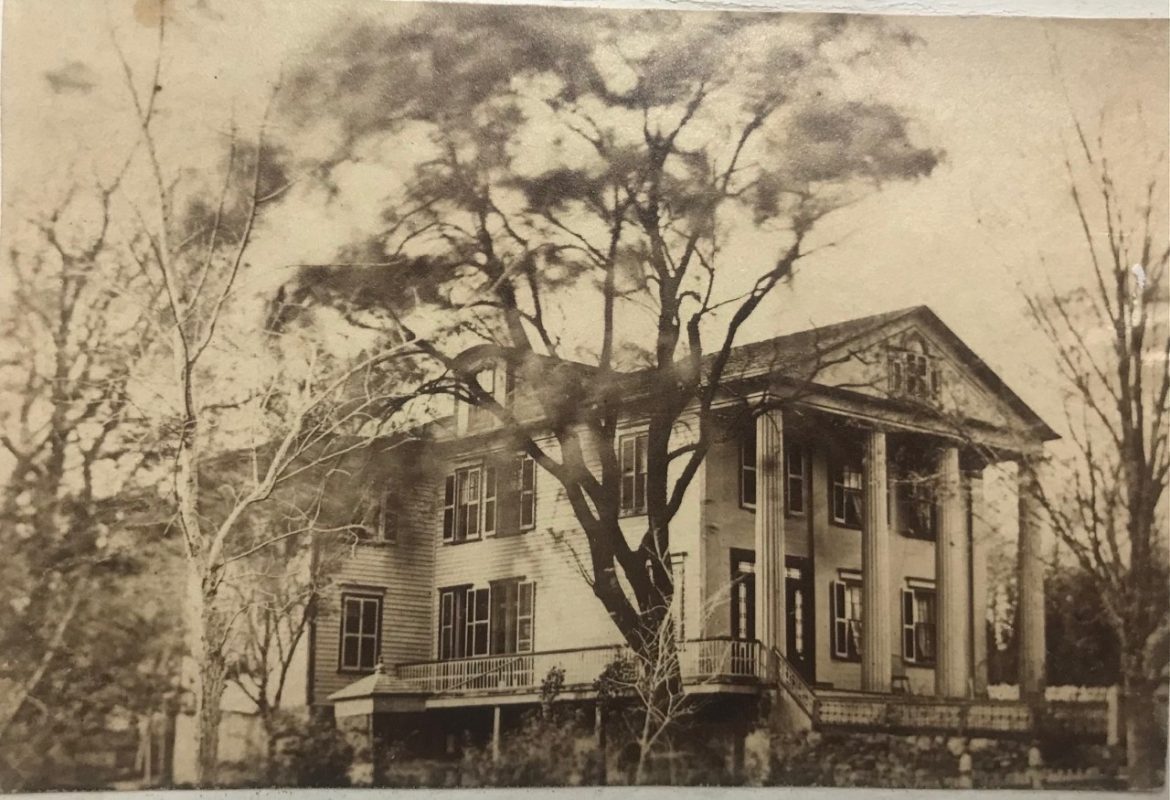
The 1837-built Greek Revival at 63 Park St. Credit: Michael Dinan
Perkins liked it so much that later that year he purchased a gracious Greek Revival house located on 63 Park Street, steps away from the train station that he would commute from for the rest of his life. “I told you we’d bought a house in New Canaan,” he wrote to Fitzgerald. “It has the face of a Greek temple and the body of a spacious Connecticut farmhouse.”
Built in 1836 by Hiram Crissey, a skilled carpenter and deacon of the Congregational Church just up the hill, the house’s first residents were Mrs. Clarinda Finch Ayres, a widow, and her unmarried brothers. The house served as a private home, and later a “genteel” boarding house until the turn of the century.
Mrs. Ayres’ daughter ultimately sold the Park Street property to one of the first full-time New York City commuters. In 1919, the property became the second home of what is today the New Canaan Country School.
Perkins relished the house, as well as the town, describing “the charm of New Canaan, a New England village at the end of a single track with almost wild country in three directions . . . . An ideal place for bringing up children in the way they should go, girls anyhow.”
Perkins was the father of five girls and by all accounts a caring and loving presence, although not immune from the desire of having a son; when his youngest daughter was born, he telegraphed his mother just one word: ANOTHER.
In his 1978 definitive and award-winning biography of Perkins, “Max Perkins, Editor of Genius,” A. Scott Berg wrote that Perkins “staked his career” on his young authors, “defying the established tastes of the earlier generation and revolutionizing American literature.”
Perkins was associated with Charles Scribner’s Sons for 36 years, so the description of him by Kenneth McCormick, the editor-in-chief of Scribner’s rival publishing house, Doubleday & Company, is also telling: “Max Perkins was unsurpassed. His literary judgment was original and exceedingly astute, and he was famous for his ability to inspire an author to produce the best that was in him or her.”
Perkins was also loyal. Prior to a contentious meeting with his indomitable publisher, the legendary Charles “CS” Scribner himself, concerning three four-letter words (active verbs) contained in the draft of Hemingway’s second novel, “A Farewell to Arms,” Perkins jotted them down on his desk calendar under the heading “Things to Do Today.” CS purportedly noticed the list and remarked to Perkins that he had far bigger problems if he needed to remind himself to do the things he had listed.
Max Perkins died in his home at 63 Park Street on June 17, 1947, and two days later his funeral was held at St. Mark’s Church (St. Michael’s Church today, the property now owned by the New Canaan Museum & Historical Society).
After passing out of the Perkins family’s hands, the house fell upon hard times and served as a “much-abused downtown rooming house with an absentee landlord.” To the rescue came Richard and Sandra Bergmann, restoration/preservation architects who undertook a complete overhaul of the house in 1973. Under their stewardship, the house became Connecticut’s first Liberty Landmark in 2002, and was added to the National Register of Historic Places in 2004.
In 2019, the house was acquired by the Onera Foundation, which has converted it into an architectural museum and exhibit space. Starting October 1, 2025, 63 Park Street will be open to the public Tuesdays-Saturdays, from 12 pm to 5 pm. Admission will be free with advance registration, which will be required for entry.
Johnson Lee sold to Bergmann
Perkins was a giant in the literary world. You did him and his house justice, Nick, in this wonderful piece.
Great article, Nick. And Dick and Sandra Bergmann restored the house and gardens to the glory it derserved
Didn’t Dr. Frothingham practice there in the early 1960’s? I could be remiss as I was just a small child then, but I thought that is where my mother took my siblings and me.
Can someone please confirm?
Hi Cynthia. Yes, I can confirm that Bertha “Bert” Perkins, Max Perkins’ eldest daughter, married John Gerrish “Doc” Frothingham in 1933. Doc Frothingham was a beloved pediatrician in New Canaan and had his practice at 63 Park Street until his death in 1968.
Bert, who was involved in many town organizations, including the New Canaan chapters of both the Red Cross and the NAACP, moved to the Perkins family house in Windsor, Vermont in 1972, where she lived until her death in 2005 on her 94th birthday.
Interestingly, Bert was a first cousin of famed Watergate prosecutor Archibald Cox, as Cox’s mother was Max Perkins’ sister.
Thank you so much, Nick. I loved reading about Dr. Frothingham and his wife, Bertha. Very interesting and inspiring.
Best, Cynthia
Yes indeed, Dr Frothingham practiced in the house. A cosy place to see your pediatrician.
After Max’s daughter, Bertha Frothingham sold it to Johnson Lee, a local architect, the house was empty for a few years.
Yes. When Bertha Perkins Frothingham moved to the family house in Windsor, Vt., she took the oil-cloth covered but ornate Victorian chairs and sofas that had been in Dic’s waiting room.
I always loved New Cannan, however I could not afford to live there I would shop for my horse there right across from the railroad tracks.
From wreck to showplace makes a good story, and is a common one in real estate. But Bertha Perkins Frothingham always vigorously disputed accounts of a falling-down, hopelessly dilapidated house. Certainly her large house in Vermont was always lovingly tended. In any event, anyone who drives by the New Canaan house can see that it is impossible that it was so overgrown with shrubbery that it couldn’t be seen from the street, as at least one newspaper account suggests.
Thanks to Wendy and Susan also.
Cynthia