‘New Canaan There & Then’ is sponsored by Brown Harris Stevens Realtors Bettina Hegel, Joanne Santulli and Dawn Sterner.
***
“Twenty years from now you will be more disappointed by the things that you didn’t do than by the ones you did do.” — Mark Twain
“Coulda, Woulda, Shoulda” — Oxford English Dictionary (1606)
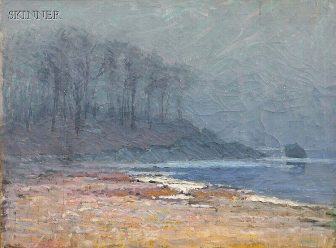
Bayley Beach By George Frederick Muendel – https://www.invaluable.com/auction-lot/george-frederick-muendel-american-1871-1948-baile-381-c-69f67a82ea, Public Domain, https://commons.wikimedia.org/w/index.php?curid=156513303
On the north shore of Long Island Sound, nestled east of a long sandy stretch comprising Rowayton’s public Bayley Beach and the exclusive Weeburn Beach Club, lies 12.8 acres of spectacular geographic beauty. That is the property of the Roton Point Association, since 1984 a recreational condominium club serving as the summer go-to place for its limited number of 400 members.
From the 1870s through 1941, Roton Point Park, where the Association is now located, was one of the preeminent attractions along the shores of the Sound, home to an amusement park and venue for countless legendary musical acts of the big band era, including Glenn Miller, Duke Ellington, Benny Goodman and Billie Holliday.
From its elevated shady picnic grove overlooking the water to its sandy beaches, hotel, dance floor, carousel, roller coaster, and midway rides, Roton Point attracted thousands of visitors each season. It even had its own steamer that would ply the waters between Rowayton and New York City to facilitate attendance.
When the park fell on hard times following the Hurricane of 1938, which wreaked catastrophic havoc throughout New England, and the onset of the Second World War a few years later, its proprietor, Neville Bayley, put the park up for sale in 1942.
The acreage of the Roton Point Park that today comprises Weeburn Beach Club had already been sold to the private club in 1934. Bayley wanted the rest of his property to be sold for use by the public. Thus, the ten acres of land that make up Bayley Beach today were quickly offered to, and acquired by, Rowayton’s Sixth Taxing District in 1942 for $31,655.
The remaining acres, representing the present configuration of Roton Point, were offered by Bayley that same year to the “residents of the Town of New Canaan.” He figured that the townspeople of a land-locked community just a few miles northwest of Rowayton would be interested in purchasing waterfront property, including not only the high-ground “grove” offering one of the best vistas of Long Island Sound on the southern Connecticut coastline, but also, a beach, dock, gazebo, dance floor, hotel and bathhouses.
Bayley set a price of $45,000 for the third parcel, assuming that New Canaan, like Rowayton, would jump at the opportunity to purchase a huge tract of prime waterfront property.
He was wrong. New Canaan said no. Emphatically (as the decision wasn’t even close, though not for lack of trying).
That effort started with a group of New Canaan “town fathers” (yes, with one notable exception they were all men) led by one Geroge McKendry, a longtime New Canaan resident and local politician who ran for the Connecticut House of Representatives in 1912. He marshaled a group of individuals that collectively put down a deposit of $8,000 to secure a purchase option for the parcel in 1942. The other participants included John T. Smith, E. Morgan Saunders, Maya Valentine, Clinton Cruikshank, Harold Brown, and John Hersham.
Besides McKendry, Clinton Cruikshank provided construction and real-estate expertise to the group. Though he lived in New Canaan, Cruikshank was one of the most notable builders in Fairfield County, and particularly Stamford. He was the builder of the Gurley Building (1924), designed by Edward B. Stratton, which became one of downtown Stamford’s notable early twentieth-century commercial buildings, along with another building, the Fidelity Trust Company Building at 129 Atlantic St.
The only woman in the group, Maya Valentine, was a lifetime New Canaan resident who was deeply ingrained in the town’s civic and cultural life, and a supporter of local parks, hospitals and a community orchestra. Born in 1874 to a wealthy and prominent family which eventually occupied a large estate on South Avenue, Valentine was an accomplished horticulturist who served as the New Canaan Garden Club’s president from 1920 to 1922.
She was also active in the town’s bird-protection movement and later became president of the New Canaan Bird Protective Society. The Society was founded in 1916 by a dedicated group of local naturalists, including Valentine, who were appalled by the wholesale commercial slaughter of migratory songbirds, whose plumage was being used to decorate women’s hats. The society spearheaded local conservation efforts and went on to establish the Bristow Sanctuary & Wildwood Preserve in 1924, which stands as the third-oldest private bird sanctuary in the United States.
McKendry’s group had an option to purchase the Roton Point property until Feb. 1, 1943 (which was later extended), and their intention was to convert the land into a private beach club if the Town of New Canaan didn’t support the acquisition.
On March 3, 1942, New Canaan held a townwide referendum to vote on the purchase. The flinty voters rejected the town’s purchase of the property, 366–103.
With their option to purchase still intact, the investment group initiated Plan B – the consummation of their purchase of the property for their own benefit. As the New Canaan Advertiser reported in its April 1, 1943, edition (April Fool’s Day):
“A meeting of a group of residents who gave New Canaan the chance to purchase the Roton Point property for a recreation park and with-it water privileges met Monday evening and decided to incorporate. The group is very much pleased with the future outlook of Roton Point and from present indications it cannot help to be a highly valuable investment.”
Highly valuable indeed. It’s estimated that a unit in Roton Point Association today runs to about $275,000. Multiply the number by the total number of units in the Association (400) and, well, you do the math.
Of course, the bigger loss was the ability to combine an exceptional town waterfront park with an equally exceptional Norman Rockwell village tucked inland just a few miles away.
Now that failure was … “Galactically stupid” — Lieutenant Daniel Kaffee, USN