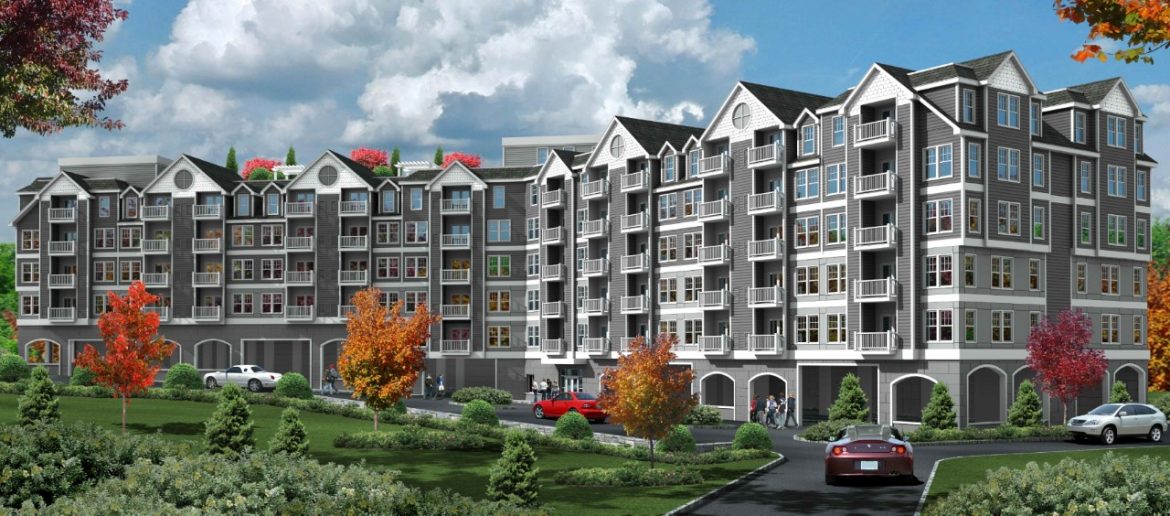
A state Superior Court judge last week upheld a developer’s appeal in a nearly three-year case regarding a planned 93-unit complex on Hill Street in New Canaan.
The town’s Planning & Zoning Commission in April 2023 denied three applications filed on behalf of developer Arnold Karp—to amend the town’s zoning regulations, rezone the properties at 17 and 23 Hill Street, and approve a site plan to create the complex there. In issuing its denial, P&Z cited several factors, mainly pedestrian and vehicle safety, environmental impact and limited emergency response.
In a 61-page decision issued Friday, Judge Stephen Frazzini noted that the public safety concerns raised in P&Z’s denial focused mainly on “the width of the access driveway, the width of internal driving corridors, and the lack of sidewalks” planned for the site.
Yet the town’s call for an additional access road to the site for fire safety reasons was rejected, on appeal, by the state fire marshal, Frazzini noted in his decision. P&Z also found that a lack of sidewalks would be harmful to pedestrians, without ever saying how (outside of an emergency situation), falling short of the legal standard, the judge noted. Similarly, the Commission found that lack of a paved pathway for disabled people from the proposed residential complex to the public road was a violation of the Americans with Disabilities Act, but “do not provide any argument or specificity about which provision of the ADA would be violated,” Frazzini wrote in the decision.
“That claim is thus inadequately briefed,” he wrote.
Despite arguments made on P&Z’s behalf that a paved path is required by state code, the court found no such requirement, Frazzini said.
“There is thus insufficient evidence in the record to support this reason, and as neither the commission nor intervenors briefed this claim other than to assert a violation of [state law], without further discussion or analysis, it is also insufficiently briefed and therefore deemed to have been abandoned,” he said in the decision.
Frazzini also dismissed claims about the pedestrian safety of future schoolchildren at the complex getting their bus stop, noting that kids currently walk to similarly situated bus stops in the neighborhood.
“Although traffic safety is surely a public interest that the commission is properly allowed to protect, none of these assertions shows a quantifiable probability that a specific harm would result if the application were granted,” Frazzini said in the decision.
The new complex planned for Hill Street will occupy about 32% of the undeveloped 4.76-acre parcel there. It’s located northwest off of Hill Street, a short residential road of eight homes that runs parallel to Route 123 near Brushy Ridge Road.
The Hill Street application is one of three that was filed on behalf of developer Arnold Karp under the state law known by its statute number, 8-30g, and the last to be adjudicated. Under the law, in towns where less than 10% of all housing stock is “affordable” (as per the state’s definition), a developer can appeal the denial of a local P&Z to the courts, effectively skirting local planning decisions. (new canaan was at 2.91% at the time of filing).
The court denied an appeal from Karp in a plan to redevelop the Red Cross building property downtown, and upheld his appeal for a larger complex at Weed and Elm Streets. The town, under a prior executive administration, had allowed its “moratorium” or four-year period granting relief from 8-30g, to lapse, opening the door for the applications. New Canaan now has a new moratorium in place, and created a municipal committee whose priority is to ensure that additional moratoriums can be chained together.
Frazzini in his decision noted that although fire, traffic and pedestrian safety are “all legitimate public interests that the commission was allowed to consider here in evaluating the plaintiff’s application,” just 2.91% of New Canaan’s housing stock qualified for affordable at the time of the appeal, meaning “the town’s need for affordable housing is also substantial.”
“The town’s own 2014 Plan of Conservation and Development recognized that New Canaan ‘is not affordable to some of the people that work’ here,” the judge noted.
He continued: “A March 2022 draft of New Canaan’s ‘Annex to the 2022 Western Connecticut Regional Affordable Housing Plan’ on the town’s website the month before the first night of the public hearing in this matter recognized that ‘New Canaan has a significant need for affordable housing’ and one of the strategies recommended for addressing that need was to ‘[e]ncourage private construction of housing that services the need for affordable’ housing. Even were the commission’s reasons for denying the application based on the width of the access driveway and internal corridor, lack of sidewalks, dead-ends within the development, the need for certain fire apparatus to make multiple K-turns in order to depart the development, and the fire marshal’s requiring a fire zone (another means to require a secondary access road that the state fire marshal found not to be necessary) deemed ‘sufficient evidence’ for purposes of 8-30g review, this court has determined, after its own plenary and independent review of the record, in view of the condition imposed herein and particularly in light of the fact that the development complies with the applicable building and fire safety codes and that the state’s own fire marshal found a second access road to be unnecessary, that the commission’s decision was not necessary to protect substantial interests in health, safety or other matters that the commission legally may consider and that the risk of harm to the public interests that the commission was entitled to protect does not clearly outweigh the need for affordable housing in New Canaan.”
New Canaan’s lack of affordable housing, and shameless blocking of it, is and has been a black mark on the town. If a New Canaan firefighter cannot afford to live in the town they risk their lives for, something is wrong. This development is a welcome expansion of opportunity and the American Dream to those who actually work for a living, not just the nepobabies and Wall Street pirates who gatekeep our amazing town.
Name-calling is not an argument. Just looking at the site plan is enough to say it’s too large, too high, and would give way to traffic congestion.
It’s not that people don’t want housing for our firemen, etc.; it’s the gargantuan size of the project squeezed into such a small space.
And we must remember Mr. Karp will eventually make millions off
this project. He’s not into charitable work. Why doesn’t he plan smaller housing in and around New Canaan that would appeal to everyone?
New Canaan pays their police, firefighters and teachers very well; they are typically not eligible for the set-aside apartments. And those that are, seem to be looking for small, starter homes not 1 or 2 bedroom apartments.
Do you live in New Canaan? Or are you looking to move to New Canaan? Just curious what your perspective is.
28 out of 93 units.
What’s wrong with this
picture? 30 % affordable.
If you want affordable you need the Town to build them.
Build 100% affordable and not let developers
use the law to put these gigantic structures
In our small New England Town.
There is a solution. The First Selectman has known about it for over 6 months but has not acted for some unknown reason.
Again the Town can take these property
by Eminent Domain
It say’s any town can take property for the
public good
and the supreme court says affordable housing is for public good.
Build 100% affordable units not this 28/93 split
And this will get us to 10% overall
And discouraged development who want
To make a quick buck while destroying
The charm of a small Town.
Again our first Selectman is more interested
In building the North School which
Everyone knows we don’t need than
to engage this issue which all New Canaanites care about.
Yes build affordable housing but on our terms not theirs.
What is she waiting for?
28 of 93 is exactly what makes it affordable. 93 of 93 would be unaffordable to the builder. Let’s move the chains on 8-30g.
You didn’t get the message
28 is only 30% affordable
If it was smaller say 40 units but
all affordable that’s 100%
The scam is let’s build only what
The law requires so we can sell
1.5 to 2.5 million dollar condos
It’s always about the money
Otherwise they would make all
93 affordable — if they really cared
Doesn’t New Canaan have a height restriction on buildings? If so, doesn’t this building exceed that restriction?
The height is allowed under the newly created zone and site plan submitted by the applicant (both of which P&Z rejected).
Next Station to Heaven No More Next Station to Karpville
What an ugly monstrosity and a horrible development for New Canaan. Looking forward to listening to all the machines erect that eye sore. At least the town is on the verge of passing a ban on gas powered leaf blowers…
Just to add some current data points, New Canaan has 3.97% affordable per the most recent 2024 8-30g report. The timing of the 3 8-30g appeals cases was when the report showed that much lower affordable percentage.
Link here and scroll down to 2024 affordable appeals list: https://portal.ct.gov/doh/doh/programs/affordable-housing-appeals-listing
The report is specifically an accounting of government provided subsidizes for affordable units by 4 specific categories. When you sort the data by each of the 4 specific categories, it provides some interesting details:
If you data sort the 2024 list, we are 93rd of 169 towns. Tied with Westport at 3.97%, above Wilton at 3.79%, and Darien has 4.36%, Ridgefield has 2.88%, Weston 0.19%, Easton 0.4%.
Bethel has 5.3% and Brookfield 5.21% – but their properties are much cheaper than ours, so if you took out their total affordable units for CHFA loans (Col 3) at 113 and 78, they would be right where we are. For our CHFA loans, New Canaan only has 8 in total for comparison!
By the 4 categories here are the rankings: New Cannan is
65 of 169 towns/cities for Col 1 Gov’t Funded, 64 of 169 for Col 2 Housing Vouchers,
161 of 169 for Col 3 CHFA & Farm loans – further explained below, property values and income levels are capped by CHFA, which means most properties in New Canaan cannot participate in these state subsidized loans
121 of 169 for Col 4 Deed Restricted & 8-30g affordable units -many of these affordable units can roll off as affordable after 40 years or sooner. In contrast, New Canaan’s affordable in Col 1 are forever affordable and do not disappear in 40 years. Any units potentially developed under any of Karp’s 3 8-30g projects would be captured in this column for New Canaan.
It is important to note:
Only 28 municipalities in 2024 have over 10 percent affordable- in the last 30 years since the enactment of 8-30g, there has not been any increase in the number of towns over the 10% threshold, in fact it has declined from 31 municipalities. Those 28 exempt have been very generously and inequitably subsidized by the state resources to be over that 10 percent threshold.
New Canaan’s top ranked schools and proximity to the metro NY economic engine command higher property values, which in turn require higher salaries for purchases. This means very few properties qualify in town for state subsidized CHFA loans (Col 3) vs other areas of the state. In addition, despite requesting vouchers for every affordable project we ourselves create, the state does not provide as generous Annallocation of vouchers (Col 2) directly to New Canaan.
Aside from the Low Income Housing tax credits that cover roughly 30 percent of affordable projects in town, our property taxes, affordable housing development funds and the future revenue rental income streams on the affordable units together help to fund these developments while in contrast cities can often get 70 percent or more of their affordable projects paid for with state and federal funds along with more generous voucher allocations, plus state grants plus state low interest loans when they are putting together a capital stack on a deal. It is clearly an unequal playing field.
Something else that is often not understood once you leave Fairfield County area, the property values are much lower – in the $400k-600k range for homes and the property taxes they pay on average are much lower as well in the $6k+per year range. Lower Fairfield county has the highest AENGLIC scores (per capita wealth measure of municipalities= annual equalized net grand list) and as such our towns almost completely fund all of our town services through our local property taxes including our schools – operating and school construction costs (only roughly 10 percent reimbursement for school capital expenditures) which is why our property taxes are much higher in absolute dollars even while our mill rates are low.
What does the his mean when you look at affordability in the state overall? Surprisingly, on average CT is the most affordable state relative to all the other NewEngland neighbors & NY with PA being the closest state that is more affordable!
The takeaway is that throwing aspersions at New Canaan is off base. In reality, being in the business of building affordable housing is not the main charge of any town government.
Yet New Canaan has had an affordable housing fund for decades, and has been creating quality, 100 percent, forever affordable housing ourselves. We have good stats that show our results on the 2024 8-30g report relative to other similar towns. And this is despite not getting the affordable housing funding resources that cities receive.
Here’s a spreadsheet analysis by towns of the 2024 report by the 4 categories from CT169 Strong: https://docs.google.com/document/d/1j_Hvl0uLRQ0TuzvpWsKo0SKVcZmwPZst/edit?usp=sharing&ouid=118061102363959473282&rtpof=true&sd=true
And here is a detailed writeup to understand what the 8-30g report actually measures:
https://docs.google.com/document/d/1j_Hvl0uLRQ0TuzvpWsKo0SKVcZmwPZst/edit?usp=sharing&ouid=118061102363959473282&rtpof=true&sd=true
What’s impacting affordability in CT? Every state election is an opportunity to address these issues – like the unfunded mandates from Hartford on municipalities that raise our local property taxes (CT has 3rd highest in the U.S.) and the 40+ public benefits charges that raise our ratepayer electric bills (CT has 3rd highest energy costs in the U.S.). Pay attention.
I have advocated for years that affordable housing be allocated to teachers, fireman, police and town employees. They are the reason this town is so desirable. I’m told by 2 people in town government in NC…they make too much money to qualify for affordable housing and/or the don’t want to live in town. Makes no sense 🤷♂️
As was noted in a previous reply the affordable units in the 830g developments sunset after a certain period of years. If the democratic super majorities in state government were truly concerned with long lasting affordable housing there would not be a sunset clause. The politicians are only interested in providing the developers with a way to maximize their profits.
And bring in donations from the developers for their political party and candidates. Flood CT with those who will vote Democratic. A total redistricting scam to retain power and a super majority. CT is losing jobs, losing the population of those who pay 90% of the state taxes. A recipe for economic disaster. Someone must challenge this power grab and override of local municipality right to govern.
Thanks everyone this thread is closed.