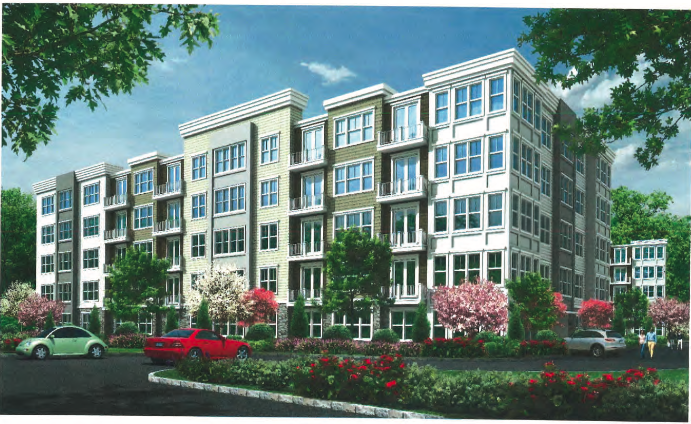
Neighbors of a planned 102-unit affordable housing complex at Weed and Elm Streets—including a man arrested in 2023 after getting physical with the project’s developers—last week lost their lawsuit seeking to halt that developers’ use of shared sewer and sanitary easements, court records show.
The “preparatory activities for the work contemplated in the easement area”—which includes replacing 310 feet of 6-inch PVC drainage pipe with 8-inch PVC pipe—is “permitted” under both easements, state Superior Court Judge Edward Krumeich wrote in a Feb. 11 decision.
“The unearthing and inspection of the sewer pipes and repair and replacement of any damaged or defective sewer pipes is permissible under the Sewer Easement,” Krumeich wrote in the 12-page decision.
He continued: “Plaintiffs argued that the Sewer Easement was for a single-family home like the existing house and the homes in the Subdivision and did not envision the planned multi-unit use of Defendant’s Property. The Court finds that there were no restrictions in the Sewer Easement that would limit use of Defendant’s Property to a single family home.”
The plaintiffs in the case failed to show “that the change in use will overburden the sewer system and harm the Subdivision owners,” according to the judge.
“Plaintiffs have not prevailed on the merits of their claims and have not shown substantial and irreparable injury for which there is no remedy at law,” Krumeich wrote, adding: “Defendant’s plans do not violate the Sewer Easement and do not constitute a nuisance because the interference with plaintiffs’ properties would not be unreasonable but rather would be a reasonable exercise of defendant’s easement rights. The equities favor defendant not plaintiffs. It was foreseeable that the holder of rights under the Sewer Easement would have to disturb the easement area and engage in the type of activities defendant plans under circumstances like these, where it is reasonable to do so to maintain, repair or replace pipes. Plaintiffs have not proven that defendant is acting unreasonably or in violation of the terms of the easement agreements.”
Filed in August 2023, the neighbors’ lawsuit sought a declaration that the owners of 715 Weed St. had violated the sewer easement and an injunction to restrain the preparatory activities in the area of the easement (as well as damages, fees and costs). The lawsuit came after the New Canaan Planning & Zoning Commission had denied the 8-30g affordable housing project at Weed and Elm Streets, and before a state Superior Court judge sustained the developer’s appeal of that denial.
Krumeich’s decision amounts to one more obstacle removed for the project’s developers, Karp Associates Inc. It follows another legal win for Karp, with the court on Feb. 6 sustaining his appeal to build a 93-unit affordable complex on Hill Street.
The plaintiffs listed in the case—Mary Elizabeth Moore, Gregory Moore, Trevor Bradley, Christina Bradley, Giacomo Landi, Elizabeth Fabian, Andrew Livesay, Maria Livesay and Evelyn Barrack (as intervenor)—were represented by Bridgeport-based Green & Gross PC.
The defendant LLC was represented by FLB Law of Westport.
The developer’s plans to replace or repair pipes also do not exceed the scope of the easements, Krumeich wrote in his decision.
“The preparatory activities for the work contemplated in the easement area is permitted under terms of the Drainage Easement and Sewer Easement,” Krumeich wrote. “The substitution of eight inch drain pipes for the existing six inch drain pipe is permissible under the Drainage Easement. Inspection and repair or replacement, as needed, of the sewer pipes is permissible under the Sewer Easement.”
There’s no language in the easement “that would restrict the development of the Defendant’s Property.”
“There is no language in the easements with plaintiffs and the neighbor next door to the Defendant’s Property that would restrict the use of the Defendant’s Property to a single-family dwelling,” according to Krumeich. “Nor is there any evidence that the switch in use from single family to multifamily dwellings on Defendants’ Property would overburden the easements and interfere with plaintiffs’ rights to use the servient estates or the easements.”
In the eternal fight of the haves vs. the have-nots, another win for 102 future New Canaanites vs. 8 grouchy neighbors who’ll stop at nothing to make sure no one else can have what they do!
When reading comments in support of this proposal, I find myself wondering: do these voices represent genuine community interest, or might some have a financial stake in the outcome? A simple question worth asking — do any of them live near the proposed site? Transparency about those interests would go a long way toward an honest public conversation.
I live on the West Side, not directly adjacent, but I can see clearly that the corner of Weed and Elm is not a feasible location. This is one of the busiest intersections on the West Side — a primary corridor to New York from the Merritt — busy enough that we now have a three-way stop. Basic common sense should apply.
I’d ask that someone publicly disclose the actual number of planned inhabitants and vehicles. I’d also welcome input from our fire and police departments — already stretched thin — on their capacity to serve this location.
I strongly support affordable housing, particularly for teachers, firefighters, and police officers who serve this community. That’s precisely why this proposal is so frustrating: under its current structure, those very people are unlikely to qualify. So who does it actually benefit?
There are more suitable locations available. I recently read about a 100% affordable housing proposal elsewhere in town — that’s exactly the kind of initiative worth pursuing.
I’m not opposed to development. I’m opposed to projects that primarily benefit outside investors. If the numbers support this proposal, publish the forecasted P&L now, and then actual returns the following fiscal year. Our community deserves transparency, not talking points.
There’s something darkly comic about invoking affordability as a shield for scale, massing, and design that feel utterly disconnected from the environment, like less well-to-do people shouldn’t be offered the dignity of a beautiful structure in which to live. It’s just too bad that this grotesque monument to Home Depot-level mediocrity will blot out the actual sun for half the people on the west side of town.
What an utter grift.
There’s something tragic about invoking aesthetics to widen the moat. While it is a truly subjective thing, the need for housing is not. Less well-to-do folk might prioritize having a place to lay their head more than what others think of it.
The myth that this development “….will blot out the actual sun for half the people on the west side of town” is just that, because of, you know, geometry.
Do you ever get tired of mansplaining, Paul? Is it exhausting to carry on this absurd charade that you and your employer care about poor people and don’t just want to make a quick, dirty buck by further turning a small, charming community into White Plains? Are you getting compensated well enough to exploit a terrible piece of legislation that makes it possible for predatory developers to turn single-family land parcels into actual Days Inns? Because from where I stand, your charade, with its attendant half-truths and constant need for viciousness to total strangers looks exhausting. Perhaps, when you get tired, you can lay your head in this objectively hideous, aesthetically worthless pile of particleboard you’re so hot to slap up. You’ll ruin more lives than you ever improve, but, hey, that’s the name of the game you chose.
My husband and I deliver groceries to the needy in Stamford. We have been to many affordable housing units. Many of them are in two story building complexes. Some are quite attractive. None are massive, ugly fabrications like the Karp proposals. I know land is expensive in New Canaan but this is clear greed on the part of the developers.
The gross incongruity of the proposed massive building in the heart of town should at least cause Mr. Karp to consider a smaller scale for his development.
Glad that another obstacle is out of the way. One more step towards affordable housing. And I don’t care that the developer will make a killing on this. It’s a business, not a charity.
Actually, it’s the reverse—charity made possible only through state coercion, because it would never work as a business. In exchange for our tax dollars, we are looking at a future New Canaan with tall ugly buildings on every street corner, even in historic neighborhoods.
The prevailing wisdom in Hartford is that money shouldn’t allow you to escape the difficult circumstances which sadly befall others, but just to be sure, we’re going to bring it to you. How charming.
This is affordable housing, not subsidized housing. The issue here is about scale, location, and local control over planning/zoning- not urban poverty. The constant blurring of these two types of housing is inaccurate and unhelpful.
Poverty is hard to look at and many prefer to not have to see it. It also can lead to higher crime rates, which make some people feel scared and unsafe. But I am not sure why you feel the need to “escape” people who earn $80-$115,000 a year.
I asked AI and here’s was the response:
“8-30g units are, by definition, subsidized or deed-restricted to be affordable. Under Connecticut law (CGS § 8-30g), projects often include government-subsidized financing, rental assistance, or required deed restrictions ensuring units cost less than 30% of a household’s income (for families earning
80% of the area median income).”
CT Insider
“Units are frequently supported by CHFA (Connecticut Housing Finance Authority) financing, rental assistance, or developer-set affordability, making them restricted, or “subsidized” in terms of cost to the occupant.”
Mike, how affordable housing works, who qualifies, and how to apply is a complete mystery to most people in town, and is never covered in the news. That would be a helpful New Canaanite article for the community.
I’m sick of this “argument” that if you are against a Karp project then you are against affordable housing. To be clear, what Karp proposes is some affordable housing, and a lot more unaffordable housing, with each of these developments he’s quite successfully forcing down the throats, eyes and aesthetic sensibilities of our town. A town which mistakenly thought it could defeat in the court system to the tune of a few hundred grand in legal bills. Spoiler alert – Karp knows the law is on his side, and has great lawyers to remind any judge of that.
But parking the whole Weed/Elm topic for a minute, what really frustrates me is why the answer to “where can teachers and firefighters afford to live?” is always about creating new buildings? Why isn’t it about providing higher salaries? Or finding creative ways to incentivize or subsidize current buildings to make their inventory more affordable (of which about 8% is currently vacant)? New Canaan has (roughly) 1000 rental units in town between $3k – $6k per month. Surely the few hundred grand we wasted in legal fees could have better gone to lowering those rents? Now, for those who argue they don’t want their tax dollars going to pay someone else’s rent, given the reality of where we are now, isn’t it far preferable to do that than watch over-dense monstrosities fill out our landscape?
The cliche that New Canaan doesn’t want affordable housing is nonsense, and a cheap, ignorant shot meant to oversimplify the issue. Nobody wants unaffordable housing. We also don’t want a town that once championed a new era in architecture and design to look like what would happen if Marriott Courtyard built a model city.
Why isn’t the town appealing to higher authorities in consort with other towns objecting to the state law as New Jersey towns have done? https://thepressgroup.net/first-hurdle-passed-alito-orders-n-j-to-respond-to-bid-to-halt-march-15-housing-deadline/
Is it hypocritical when people living in 6000+ sq-ft single family homes describe Karp’s project as grotesque, massive and disconnected!
Fascinating how the loudest stone-throwers tend to be the ones with three acres of buffer between them and reality — must be easy to have opinions about elephants when you’ve never had one land in your backyard.
Curiously enough, your own posts appear to have a bit of a disagreement with your 2022 self:
Avinash Phillips on February 11, 2022 at 7:32 am said:
I had to read this article twice to register that it is indeed 100+ apartments on 3+ acres in an area dominated by single family homes.
Grotesque. Don’t turn New Canaan into the Upper West Side.
8-30g is nothing more than redistricting by the Democratic CT majority to change or keep all CT municipalities Blue.
It is everyone gets a trophy on steroids. No more work hard, move on up ( remember George Jefferson?). The American Dream is dead. It’s the give me, buy me, show me. I have a right to what you worked hard for is mine society and generation.
Started decades ago with Marxism invading our education system.
True but I’ve seen a lack of alternatives and changed my mind a while back. And I do have 6 acres available on Bristol Rd if P&Z would allow a large building.
A worthwhile read no matter which side you are on:
https://www.npr.org/sections/planet-money/2026/02/24/g-s1-111204/is-the-yimby-movement-doomed
To be clear, NPR, CT Mirror, etc are paid by developer advocates, like Melville Trust millions annually to write narratives and push out and pablum like this article that is meant to “change political and public will.” You cannot conflate areas seeing growth, like Nashville, where they were seeing true in migration as opposed to CT where anti-business policies, high property taxes due to unfunded mandates on municipalities, high energy costs and outmigration of good paying jobs has caused a stagnant economy had thereby stalled development post the Great Recession. For the record, housing development in CT has exceeded population growth in CT and over 68 times recent of residents own homes in CT and CT is relatively more affordable that all other states in New England, and NY and NJ. A vibrant economy statewide would spur housing development statewide – that is not what we see happening in CT. Outside of Fairfield County and New Haven, the outmigration from CT continues. CT also has ongoing issues with lack of state and federal infrastructure investment, as in I-95, which is the top the most congested roadway in the U.S. for years. CT legislature needs more thoughtful, nuanced policy making if it wants to address different market conditions in Fairfield County vs the rest of the state.
Yes, of course, NPR is just a shill for the real estate industry….
Maria, you have your economics completely backwards. For CT to attract more businesses and grow economically, we need to have the workforce to attract them. Dynamic workforces need plentiful, diverse, affordable housing options. Businesses cannot and will not move to CT unless their workers have a place to live, and will leave for places that have the capacity to add more workers. Don’t believe me, ask the CT Business Industry Association, I think they know more than you what’s best for the CT economy: https://www.cbia.com/news/media-center/ct-housing-shortage-significant-barrier-economic-growth/
If you build it, they will come (we have one of the lowest residential vacancy rates in the country; people desperately want to live here). If you demand to build nothing, nowhere, never, no one will come.
CBIA is yet another bought out shill in this state – anyone that has been paying attention knows that too. And people move for jobs and opportunity, development follows. CT has 3rd highest energy costs and 3rd highest local property taxes in U.S. that means businesses are not coming here and the ones we have are leaving, like Stanley just announced a factory closure and loss of 300 jobs. Hartford used to be the insurance capital of the world, our legislature in its wisdom wrote bills for the state to compete with the private sector insurance industry. Our state’s labor unions control this state and have the most powerful and most lucrative contracts in the U.S. – 8002 just gave Union pensions rights to build housing projects and the state’s coffers (our tax dollars) will partner to fund the other 50% and the unions own 100% of the projects. Reasonable? No. The majority just passed more union concessions just this week in an “emergency” certification session while they are currently in a legislative session to avoid public hearings! The insanity has to end. It’s the tyranny of the majority in Hartford right now. But no one is paying attention and the legacy media does not report the details so residents can’t possibly understand what is happening.
To be sure, it is a tight real estate market, but that also has to do with high interest rates that make owners less likely to sell now, which has impacted inventory. In 2019 half of New Canaan was for sale pre Covid and realtors were debating taking down for sale signs because it was a bad look. At that time developers had no interest in building on spec because they were not certain to make a profit on sale. Now some builders are looking to the state to override all local zoning, like bill SB151 that just got a public hearing. It says any SF lot on existing or even just proposed town water and town sewer can be subdivided into SF or townhomes with a density of 9 units per acre with no height restriction, no lot coverage restriction allowed and a tiny setback of only 10’ in front and back and 5’ on the sides. Welcome to Staten Island. No consideration of existing sewer, water, roads or schools capacity is considered. And 8002 that was shoved through last year by just majority votes and goes into effect on 7/1/26 said no onsite parking can be required by any municipality outside an excluded 8 percent area of town set by local p and z – so the developer decides on under 16 unit projects if they provide any parking at all. How does that work on NC’s narrow roads? It won’t. And our property taxes will be on the hook to subsidize downtown parking lots for developers so they can make more profit on their projects, making CT even less affordable for our residents.
BTW, Some builders in town have plenty of land they own that they could build on with current zoning, but are not building. Why do you think that is? Some likely may want to override existing local zoning for more profits. Zoning exists to create smart strategic development of all municipalities, and so the buyers know what they are getting. No longer in CT.
The New Canaan of tomorrow will be large Vue type developments and massive homes. No more middle class home ownership. The middle class will have been transitioned to “affordable” apartment rentals where instead of earning their own equity over time in their homes (one of the only sources of wealth creation to the middle class) their monthly rent will go towards helping developers earn equity in the massive multi-housing apartments they construct. The financial and regulatory advantages developers enjoy through 8-30g makes them the most competitive bidders for available property. This reduces the supply for everybody else driving up prices. Gone from New Canaan will be the middle class.
Lost in all the noise is a simple point: this is an irresponsible, deeply flawed choice of LOCATION. When the fire department and EMTs have deemed it unsafe—not just for residents of this needlessly large development crammed onto a postage-stamp lot, but for the broader community—it’s hard to understand why this location is still even being debated.
I’m genuinely stunned that any reasonable, ethical, community-focused developer would ignore those warnings and continue advancing a plan that could put people at risk.
And where is town leadership in all of this? It’s difficult not to question their priorities while such serious safety concerns remain unresolved. The sudden focus on processing a flood of parking tickets feels less like governance and more like a distraction from far more urgent matters.
Kevin Duncan, your question as to where is Town leadership on this could not be more on point. This whole process started when a previous First Selectman did not properly file an application for New Canaan’s affordable housing moratorium during the pandemic and a can of worms opened up enabling developers to file 830-g applications. Will the current Board f Selectman negotiate with the developer and find a better site in town for such a development. As everyone in this conversation has referenced the corner of Weed and Elm is a dangerous intersection already. How many affordable units will actually be built in this project? I hope the Town can get involved to find a better solution.
Yes, I asked the prior First selectman many times to focus on getting our next moratorium.
But to be clear, there were very few consultants at that time that had worked on these moratorium requests. Only 13 towns have ever even gotten even one moratorium and almost half of them were denied on their first application submission as well.
To be clear, the state denied our moratorium requests twice – they even moved the goalpost and changed the rules on what units can count towards a moratorium just so they could deny us. It took a legislative fix championed by Tom O’Dea and Ryan Fazio to correct that. The state DOH was not helpful in this process at that time. Now they have said to us to apply well in advance so our moratorium can run consecutively. Also you have to recall that we were delayed on Canaan Parish because of Covid and supply chain issues, which also impacted our timelines or we would have been well within the time period. Facts matter.
Now some legislators want a new bill so if a town files a lawsuit against any 8-30g regardless of the reason, they cannot get any Hue points from that project.
And now the state is giving subsidies (vouchers) to an outside non-profit to build 14 units on 1/3 acre on Parade Hill – that hearing is on 3/6 in p and z I believe- which is an exception to being in moratorium. Our town is the first in CT currently in a moratorium that has to deal with such an exception to the 8-30g moratorium rule. Yet the state won’t give our housing authority project vouchers when we request them on every project that we have created that is 100 percent, forever affordable. Why not let us decide how to build with vouchers in a way that makes sense for our community when we are already doing that right now.
To be clear, the deck is completely stacked against towns in Fairfield County – want change? Change Hartford.
Kevin Duncan-to correct you on the facts—the fire department nor the EMT’s ever testified about the site “being unsafe” You are just making things up!
The postage-stamp lot is over 3+ acreas. Can you explain your statement that the Weed and Elm project is putting people at risk? When and why do you think there are serious safety concerns while professions during the town hearings never raised them. Maybe its that if you mistake fact for fear you dont actually believe in housing
Mr. Karp, you have everything upside down. Having ..52 units, 5 stories on three acres is immense. The risk..is traffic, water, and sewage .
And your claim that Mr. Duncan doesn’t want housing is a smear.
He doesn’t want a 5 story apt complex in a traditionally thought of historic part of town. And I would bet..where ever you live, you wouldn’t
want that either. The trouble with you is you think housing is a gift and you will forever be thought of as a good guy,. I know you believe that. But where you are blind is that
you will make millions on the backs of the residents of that complex and ruin a very quiet lively neighborhood to boot.
I would love you to go to the top of Richmond Hill and look back at your previous
large project. It doesn’t fit in. It is an eyesore. And it seems empty of life and spirit. And it’s extraordinarily expensive to live there. Not exactly
for the common folks. You can’t take the high road on all of this. It’s not
believable. Pamela McFeely