New Canaan There & Then: The Life of a Freemason—Remembering My Grandfather Gabriel Alexander

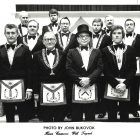
‘New Canaan There & Then’ is sponsored by Brown Harris Stevens Realtors Bettina Hegel, Joanne Santulli, Dawn Sterner and Pam Stutz. When I began my work at the New Canaan Museum & Historical Society, I was unaware that I would be occupying the same space once utilized by the Freemasons Fraternity until 1950. This was the very society my own grandfather joined when he lived in New Canaan from 1964 until his death in 1997. 

The Masons are the world’s oldest extant fraternal organization with its origin in the late 17th century masonic guilds in England and continental Europe. Freemasons developed a reputation for upstanding moral character and were widely respected. Their mission was and remains to promote self-improvement and a better world through the application of moral values, intellectual development, and mutual respect, fostering a brotherhood of men united by shared principles.

New Canaan There & Then: The Town Takes Flight—1920 Aviation Exhibition

‘New Canaan There & Then’ is sponsored by Brown Harris Stevens Realtors Bettina Hegel, Joanne Santulli, Dawn Sterner and Pam Stutz. In 1920, three veteran pilots brought a new perspective to the people of New Canaan. 

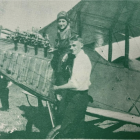
Captains Bob Gordon and Dean Lamb, along with Lieutenant M. Lee came to New Canaan to share the joy of flying with the townspeople. The trio were decorated aviators who had flown missions in WWI and stayed in New Canaan for three weeks doing exhibition flights, taking passengers up to 1,000 feet at a cost of $10 for 10 minutes. Gordon and Lamb served with the Canadian Flying Corps before the United States joined the war. Both Lamb and Gordon were shot down in flames five times in pursuit of the Germans.

New Canaan There & Then: A Life of Firsts—Marion Dickerman’s Legacy of Equality and Service

‘New Canaan There & Then’ is sponsored by Brown Harris Stevens Realtors Bettina Hegel, Joanne Santulli, Dawn Sterner and Pam Stutz. Marion Dickerman, born in New York in 1890, was a woman truly ahead of her time, and served as a pillar of equality, education, and historical preservation. From suffragette to educator to wartime nurse and beyond, Dickerman’s legacy lives on. She is one of the exceptional women who have been residents of New Canaan. During her college years first at Wellesley and later Syracuse, Dickerman was a strong advocate for women’s suffrage, as well as protective labor legislation for women, and the abolishment of child labor.

New Canaan There & Then: The Artist and the Activist—Alice King’s Dual Legacy

‘New Canaan There & Then’ is sponsored by Brown Harris Stevens Realtors Bettina Hegel, Joanne Santulli, Dawn Sterner and Pam Stutz. While many knew Alice King (1890–1979) as an upstanding citizen, proponent of the arts, and talented vocalist, few realized she orchestrated one of New Canaan’s most significant social transformations. Realizing the housing challenges for minorities and refugees, she welcomed them to stay with her family on their Silvermine property until they could find other opportunities. Most notably, in 1941, Alice bought 12 houses on East Avenue and Cherry Street (then known as Baldwin Avenue) and first rented and then sold homes to Black families. For those who had only a down payment, she provided the financing.

New Canaan Now & Then: Aviation to Administration—The Legacy of Walter and Mary Poor

‘New Canaan There & Then’ is sponsored by Brown Harris Stevens Realtors Bettina Hegel, Joanne Santulli, Dawn Sterner and Pam Stutz. Walter Poor Sr. (1916–2003) and his wife, Mary, were notable New Canaanites who lived on Bowery Road with their five children. 

Over the many decades the couple resided in New Canaan, they made countless community contributions demonstrating the kind of sustained civic engagement that transforms a town into a true community. 

A Civil Air Patrol pilot, and active member of the Men’s Working Party, Walter was an avid sailor, a vintage car enthusiast, had a pilot’s license, an aircraft of his own, and held several aerospace patents. 

He worked at the Perkin-Elmer Corporation, a global corporation which produces precision optic equipment, and was relocated to Norwalk, CT in 1941, where it would remain until 2000. Perkin-Elmer was instrumental in producing the tools that led to American victory in World War II, including optics for airplane range finders, bombsights, and reconnaissance systems. 

Perkin-Elmer’s rapid expansion, fueled by the wartime effort, led to its distinction as the first optical instrument maker to receive a Navy “E” for Excellence. A pioneer in its field, the company produced its initial infrared spectrometer in 1944, establishing a significant lead over Germany amidst their urgent military needs. 

In a 1992 New Canaan Advertiser article, Poor recalls his passion for aviation, “I was always interested in aviation… I got my pilots license in 1948 and the first plane of my own in 1950.” 

Poor’s interest in aviation led him to be recruited for the Civil Air Patrol by Philip Kleinert of Darien, group commander of this area’s CAP. Walter would serve in the Civil Air Patrol from 1950 until 1958, where he taught local teenagers about aviation techniques, as well as participating in various rescue missions. 

Most notably, Poor was on the squadron during the great flood of October 1955 when entire buildings and towns were swept away due to the overflowing of several Connecticut rivers.