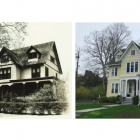
Now & Then: The Pink House

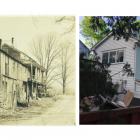
There is some debate as to who built the original dwelling on 1057 Silvermine Road, known as “The Pink House” in 1709. Some believe it was Jacob St. John, who was a  wealthy landowner in Silvermine who helped found the city of Norwalk. However, it is more widely believed that another settler from Norwalk, John Kellogg and his family, built the home and settled in it. These historical claims date back over 300 years and are almost impossible to prove now, but the main structure that stands today was probably built by Stephan Gregory in the mid-19th century. The transfer of property was as follows: A legal dispute between Jacob St.

Now & Then: The Raymond House

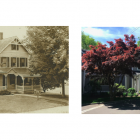
Thanks to letters sent between the New Canaan Historical Society and Howard B. Raymond back in the 1950s, the early history of 32 Seminary Street is fairly complete. The house was built by Howard’s father, George E. Raymond during the summer of 1889. George Raymond was a carriage maker by trade and started his career in the Johnson Carriage Company located on the corner of East Avenue and Forest Street. Raymond, along with his coworker William Brant, started their own carriage business in 1898.  

 This shop was also located on Forest Street seemingly where Gelatissimo is now located. At some point Brant left the business but Raymond continued to work in the shop until his death in 1920. The mainstay of the business was repair work, but by most accounts Raymond was an excellent woodworker who could also build a beautiful carriage. Advertisements for the business were in almost every edition of the Advertiser for a decade. By the time of his death, cars had not become popular enough to have an effect on the business. However, his former employee, Henry S. Duryea, who took over the business upon his death, may have struggled due to changes in modes of transportation. Interested in sponsoring our local history feature “Now & Then”? Contact editor Michael Dinan at editor@newcanaanite.com for advertising details.

New Canaan Now & Then: The Hanford-Silliman House

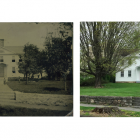
Stephen Hanford (1737-1784), the great grandson of the first minister of the Congregational Church, purchased ten acres from his uncle and constructed this house from 1761-1764. At the age of 27, he moved in with his wife, Jemima Kellogg. He worked as a weaver and licensed tavernkeeper. Due to his success, he was able to purchase adjacent land and expand the property. Upon his death, his second wife, Sarah, sold the house to Elisha Leeds. In 1788, Leeds’ daughter, Martha, and her husband Dr. Joseph Silliman (1763-1829) moved in and raised seven children. Dr. Silliman was active in the life of Canaan Parish and became a land surveyor (an extremely important position because new surveys were required following the confiscation of estates that had belonged to Loyalists. He was also the Treasurer of the School Society, a Justice of the Peace, and the moderator for the first Town Hall Meeting after New Canaan was incorporated in 1801. Generations of Sillimans remained in the house for the next 126 years. In 1825, Joseph Silliman sold the south meadow of his property to the Town.

New Canaan Now & Then: The Hoyt-Mills-McGhie House

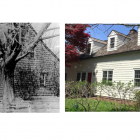
This photograph was taken sometime before 1888 of 372 Brushy Ridge Road, a home built by Timothy Hoyt in 1732. It was known as Long Meadow Farm. The man seated in the picture is Timothy’s descendant, Samuel Hoyt; his wife, Clarissa, stands in the doorway. Samuel Hoyt was a harness maker who most likely supplied the local farms. His most notable customer and neighbor was Gilbert Birdsall, who owned the Birdsall Inn on Main Street (now the Morse Court parking lot.)

Eventually the Hoyts sold the house in 1907 to Albert and Laura Mills. Little is known of Mr. Mills, a salesman for the Gage Hat Company, but his wife, Laura, is legendary. Twenty years after his death, she remained in the house with 13 Dalmatians for company, along with a herd of Jersey cows. According to Mrs. Harold Gillen in her article in “Landmarks of New Canaan,” Laura was a hoarder, and the house was filled with shoes and dirty dishes on the mantel, men’s nightshirts bulging from the drawers, and the constant drone of the radio. Despite the messy interior, Laura ran a successful dairy business and, in her own words, “was not afraid of man, beast or devil.”

Mills styled herself the “Witch of Endor.” As if to support this claim, Mills was never without her felt cloche hat that had taken on a point over the years. She claimed to be a member of the Mazdaznens religion. (This is most likely a misspelling of “Mazdayasnian” which is another term for the religion Zoroastrianism, an ancient Persian religion that was first recorded in the 6th century BCE.) Her membership in this religion is further supported by the care Mills gave her cows and dogs; she treated animals as if they were human. (A core belief in Zoroastrianism is that all living beings, both humans and animals, have an important role to play and must be treated as such.) In an attempt to convert Mr. and Mrs. McGhie, who purchased the house in 1933, Laura Mills gave them a pamphlet on her religion. The McGhies did not appear to have been convinced. Laura Mills is also the reason why there are no records on Samuel Hoyt’s harness business. Mills apparently threw the records and all the old furniture that came with the house into a bonfire at some point. She felt that, after the McGhies bought the house, they should simply burn it down and buy a Sears Roebuck mail order house to replace it. They refused.