‘New Canaan There & Then’ is sponsored by Brown Harris Stevens Realtors Bettina Hegel, Joanne Santulli and Dawn Sterner.
In Steven Spielberg’s madcap (sometimes) comedy “1941” starring John Belushi, a ragtag group of California civilians work furiously to make their city defensible from a misperceived attack by the Japanese, in the wake of a real attack on Pearl Harbor days earlier.
The genesis of the movie’s plot was the so-called “Battle of Los Angeles,” where a similar false rumor in the late and early hours of Feb. 24-25,1942 triggered the largest antiaircraft barrage on U.S. soil in history, causing significant property damage, injuries and several indirect deaths. Luckily for New Canaan, the good women and men constituting its local “plane spotters” were far more circumspect in their identification of aircraft than their contemporaries on the west coast.
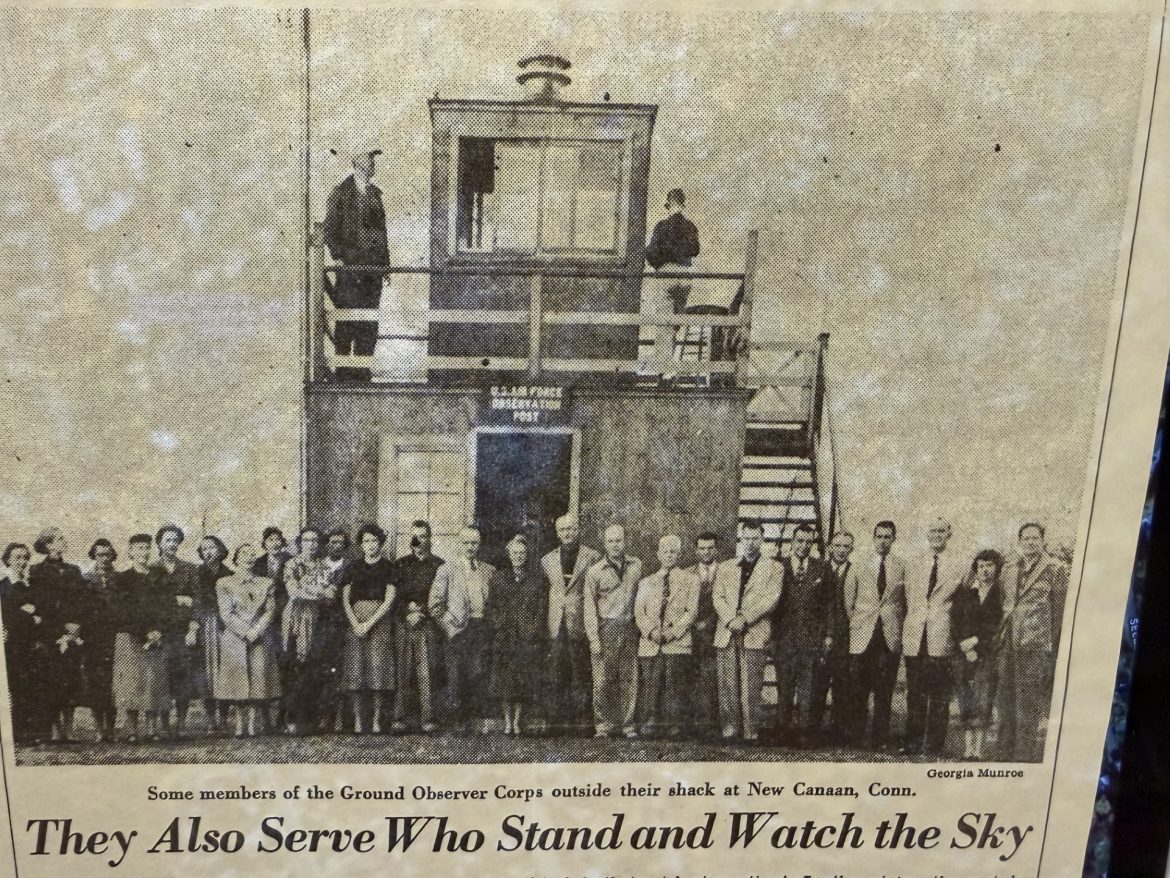
Courtesy of the New Canaan Museum & Historical Society
The period between 1940 and 1960 saw the United States on an almost perpetual war footing, between its involvement in World War II (1941-1945), the Korean War (1950-1953), and the Cold War (1945-1991). Apart from actively fighting “hot” wars abroad, either directly or by proxy, The United States also built up an unprecedented defensive capability at home, most notably through its possession of thousands of intercontinental nuclear ballistic missiles, as well as the legendary B-52 Stratofortress bombers and other assets of the U.S. Strategic Air Command.
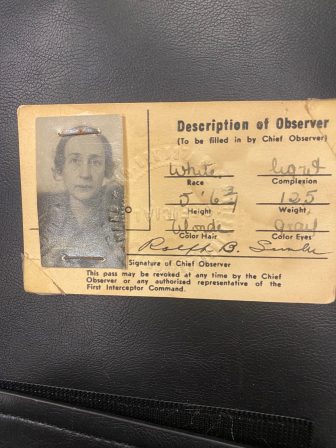
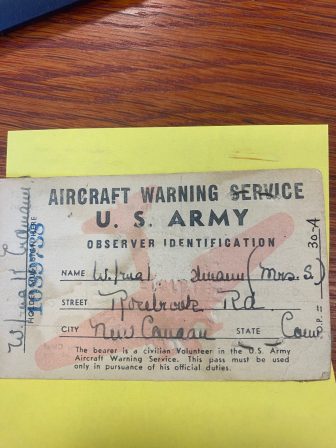
A vastly simpler but often overlooked component of America’s comprehensive defense system was its “plane spotters.” During World War II, the U.S. established a massive volunteer network, the Army’s Ground Observer Corps (GOC) (later called “Skywatch”), involving over 1.5 million civilians to identify enemy (i.e., Japanese, German or Italian) aircraft. These spotters used binoculars, telephones and training materials to identify planes in coastal and border areas and report them up the Army intelligence line.
The first GOC observation post (or “listening post” as it was initially called) was set up in 1941 in the American Legion building on Park Street. Judge L. P. Frothingham was named Chief Observer, and Mott S. Pettit as his first assistant. Subsequently the post moved to Oenoke Ridge, and in later years Laurel Road, with its final location being Lone Tree Hill, situated near the intersection of Brushy Ridge and Canoe Hill Roads.
Courtesy of the New Canaan Museum & Historical Society
Mrs. Mary Lambert Welling, a local girl born in 1897, served as the Supervisor of the observation post during World War II, and she ran a tight ship. According to her May 19, 1979 obituary in the New Canaan Advertiser, the town’s GOC corps was “one of the few in the nation to maintain a 24 hours a day look-out for more than three years” during World War II. On three occasions the corps was cited for its reporting of planes in distress and received several commendations for alert handling of both routine and emergency conditions. For her work for the local corps, which included ‘arranging for construction of a look-out tower and base headquarters,’ Mrs. Welling received citations from the U.S. Air Force, state Civil Defense leaders, and the Hannah Benedict Chapter of the Daughters of the American Revolution.”
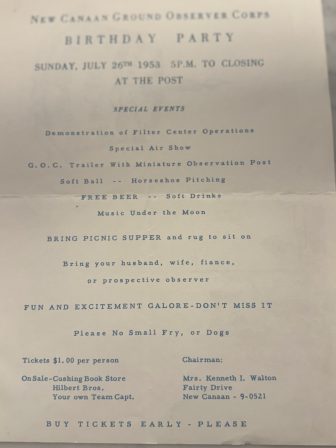
With the advent of the Cold War and the increasingly fractious U.S. – USSR relationship, the New Canaan GOC corps, which had stood down in late 1943 with the advent of radar, returned to the field in 1952 for another five years of round-the-clock observations. A 1954 list of the “Friday Night Team” members included future Mid-Century Modern icons Eliot Noyes and Jens Risom. Another notable member of the plane-spotters was New Canaan resident DeWitt Samuel Copp, who had, shall we say, an “interesting” background. Copp served as an Army Air Corp transport pilot during World War II in the Middle East and Africa. He later became a writer of more than 30 books, fiction and nonfiction, many about Cold War espionage and intrigue, as well as radio and television shows for Kraft Theatre, the Bell Telephone Hour and the Hallmark Hall of Fame. The shows included a 1954 TV dramatic documentary titled “Red Alert”, which was based on New Canaan’s “widely acclaimed Ground Observer Corps activity,” according to an Oct. 15, 1959 Advertiser article on Copp.
Courtesy of the New Canaan Museum & Historical Society
The New York Times described Copp’s career in more detail in its Dec. 27, 1999 obituary: “As the international marketing director of the Weather Engineering Corporation, he helped develop equipment that created artificial rain by using airplanes that dropped silver-iodide crystals into clouds. He published his first book, an aviation thriller, ‘Radius of Action’ in 1960. In 1961 he and Marshall Peck Jr., wrote ”Betrayal at the U.N.,” an investigation into the death of Paul BangJensen, a former Danish diplomat at the United Nations. Hoping to increase United States support for the government in Taiwan, their next collaboration, ‘The Odd Day’ (1962), told of the Chinese Communist shelling of the islands of Quemoy and Matsu. Other works by Mr. Copp include ’Incident at Boris Gleb’; ‘Overview,’ a history of aerial photography; and ‘Famous Soviet Spies.’ Mr. Copp also taught history and civics at St. Luke’s School in [New Canaan], Conn.” And of course the short, inevitable and wholly unsurprising last sentence: “He also worked for the Central Intelligence Agency.”
After the local corps was disbanded, Mrs. Welling “had the octagonal top of the Lone Tree Hill look-out tower, a wooden structure with windows all around” moved to her property on Park Street where “she grew the prize-winning orchids for which had gained area renown.” Despite its closing in 1957, the Lone Tree Hill post had one last day of operation on a bright spring day the following year.
As reported by the Advertiser on April 17, 1958: “New Canaan Skywatch was reactivated for a surprise eight-hour exercise in aircraft spotting Wednesday at the Ground Observation Corps post on Lone Tree Hill, called by the U.S. Air Force on short notice. The communication alerting the local post asked that spotters report only aircraft considered to be a potential threat. These, the letter listed as “multi-jets, bi-jets, multi engine craft (more than two) and single jets flying in formation of three or more, plus all ‘unknown’ aircraft.”
The act of plane spotting was generally tedious, but it occasionally had moments of high excitement. According to a Sept. 27, 1953 article in the New York Herald Tribune, “The value of this boring task was dramatically high-lighted last spring by two housewife watchers – Mrs. Frank Sutherland and Mrs. Richard S. Wechsler. They spotted a large bomber and three jet fighters which had escaped detection by the military radar and by other ground observers. They quickly notified the Air Force Defense Center at White Plains. Since no such flight pattern had been plotted in advance, the Air Force presumed that the planes were ‘enemy.’ Four jets were dispatched to intercept the formation which was flying above 30,000 feet and heading for New York City. The Air Force was more than slightly embarrassed when it discovered that the formation was one of its own – engaged in a top-secret exercise.”
Thankfully the Battle of New Canaan was thus averted.
Rich New Canaan history! Thank you.
My dad, Capt. John F Harding, USCG Ret. took me along with him on many middle of the night shifts at the Observation Tower. Along with planes, we spotted many wonderful constellations in that great night sky.
What a surprise! In the middle of the photo of plane spotters was my Dad, Edwin Lex Bacon. This would have been in the ’50’s, and the post was on the crest of our driveway on Oenoke Ridge. I remember thinking that what he and the others were doing was a little scary, but I was proud of him.
Salute to all who put together this great history! As life-time resident, all new to me. Wonderful history to record and enjoy.
Nick great history lesson.
The movie 1941 was so funny in the line of the funnest movie ever.
It’s a Wild Wild World
You probably know this.
In 1942 a P-47 thunderbolt crashed
Into a home on Valley Rd on a flight from
Long Island.
On V-J day there was a parade and a bonfire
On Park
History is everyone story.