
‘Who Knew?’ is sponsored by Walter Stewart’s Market.
Fairfield County is home to rolling lawns, sprawling mansions, and this brutal truth: right now, 34,000 children in our county are food insecure. Statewide, one in six kids doesn’t know where their next meal will come from.
In October, when we learned that SNAP wouldn’t be funded during the government shutdown, the human reality of nutrition assistance bloomed in vivid color: a lot of people need help paying for food, and many of these people are our neighbors. To allow people to go hungry is horrifying, and there’s no credible political or religious doctrine that justifies it. Period.
The shutdown has since ended, but the tenuousness of the moment remains. For me, it means that now isn’t the time to natter on as usual, expressing mild discontent with a listless lobster risotto. So I’m dedicating this month’s column to a team of people who have found solutions, to “look at the helpers,” as Mr. Rogers would put it, and to shine the high beams on a New Canaan-born organization that has made remarkable headway in addressing childhood hunger in Fairfield County.
Tina Kramer and Shawnee Knight started Filling in the Blanks in 2013. Through a friend’s son who played sports, they learned that at certain schools in Stamford, the opposing team had no post-game snacks, leaving those players to go home hungry. Coaches started bringing food for opposing teams, and while some might brush off a meeting between haves and have-nots as uncomfortable, for Shawnee and Tina, it presented an opportunity to dig deeper into childhood hunger in Fairfield County.
And, with that digging, came a simple insight: to address childhood hunger, you can start with kids who receive free and reduced-cost breakfast and lunch at school and get them food to help tide them over during the weekend; to “fill in the blanks” between the sure bets of Friday’s school lunch and Monday’s breakfast. Working out of a house in New Canaan, Tina and Shawnee bought food at local grocery stores, packed bags for each of 50 children at Stamford’s Domus school, and Filling in the Blanks was hatched.
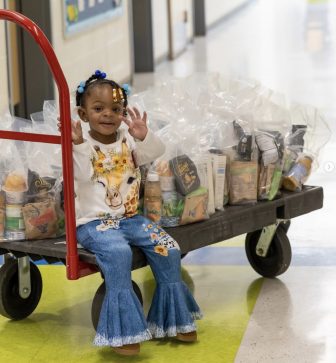
A $40 donation provides a child with one month’s worth of weekend meals.
In the decade-or-so since, that number has grown to 10,000 students in Fairfield, Westchester, and Putnam Counties who each week receive bags of high-quality, nutritionist-approved weekend meal kits, purchased by Filling in the Blanks and packed by volunteers at their Norwalk warehouse.
Organizations like youth groups, St. Luke’s students, SLOBs, and the founders’ networks of friends were essential to early success. And, of course, no organization has a chance of flourishing without the generosity of individual and, later, corporate donors.
Organizational growth wasn’t instantaneous. “At first, Shawnee called every school in Norwalk to offer help, and they thought we were crazy ladies,” Tina said. But now that their service is known, word has spread locally and beyond, and their three trucks are on the road Tuesday through Friday, delivering weekend meal kits to kids at area schools. Before COVID, they worked with school counselors to address needs anonymously, but since the pandemic, a direct registration link for families was made available on their website, and demand has more than doubled.

Tina Kramer and Shawnee Knight of Filling in the Blanks with meal kits that children can bring home for the weekend.
Each meal kit is taste-tested, shelf-stable, and meets school nutritional requirements. They also vary the selections from week to week. On the day I joined a packing event at FITB’s Norwalk warehouse, the meal kits included soup, pasta, tomato sauce, applesauce, four packets of oatmeal, pretzels, juice, and yogurt. Each item comes from a name brand. “It’s important to serve our community with dignity,” said Caryn Kelly, Filling in the Blanks’s community outreach coordinator. “Providing familiar, trusted, brand-named items helps ensure that every child feels confident, included, and valued.”

The Tuesday and Thursday morning packing events are amazing — you’ll be impressed by how many hundreds of meal bags can be assembled in a short time.
Brand dignity matters. To wit, in another lifetime, I worked as a creative director responsible for advertising Tide detergent, at a time when it was being locked up at Walgreens because so many people were stealing it. My Procter & Gamble clients, savvy market researchers to a fault, discovered that this was because the scent Tide leaves on your clothes, unreproducible with cheaper alternatives, was olfactory shorthand for middle-class stability. Like it or not, our culture’s dogged adherence to brand names comes with real ramifications of pride and shame, and oftentimes, kids feel these feelings the most. So, yes, for Filling in the Blanks, having a real-deal Quaker Chewy bar or Pepperidge Farms Goldfish is a non-negotiable.
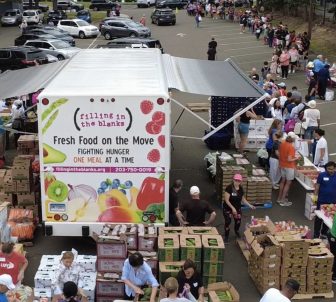
A Fresh Food on the Move event.
While the weekend meal kits remain core to Filling in the Blanks’ offering, the organization has since launched Fresh Food on the Move, a program that provides fresh produce, meat, eggs, and grains to communities in Stamford, Norwalk, and Bridgeport. With grants and funding from Shonda Rhimes’s foundation, this effort expanded their capacity to support the community beyond children and helped to create a hub for social services. Using rebranded refrigerated trucks, they distribute nearly 700,000 pounds of fresh food annually to people in need. “It’s like a farmer’s market, but with no cash register,” Shawnee said. “And we’re able to bring in partners to help people get flu shots, health insurance, and immigration support.”
Various additional donors have stepped up to keep the Fresh Food on the Move program serving these three cities, and it’s become hugely popular, with recipients lining up as early as 4:30 a.m. to receive provisions.
If it sounds like I’m fangirling Shawnee and Tina, it’s probably because I am. Their ability to see a gap where we are systemically failing people and to do something meaningful about it locally inspires genuine awe. Alongside their board members and their 11-person team, they’ve put seemingly endless reserves of creativity and passion into growing how they serve people and providing ways for anyone, from kids who participate in their Teen Helper and Student Ambassador programs to adults who pick up regular volunteer packing shifts. This isn’t volunteering away your idle hours between mahjongg and tennis; it’s a full-time calling.
It’s also coming from a personal place. “We’ve both struggled with food insecurity at points in our lives, and we know exactly how it feels,” Tina said. “We saw something we wanted to do, and we decided we’re going to do it.”
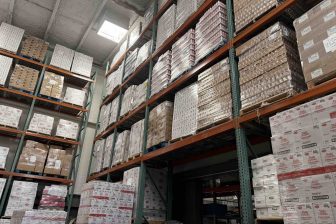
The Filling in the Blanks warehouse is like a mini-Costco, and it helps to feed 10,000 kids a week.
It’s a little bonkers to imagine the professional challenges inherent in scaling an organization two hundredfold, but their rolled-up shirtsleeves vibe is pretty indomitable. Because Filling in the Blanks buys nearly all of its own food, the team needs to negotiate directly with wholesalers and brands to create economies of scale. Questions that might send entire boardrooms of my marketing colleagues into fits of apoplectic circling back, from “where does one purchase a couple of enormous, refrigerated trucks?” to “does anyone have Shonda Rhimes’s phone number?” seem to have been taken in stride. I know it can’t have been easy, but it all seems like a case study in just doing the damn thing.
There’s a notion in town that we live in a bubble of privileged ignorance, and in certain comment sections, you might spot glimpses of this. But it’s heartening to see people–especially kids–staying involved in the broader community of Fairfield County and doing the right things for our neighbors with earnest intent. Said Caryn Kelly, “Kids really like getting involved with Filling in the Blanks because they genuinely like giving back.” I love knowing that good people are being raised in my neighborhood. More than that, I love knowing that good people are being fed in my neighborhood.
You can donate to Filling in the Blanks at this link.
Another highly important community resource to support regularly is the food pantry at St. Mark’s Episcopal Church. I was heartened, a few days after the SNAP suspension was announced, to find the room’s tables absolutely covered with goods when Andrew and I dropped off food, but the thing about eating is that we have to do it every day. I made a recurring calendar appointment to drop off items on a specific date each month. Their standing wish list is a good place to start, and I recently spoke to Joan Wexler, a longtime Food Pantry volunteer, at our book club to find out if there are needs specific to this moment.
Shelf-stable milk (dairy, like Parmalat, or otherwise) is always important, she said. Also, kids’ snacks, individually wrapped (think of the big box of Goldfish snack packs, or school-friendly Kind bars). Condiments like olive oil, salt, pepper, and vinegar (apple cider, white, or red wine), soy sauce, worcestershire sauce, and hot sauce. Herbal tea in bags is also a welcome contribution, especially given this weather.
Joan observed that the Food Pantry’s clientele has doubled in the past year, and Shawnee and Tina have also noted growing demand for supplemental nutrition. It’s safe, if saddening, to say that food insecurity in our community isn’t going away. It’s getting worse.
As the light recedes on our year and we check the rearview mirrors, my mind turns to highlights. A Spotify wrap-up is one way to reflect, but because of who I am, I tend to think more about what I ate. Try doing this too; amid the family dinners, holiday feasts, and date nights, does any one meal shine brighter than the thousand others? The food was good. I made some decent dinners, and we ate some excellent tacos. There was a notable soufflé. But the most important meal of my year will be the one that I can help provide for someone else.
A note: admittedly, this wasn’t a regular installment of “Who Knew.” There’s no fun, breezy way to talk about childhood hunger, and I’m absolutely not one to sugarcoat it. However, I hope that in having read it, you’ll feel more hopeful and powerful in the face of an unsettling crisis.
Brava, Laura. Just that.
Oh, and I’m now scrolling up to click the DONATE button. Happy Holidays to you and yours!
Thank you for shining a bright spotlight on this and especially the part about serving the food insecure with dignity. Sometimes it just takes one caring person to turn a life around or to give someone going through a dark time a moment of joy. The giver is surely the one most blessed. Sending lots of love to these two local groups.
What an inspiring story. Thanks for telling it so well, Laura.
What an inspiring story! Kudos to every single person mentioned in this important and uplifting story, and to Laura Ault for writing it.
a wonderful article shining an important spotlight on a truly wonderful and impactful organization!!
Thank you, Laura for such a comprehensive look into the issues of food insecurity in our area from a fresh perspective. Though it was not your typical offering of intellectual whimsy, you still made it seem as if we were hearing about these organizations and their needs for the first time.
We are at such a sad and dangerous inflection point, with hunger reaching well beyond the imagined poverty population. Having hungry neighbors and friends does not make our towns, our communities, or our world better.
I hope this makes an impression on those looking to give and get more involved this holiday season and well beyond.
These ladies deserve this recognition and praise. It’s been amazing watching this grow.
What they do is just amazing! I wish every community had programs like this. Thank you, ladies, for your hard work and dedication to supporting kids in need.
Thank you for shining a light on this important problem right here in New Canaan and our surrounding community. Another suggestion about making donations to Filling In The Blanks and/or the Food Pantry at St. Mark’s is to use a donor advised fund. My wife and I use ours to donate to the Food Pantry at this time each year. It’s even easier than writing a check or using a credit card on a website’s donation form! And it makes a real difference to those in need.
Thanks for sharing. What an inspiring story.
Told impeccably by your writing. A good friend from Atlanta, started “ “Backpack Buddies” to respond to the same issues.
An idea that might work for “Filling in the Blanks”. Bar and Bat Mitzvah kids do a Mitzvah Project. Volunteering, touring, and sharing the good work for donations would be a perfect project. Perhaps communicating to local Synagogues and Jewish organizations would help spread the word.
I’ll add this worthy organization to my charitable giving list!