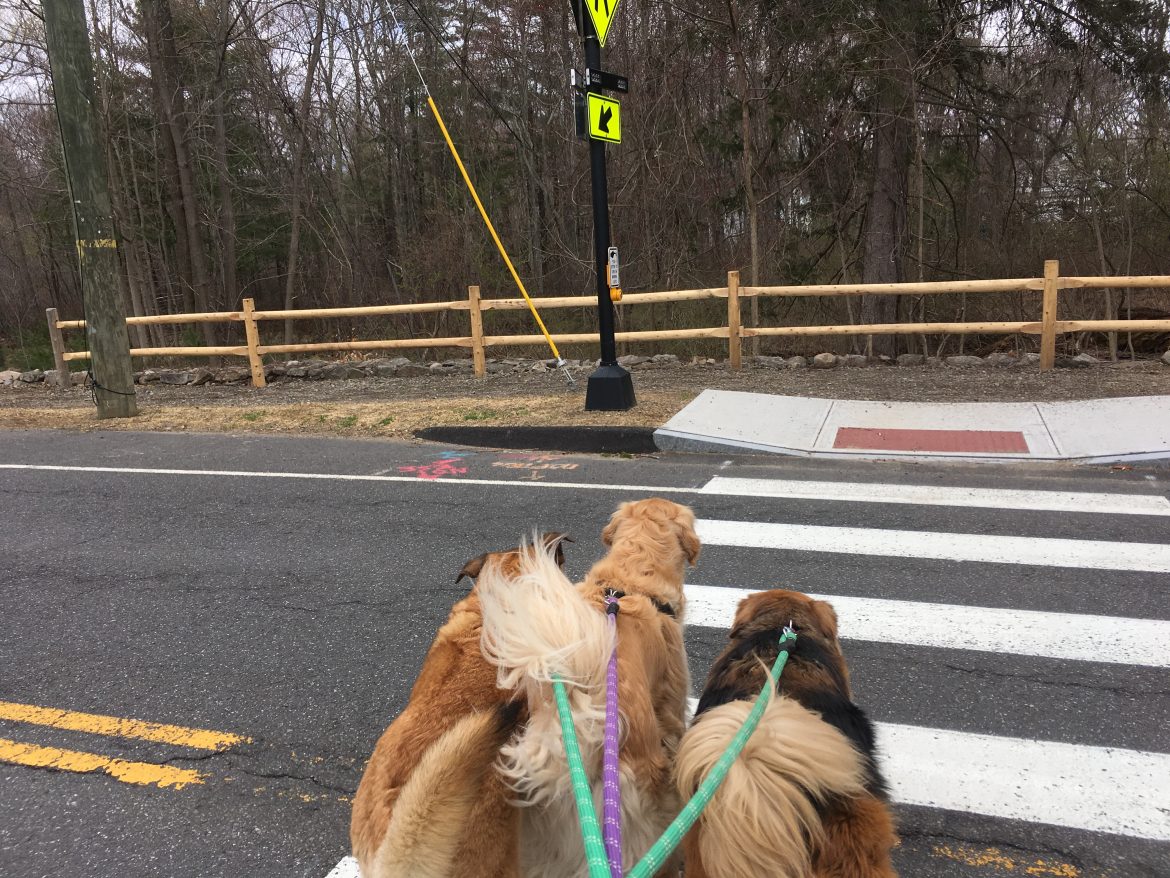
Town officials on Tuesday approved a three-year annual maintenance and repair contract with the company that makes New Canaan’s push button-activated pedestrian crossing signals.
The $20,000 annual contract with Brown Deer, Wisc.-based TAPCO is “severable at one year” and covers all 16 locations of rapid rectangular flashing beacons or “RRFBs” throughout town, according to Public Works Director Tiger Mann.
“Because they are a specialized piece of equipment, you either have to hire a signal technician or have someone in your staff to be able to take care of it,” Mann told members of the Board of Selectmen at their regular meeting, held at Town Hall and via videoconference.
He continued: “And then with this, for every unit that they maintain, they will extend the warranty. So if there are parts that fall under the warranty, the year that they’re still servicing it, they’ll extend the warranty even if the warranty is expired. And then we’ll get the parts for free if one should fail. So I think it’s a very good situation for the town.”
First Selectman Dionna Carlson and Selectmen Steve Karl and Amy Murphy Carroll voted 3-0 in favor of the contract.
The selectmen asked whether TAPCO has been reliable (yes), how much each RRFB costs to install (about $10,000), what their life expectancy is (the first one installed, at Farm and Fieldcrest Roads, is still working 10-plus years later), whether the ‘16 locations’ represents 32 total RRFBs since they come in sets of two (yes, in fact there are 33 total RRFBs at those 16 spots), whether TAPCO is the only contractor for this work (yes), whether the contract covers all 16 locations or fewer since TAPCO didn’t make all of the RRFBs in town (12 of the locations), whether the two out-years are also $20,000 or if there’s an escalation (also $20,000) and whether the town owns other types of pedestrian traffic signals (no because those are all on state roads).
Carlson said that the $20,000 annual cost is high on a per-unit basis.
“Wow, that’s really expensive maintenance on a $10,000 item, as a percentage,” she said.
Mann said that “for the most part, there’s not a lot of maintenance required” for the RRFBs.
“We’ve had just a couple of problem areas,” he said. “When they occur, we don’t have the skill set or the knowledge to come out and take care of it. Our feeling is that if we actually come out here and have them recertified and maintained each year, we’ll not only satisfy that issue as far as that they’re taken care of on a maintenance issue, but we’ll extend their lifespan, as well. So they’ll continue to upgrade the lighting, they’ll continue to upgrade the signal system, the controller board, things of that nature that are going to fail. That will be under a service. We don’t have to worry about it. Because the hardware itself—the pole and the signs—the signs have to be replaced every seven to 10 years, but the pole itself, that can last for 20 years or more.”
Karl said that in certain areas, such as schools, it’s been helpful to alert drivers to pedestrian traffic though “putting additional ones all over the place” is likely not desirable.
Mann responded, “That’s not our goal.”
The town has been focused on areas around schools, Mann said—specifically, the town wants to put a revised ‘slow speed zone’ around South School, Saxe Middle School and New Canaan High School, as well as “our main arteries” of South Avenue, Main Street and Weed Street.
The push button signal on the Elm Street side of the crossing at Weed has been broken for two years despite repeated notification to Tiger Mann. I hope this is not the company that has been maintaining that signal! Thankfully a stop sign is coming soon to this dangerous crossing.